
Artículo de investigación
Programas educativos digitales y su aplicación en el derecho público y privado
Digital educational programs and their application in public and private law
Recibido: · Aceptado: · Publicado:
Cómo citar: Panova, L., Zghama, A., Kravchenko, S., Arabadzhy, N., & Atamanova, N. (2026). Digital educational programs and their application in public and private law. Revista Eduweb, 20(3), 399–415. https://doi.org/10.46502/issn.1856-7576/2026.20.03.22
Resumen
El artículo analiza los programas educativos digitales y su aplicación en el derecho público y privado. El objeto del estudio es el proceso de transformación digital de la educación jurídica, y la materia de estudio comprende el contenido, las tecnologías, los métodos pedagógicos, los resultados de aprendizaje y las particularidades de estos programas en ambas ramas del derecho. El objetivo es identificar sus características teóricas y prácticas, comparar los instrumentos y direcciones de uso en el derecho público y privado, y proponer un modelo estructural para su integración en la formación jurídica. La metodología se basa en investigación documental cualitativa, análisis de contenido, método comparativo y modelización. El estudio examina programas, cursos y módulos digitales seleccionados de universidades de Ucrania, Europa y América Latina. Los resultados muestran que el derecho público se orienta al gobierno digital, los servicios administrativos electrónicos, los datos abiertos, los derechos humanos digitales y la inteligencia artificial en la administración pública, mientras que el derecho privado se centra en contratos electrónicos, comercio electrónico, activos digitales, legaltech, propiedad intelectual y resolución de disputas en línea. Se propone un modelo basado en núcleo digital común, especialización sectorial, tareas prácticas digitales, evaluación por competencias y reflexión ética.
Palabras clave: educación jurídica digital; competencias digitales; derecho público; derecho privado; tecnología jurídica.
Abstract
The article examines digital educational programs and their application in public and private law. The object of the study is the process of digital transformation of legal education, while the subject covers the content, technologies, pedagogical methods, learning outcomes and specific features of these programs in both branches of law. The aim is to identify their theoretical and practical characteristics, compare the tools and directions of their use in public and private law, and propose a structural model for their integration into legal education. The methodology is based on qualitative documentary research, content analysis, comparative method and modeling. The study examines selected digital programs, courses and modules from universities in Ukraine, Europe and Latin America. The results show that public law is mainly oriented toward digital government, electronic administrative services, open data, digital human rights and artificial intelligence in public administration, whereas private law focuses on electronic contracts, e-commerce, digital assets, legaltech, intellectual property and online dispute resolution. The article proposes a model based on a common digital core, sectoral specialization, practical digital tasks, competency-based assessment and ethical reflection.
Keywords: digital legal education; digital competencies; public law; private law; legal technology.
Introduction
The
European approach to digital education is based on the idea of high-quality,
inclusive and accessible digital education, which should combine technological
infrastructure with the development of digital skills and competences. The
Digital Action Plan for Education for 2021–2027 (European Commission, n.d.) defines
digital education not as an auxiliary tool, but as one of the key areas of
modernization of education systems. At the same time, the DigComp 2.2 framework
focuses on such components of digital competence as information literacy,
communication and collaboration, digital content creation, security and problem
solving (Vuorikari et al., 2022).
Despite the growing body of research on the digital transformation of higher
education, digital competence and the use of artificial intelligence in
teaching, the specific transformation of legal education remains insufficiently
systematized. Existing studies predominantly examine digital education as a
general pedagogical phenomenon or address individual technological aspects of
legal practice, such as legaltech, artificial intelligence, e-commerce or
online dispute resolution. However, less attention has been paid to the
differentiated application of digital educational programs across the major
branches of law. In particular, there is a lack of comparative research
examining whether the digital competencies required for future lawyers are
identical in public and private law, which technologies and professional tasks
are common to both fields, and which should be differentiated according to the
nature of legal relations and professional practice. This gap is scientifically
relevant because the digital transformation of public law is primarily
connected with the digitalization of government, administrative
decision-making, public services and the protection of human rights, whereas
the transformation of private law is increasingly associated with digital
transactions, e-commerce, legaltech, digital assets and the automation of legal
services. Treating digital legal education as a uniform process may therefore
overlook substantial differences in the professional competencies required in
these two areas. The novelty of this study lies in moving beyond a general
discussion of digitalization in legal education and proposing a differentiated structural
model that combines a common digital competence core with sector-specific
educational components for public and private law.
The purpose of the article is to determine the theoretical and practical features of digital educational programs, compare the directions and tools of their application in public and private law, and develop a structural model of their integration into the legal education system.
The object of the research is the process of digital transformation of legal education. The subject of the research is the content, technologies, pedagogical methods, learning outcomes and features of the application of digital educational programs in public and private law.
In accordance with the goal and objectives of the study, the following research questions were formulated:
- Which digital technologies are most often integrated into educational programs in public and private law;
- Which digital competencies are common to both legal blocks;
- Which competencies, tasks and assessment methods are industry-specific;
- How digital tools are changing practice-oriented learning in public and private l
aw;
- What should be the structural model for integrating digital educational programs into the training of future lawyers.
The study has certain limitations. It is based on open sources and does not cover internal educational and methodological materials of universities. In addition, the study analyzes the content of the programs, and not the actual learning outcomes of students. At the same time, the chosen approach allows us to identify general trends, structural gaps and promising directions for the application of digital educational programs in public and private law.
Theoretical Framework or Literature Review
The European Digital Competence Framework for Educators DigCompEdu defines digital competence as the ability to effectively use digital technologies for professional activities, create and disseminate digital resources, organize learning, assess, support students and promote the development of digital competence of learners (Redecker, 2017). This framework is important for legal education, as the digital competence of a law teacher directly affects whether a student will acquire not only theoretical knowledge, but also practical skills for digital legal work.
Of particular interest in the context of this study are works devoted to the digital transformation of higher education in Latin America, as this region demonstrates a combination of the rapid development of digital educational practices with deep institutional, social and infrastructural inequalities. Researchers emphasize that the digitalization of university education in Latin America cannot be reduced to a technical transition to online platforms, as it requires a rethinking of pedagogical models, the organizational culture of universities, the accessibility of digital infrastructure and the ability of students and teachers to use technologies for active, reflective and practice-oriented learning (Cerdá Suárez et al., 2021; Useche et al., 2022).
The Latin American literature particularly emphasizes the distinction between formal digitalization and real educational transformation. Thus, an analysis of the experience of e-learning and b-learning in higher education shows that the successful use of digital technologies depends not only on the availability of platforms, but also on the coordination of educational, technological and organizational components of the educational process (Galvis & Carvajal, 2022). A similar conclusion is found in studies of distance education in Latin America, where digital educational environments are considered as a stage of transition from flexible learning to adaptive models capable of taking into account individual educational trajectories of students (Miralrio et al., 2024).
Another important aspect is the issue of digital inequality. A study of the digital divide in higher education using the example of a Latin American college during the COVID-19 period showed that inequality is manifested not only in physical access to devices and the Internet, but also in different levels of knowledge, confidence, duration of use and ability to apply digital tools for learning (García-Martín & García-Sánchez, 2022). For legal education, this finding is fundamental, since the digital training of a lawyer must take into account not only the technological infrastructure, but also the actual ability of the student to work with electronic sources, digital evidence, legal platforms and artificial intelligence tools.
A separate area of Latin American research concerns artificial intelligence in higher education. A systematic review of AI applications in Latin American universities shows that the most common areas are predictive modeling, intelligent analytics, assistive technologies, automatic content analysis, and image analytics, and AI is used to support student learning, improve teaching quality, and improve university governance (Salas-Pilco & Yang, 2022). At the same time, more recent research by ChatGPT in Latin American higher education institutions suggests that generative AI creates not only opportunities for personalized learning and support for academic work, but also risks for academic integrity, critical thinking, and regulatory certainty (Rivadeneira et al., 2025).
For the article on digital educational programs in public and private law, works that link the digital transformation of education with a competency-based approach are of particular importance. A comparative study of the digital competence of university teachers in Spain and Peru based on DigCompEdu confirms that effective digital learning depends on the teacher's ability not only to use technologies, but also to integrate them into teaching methods, communication, assessment and student support (Martín-Párraga et al., 2023). In this context, ePortfolio, networked learning, reflective pedagogy and practical digital tasks can be considered as tools for the formation not only of digital literacy, but also of the student's professional autonomy (Roco & Barberà, 2022).
Finally, it is important for legal education to consider Latin American research that focuses specifically on technological innovation in legal training. Daniel Bonilla Maldonado views technological innovation in legal education not as a neutral instrument, but as a phenomenon related to student expectations, the needs of the legal market, the transformation of legal services, and a critical reflection on the power of technology in law (Bonilla Maldonado, 2020). This approach is important for this article because it allows us to consider digital educational programs not only as a means of modernizing training, but as part of a broader transformation of the professional identity of the lawyer in public and private law.
The theoretical framework of this study requires a distinction between the general digitalization of education and the digital transformation of legal education. In this article, a digital educational program is understood not merely as a program delivered through online platforms or distance-learning technologies, but as an educational structure in which digital technologies, digital legal phenomena and practice-oriented technological tasks are systematically integrated into learning objectives, content, teaching methods, practical activities and assessment. Digital legal competence may therefore be defined as the ability of a future legal professional to critically and effectively use digital technologies and information resources in the performance of legal tasks while understanding their legal, ethical and social consequences. Such competence goes beyond general digital literacy and includes digital legal research, work with electronic legal databases and digital evidence, responsible use of artificial intelligence, and the ability to apply digital tools to practical legal problem-solving.
The technological transformation of legal practice makes the development of such competencies an essential component of modern legal education. The expansion of legaltech, artificial intelligence, automated document generation, digital databases, online legal services and online dispute resolution is changing both the professional tasks performed by lawyers and the skills expected from law graduates. As Bonilla Maldonado (2020) argues, technological innovation in legal education should not be understood as a neutral introduction of new tools, since it affects the organization of legal knowledge, professional identity and the relationship between legal education and the changing legal services market. Consequently, digital legal education should prepare students not only to use technology, but also to critically assess how technological systems affect legal reasoning, professional responsibility, access to justice and the protection of rights.
The analytical distinction between public and private law is particularly important because digital technologies transform professional legal tasks differently in these two areas. In public law, digitalization is primarily associated with e-government, digital administrative services, electronic justice, open data, automated administrative decision-making and digital human rights, requiring lawyers to assess the legality, transparency and human rights implications of digital state action. In private law, digital transformation is more closely connected with electronic contracts, e-commerce, digital assets, intellectual property, online platforms, legaltech and online dispute resolution. At the same time, areas such as artificial intelligence, personal data protection and cybersecurity have an interdisciplinary nature, which demonstrates the need to combine a common digital competence core for all future lawyers with sector-specific specialization. This distinction provides the theoretical basis for the comparative model of digital educational programs proposed in this study.
Recent scholarship increasingly examines the technological transformation of legal education as a distinct field rather than as a general extension of digital education. Research on technology-enhanced legal services demonstrates that law students and legal professionals require competencies that combine legal knowledge with technological understanding, particularly in relation to artificial intelligence, digital legal research and technology-supported legal services. Janeček et al. (2021) identify significant knowledge and skills gaps among legal professionals and argue for dedicated educational models capable of preparing students for technologically enhanced legal practice. Similarly, Kimbrough (2025) proposes integrating technology-driven lawyering skills into law school learning outcomes in order to reduce the gap between traditional legal education and contemporary legal practice. These studies indicate that digital transformation requires changes not only in teaching methods but also in the competencies and learning outcomes of legal education.
Artificial intelligence has become a particularly important area of research in legal education. Recent scholarship emphasizes that the integration of generative AI into law schools creates both pedagogical opportunities and new risks, including concerns about accuracy, academic integrity, critical thinking and professional responsibility. The American Bar Association's survey of law schools found that a substantial proportion of responding institutions had already introduced curricular opportunities for students to learn about AI and its use in legal practice. More recent research further argues that legal education should develop students' ability to use AI critically and ethically rather than treating it simply as another technological tool (Guglyuvatyy, 2026). This literature supports the need to conceptualize digital legal competence as a combination of technological proficiency, legal reasoning and ethical judgment.
Another important strand of research concerns practice-oriented digital legal education. Studies of online dispute resolution (ODR) demonstrate that simulations and technology-supported exercises can develop legal reasoning, problem-solving, digital communication and professional skills while exposing students to emerging forms of technology-enabled legal practice (Grant & Lestrell, 2020; Wang, 2026). Research on legaltech education likewise shows that practical projects involving automation and digital legal services can integrate substantive legal knowledge with transferable professional skills, including teamwork, task management and client-oriented problem solving (Eaton, 2026). Taken together, this literature demonstrates that the technological transformation of legal education involves not only the digital delivery of courses, but also the substantive integration of legal technologies, practical simulations and competency-based learning outcomes. However, comparatively less attention has been devoted to how these developments should be differentiated between public-law and private-law education, which provides a basis for the comparative approach adopted in this study.
Methodology
Documentary analysis was used to study publicly available descriptions of educational programs, training courses, syllabi, university information pages and educational platform materials. This approach makes it possible to examine how digital technologies are integrated into legal education at the level of learning objectives, subject content, practical tasks, expected learning outcomes and assessment forms. Documentary analysis is understood as a systematic method of examining written and digital sources containing relevant information about the organization and content of educational processes (Bowen, 2009).
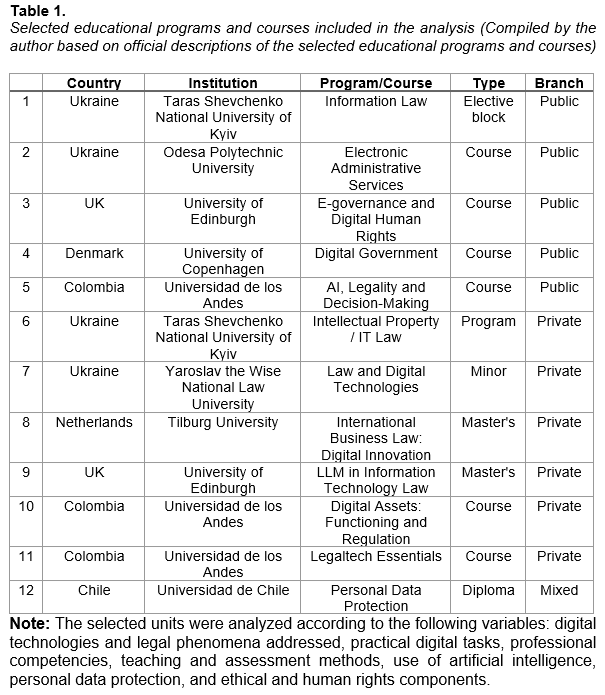
The empirical basis of the study consists of twelve digital educational programs, courses and modules selected through purposive criterion-based sampling of publicly available materials. The selection was not intended to produce a statistically representative sample, but rather to identify information-rich cases demonstrating different approaches to the integration of digital technologies into legal education. The sample includes programs from Ukraine, European countries and Latin American countries, allowing for comparison across different institutional and educational contexts. Programs were included if they met the following criteria: (1) an official description was publicly available; (2) the program had a direct connection with legal education; (3) its content included a significant digital, technological or online component; (4) sufficient information was available regarding learning objectives, content, teaching methods, learning outcomes or practical orientation; and (5) the program could be analytically classified according to its predominant orientation toward public or private law. Programs for which no meaningful description of the digital component was available were excluded from the analysis.
The public law block includes courses and programs related to e-government, digital administrative services, open data, digital human rights, automated decisions of government bodies and the use of artificial intelligence in public administration. The private law block includes programs related to e-commerce, IT law, digital assets, intellectual property, legaltech, online transactions, electronic contracts and personal data protection. This analytical division is based on the predominant nature of legal relations and professional tasks addressed by each program, while recognizing that certain areas, including artificial intelligence and personal data protection, may have an interdisciplinary character.
Content analysis was carried out using a pre-defined analytical matrix to ensure consistency and comparability across all twelve units. The matrix included the following variables: country and institution; type and format of program or course; predominant legal branch; digital technologies and legal phenomena addressed; use of electronic legal databases and digital platforms; practical digital tasks; expected professional competencies; teaching methods; assessment methods; use of artificial intelligence; attention to personal data protection; and ethical and human rights components. For each variable, the analysis determined whether digital technologies functioned merely as auxiliary technical tools or were substantively integrated into the content, practical activities and expected learning outcomes of the program. This coding procedure made it possible to identify both recurring patterns and sector-specific characteristics across the selected cases.
A comparative method was subsequently used to identify common and distinctive characteristics of digital educational programs in public and private law. The comparison focused on recurring competencies, technologies, practical tasks and assessment approaches. Common elements included digital legal research, work with electronic sources, personal data protection, digital ethics, cybersecurity and the critical use of artificial intelligence. Sectoral differences were identified primarily through the types of professional legal tasks emphasized in the programs: in public law, these included work with e-government, administrative services, open data, automated decision-making and digital human rights; in private law, they included electronic contracts, e-commerce, digital assets, legaltech and online dispute resolution.
Finally, the modeling method was used to develop a structural model for integrating digital educational programs into legal education. The five components of the proposed model were derived from patterns identified through the analytical matrix. Recurring competencies and technologies common to both legal branches formed the common digital core. Sector-specific content and professional tasks provided the basis for sectoral specialization. The presence of simulations, case studies, document drafting and other applied activities supported the inclusion of practice-oriented digital tasks. The analysis of examinations, projects, portfolios and practical assignments informed the component of competency assessment. Finally, the recurring attention to data protection, algorithmic risks, professional responsibility, human rights and ethical consequences of technology led to the inclusion of ethical and human rights reflection. Thus, the proposed five-component model was developed through a sequential analytical process linking the coding of the twelve educational units with the comparative findings and subsequent conceptual modeling.
Results and Discussion
Digital educational programs in public law
Within the Ukrainian sample, the public law direction is most clearly represented by the elective block “Information Law” of the Taras Shevchenko National University of Kyiv and the course “Electronic Administrative Services” of the Odesa Polytechnic University. The elective block “Information Law” covers e-governance, e-democracy, e-justice, e-administrative services and electronic interaction of the state with citizens and business. This content indicates a gradual transition from the general study of information law to the formation of specialized competencies necessary for the analysis of the digital activities of public authorities (Taras Shevchenko National University of Kyiv, n.d.-a).
The course "Electronic Administrative Services" of Odesa Polytechnic University is more applied in nature, as it focuses on digital tools for providing administrative services. Its content is related to the use of state electronic platforms, electronic signature, BankID, MobileID, electronic queues, state registers and the Diya portal. This allows us to consider the course as an example of a digital educational program in which public law is studied not only through regulatory acts, but also through practical mechanisms of interaction between a person and the state in an electronic environment (Odesa Polytechnic University, n.d.).
European examples demonstrate the further expansion of the content of digital public law. The University of Edinburgh course “E-governance and Digital Human Rights” combines the issues of e-government with issues of digital human rights, democratic processes, administrative law and public services. Of particular importance is that digital technologies are considered here not only as a tool for the efficiency of public administration, but also as a factor that can affect freedom of expression, the right to a fair trial, access to public services, non-discrimination and democratic participation (The University of Edinburgh, 2026).
The University of Copenhagen course “Digital Government” also confirms that modern digital training in the field of public law should go beyond the boundaries of classical administrative law. Its content covers digitalized public administration, data-driven public authority, personal data protection, cybersecurity, accessibility of digital services, regulation of artificial intelligence and automated decision support systems. Such a structure shows that the future lawyer in the field of public law should understand not only legal norms, but also the technological logic of digital administration, the risks of algorithmic governance and the requirements for the legality of digital decisions (University of Copenhagen, 2025).
A Latin American example, the Universidad de los Andes course “IA, legalidad y toma de decisiones para la Alta Gestión Pública” focuses on the use of artificial intelligence in public administration. Its inclusion in the sample is important because it demonstrates that digital education programs in public law are increasingly associated with legal criteria for the use of AI, responsibility, legality, strategic management and administrative decision-making. In this context, legal education should develop the ability not only to use AI tools, but also to assess their compliance with the principles of transparency, accountability, non-discrimination and the protection of human rights (Universidad de los Andes, n.d.-a).
Generalizing these programs allows us to conclude that the public law block of digital legal education should include at least five key components: e-government; digital administrative services; open data and e-participation; digital human rights; legal regulation of automated decisions and artificial intelligence in the public sector. It is these components that reflect the specifics of public law, as they relate to the organization of power, the legality of administrative decisions, access to public services and the protection of the individual in relations with the state.
Digital educational programs in private law
Private law digital programs are focused on preparing lawyers to work with electronic contracts, online transactions, digital assets, e-commerce, legaltech tools, digital platforms, personal data, and online dispute resolution.
In the Ukrainian sample, the private law direction is represented by the educational program "Intellectual Property" of the Taras Shevchenko National University of Kyiv, in particular its specialization related to IT law. The program covers contracts in the IT industry, personal data protection, legal regulation of e-commerce, corporate law in the IT industry and protection of rights in the digital environment. This indicates that the digital transformation of private law is most noticeably manifested in areas where technologies change the forms of concluding contracts, circulation of property rights, protection of intellectual property and organization of entrepreneurial activity (Taras Shevchenko National University of Kyiv, n.d.-b).
The minor “Law and Digital Technologies” of the Yaroslav the Wise National Law University also has a significant private law component, although it is generally an interdisciplinary program. Its content includes the legal foundations of e-business and e-commerce, circulation of virtual assets, FinTech, marketplaces, Big Data, blockchain, the EU digital economy and information security. This example shows that private law training in the digital age can no longer be limited to the classical institutions of contract, property and liability, as property circulation is increasingly carried out through digital platforms, automated services and technological infrastructures (Yaroslav the Wise National Law University, 2023).
In the European block, the Tilburg University Master's program "International Business Law: Digital Innovation in Commerce and Finance" is exemplary. It combines international business law, finance, innovation and digital technologies. Importantly, the program uses a blended learning format, combining online and offline components, as well as practical tasks related to real client cases. This approach demonstrates the transition from theoretical teaching of private law to a model in which the student learns to apply legal knowledge to digital business processes, commercial risks and technological innovations (Tilburg University, n.d.).
The University of Edinburgh’s online LLM in Information Technology Law is another example of private law digital education. Its content covers e-commerce, e-transactions, e-payments, online consumer protection, jurisdictional issues, cryptocurrencies, digital services, online privacy and platform regulation. This programme is important for research for two reasons. First, it demonstrates the digital content of private law training. Second, its online format itself is an example of a digital organisation of legal education, in which the learning process takes place through distance resources and digital interaction (Edinburgh Law School, n.d.).
In the Latin American bloc, the private law focus is traced in the Universidad de los Andes course “Activos digitales: funcionamiento y regulación”. It focuses on digital assets, blockchain, Bitcoin, Web 2.0, Web 3.0, financial services, digital transactions and regulatory risks. Such a course is important for private law, as digital assets create new objects of economic turnover that require legal qualification, risk assessment, determination of the circulation regime and protection of the rights of transaction participants (Universidad de los Andes, n.d.-b).
Another relevant example is the Universidad de los Andes course “Legaltech Essentials: strategías para el abogado moderno”. Its content is aimed at the practical use of legaltech tools in the work of lawyers, law firms and modern legal services. This course demonstrates that digital educational programs in private law have not only a substantive and legal dimension, but also a professional and organizational dimension. They form the lawyer’s ability to work with digital tools for automating legal processes, managing information, preparing documents, interacting with clients and improving the efficiency of legal services (Universidad de los Andes, n.d.-c).
The Universidad de Chile program “Diploma en Protección de Datos Personales” occupies a special place in the sample. It has a mixed nature, since the protection of personal data concerns both private companies and public authorities. However, for private law, this program is particularly important, since it covers the processing of personal data in commercial, financial, labor, consumer and organizational contexts. Its content shows that data protection in digital legal education should be considered not only as a matter of public control, but also as an obligatory element of private law responsibility, contractual regulation and compliance (Universidad de Chile, 2026).
Thus, digital educational programs in private law should include the following main components: electronic contracts; electronic commerce; digital assets; intellectual property in the digital environment; legaltech; personal data protection; online consumer protection; automation of legal documents; online dispute resolution. Unlike the public law block, where the main focus is on control over the digital activities of the state and protection of the individual in relations with the authorities, the private law block is aimed at ensuring legal certainty, security of digital transactions, protection of property interests and efficiency of legal services in the digital economy.
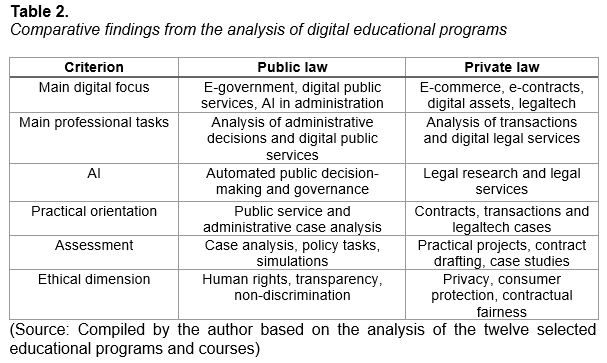
The comparative analysis of the twelve educational units revealed that digital technologies are not integrated into public and private law education in the same way. Public-law programs predominantly focus on technologies connected with the digital transformation of state institutions, including e-government, electronic administrative services, open data and artificial intelligence in public administration. Private-law programs, in contrast, are more frequently oriented toward technologies supporting digital economic activity and legal services, particularly electronic contracts, e-commerce, digital assets and legaltech. Thus, the main difference between the two groups lies not simply in the technologies studied, but in the professional legal tasks for which students are being prepared.
The analysis also demonstrated differences in the practical orientation of digital legal education. In public law, practical tasks are primarily connected with the assessment of digital public services, administrative procedures, automated decisions and potential risks to human rights. In private law, practice-oriented activities are more closely related to the preparation and analysis of electronic contracts, assessment of digital transactions, work with online platforms and the application of legaltech tools. These findings indicate that a uniform approach to digital legal training would not adequately reflect the different professional contexts of public and private legal practice.
The comparison further confirms the importance of competency-based assessment. Across the analyzed programs, traditional theoretical assessment is increasingly supplemented by practical cases, project tasks, simulations and the analysis of digital legal documents. However, the specific form of assessment depends on the legal branch and the professional task being simulated. This finding supports the conclusion that the assessment of digital legal competence should evaluate not only knowledge of digital legal phenomena but also the ability to apply technological tools and critically assess their legal and ethical consequences.
Comparative analysis of the application of digital educational programs in public and private law
Thus, the main difference between public-law and private-law digital programs lies in the nature of the legal interaction that they model. In public law, the vertical connection between the individual and the state is central, so digital programs should form the ability to assess the legality of government actions, the transparency of administrative procedures, the risks of automated decisions and the impact of digital technologies on human rights. In private law, horizontal interaction between private entities prevails, so the skills of preparing electronic contracts, analyzing digital transactions, working with legaltech, protecting intellectual property and supporting e-commerce are prioritized. At the same time, individual components, in particular personal data protection and artificial intelligence, are interdisciplinary in nature, which confirms the need for a two-tier model of digital legal education: a common digital core for all law students and sectoral specialization for public and private law.
Discussion
Author's model of application of digital educational programs in public and private law. The proposed model consists of five interconnected elements:
The first element of the model is the common digital core. It should be mandatory for all law students, regardless of their further specialization. It includes digital legal research, working with electronic legal databases, checking the authenticity of digital sources, using electronic documents, protecting personal data, the basics of cybersecurity, academic integrity, digital communication, digital ethics, and the critical use of artificial intelligence. It is this level that forms the basic ability of a future lawyer to work in a digital legal environment. Its meaning is consistent with the logic of DigComp 2.2, where digital competence encompasses information literacy, communication, digital content creation, security, and problem solving (Vuorikari et al., 2022).
The second element is sectoral specialization. It is necessary because digital tools function differently in public and private law. In public law, digital specialization should cover e-government, digital administrative services, open data, e-democracy, e-justice, automated administrative solutions, digital human rights and the use of artificial intelligence in public administration. In private law, the corresponding block should include e-contracts, e-commerce, digital assets, smart contracts, legaltech, intellectual property in the digital environment, online consumer protection, digital evidence and online dispute resolution.
The third element of the model is a practice-oriented digital task. It should ensure the transition from the acquisition of theoretical knowledge to the professional application of digital tools. In public law, such tasks may include the analysis of an electronic administrative service, the preparation of a legal assessment of an automated decision of a government agency, the development of recommendations on the accessibility of a digital service, the analysis of open data, or the modeling of an individual’s application through an electronic platform. In private law, practical tasks may include the preparation of an electronic contract, the analysis of the terms of a digital platform, the assessment of the risks of a transaction with digital assets, the development of a privacy notice, the analysis of a smart contract, or the modeling of online dispute resolution.
The fourth element is competency assessment. It should be aimed not only at testing knowledge of legal norms, but also at assessing the student’s ability to apply digital tools in legal practice. A traditional written exam in this context is insufficient, as it does not always demonstrate whether the student is able to work with electronic sources, digital evidence, online platforms, automated documents or AI tools.
Therefore, it is advisable to use practical cases, electronic portfolios, simulations, project tasks, analysis of digital documents, preparation of legal opinions on digital services and presentation of the results of digital legal research.
The fifth element of the model is ethical and human rights reflection. It should conclude each digital training module, since the use of technology in law is always associated with risks for human rights, privacy, non-discrimination, access to justice, equality of arms, transparency and professional responsibility. In public law, such reflection should aim to assess whether digital tools create new forms of administrative arbitrariness, opaque control or discriminatory access to public services. In private law, it should concern the fairness of contractual terms, the protection of the weaker party, the transparency of digital platforms, liability for automated decisions and the security of personal data.
In general, the model can be presented as follows:
Common digital core → sectoral specialization → practice-oriented digital task → competency assessment → ethical and human rights reflection
This model has several advantages. First, it does not equate digital education with distance learning. The online format is only one possible tool, while a true digital educational program involves the meaningful integration of technology into the professional training of a lawyer. Second, the model avoids fragmentation, when individual digital tools are used without a connection to learning outcomes. Third, it takes into account the distinction between public and private law, without destroying the integrity of legal education. Fourth, it combines the technological, legal and ethical dimensions of the training of future lawyers.
The special significance of this model is that it allows us to distinguish three levels of digitalization of legal education:
The first level is instrumental and is associated with the use of digital platforms, electronic libraries, online communication and distance learning systems.
The second level is substantive and involves the inclusion of digital legal phenomena in the curricula: e-government, e-commerce, artificial intelligence, digital assets, data protection and legaltech. The third level is competency-based and involves the student's ability to independently apply digital tools, assess their legal consequences, prepare legal documents in a digital environment, protect individual rights and act in accordance with professional ethics.
It is the third, competency-based level that is most important for the modernization of legal education. If digitalization is limited only to the first level, it actually means a change in the form of education, but not a change in its content. If it stops at the second level, students gain knowledge about digital legal phenomena, but do not always acquire practical skills in their application. Only the third level allows for the formation of a lawyer capable of operating in the conditions of digital transformation of law, public administration, business and legal services.
The proposed model also allows for the identification of different educational outcomes for public and private law. For the public law block, the expected learning outcomes should be the ability to analyze digital administrative procedures, assess the legality of automated decisions, use open data, work with electronic public services, identify risks of human rights violations and propose legal mechanisms to minimize them. For the private law block, such outcomes should be the ability to develop and analyze electronic contracts, assess the risks of digital transactions, work with legaltech tools, protect intellectual property in the digital environment, analyze the conditions of digital platforms, and provide legal support for e-commerce.
At the same time, both blocks should have common learning outcomes: the ability to conduct digital legal searches, critically evaluate electronic sources, comply with personal data protection requirements, use artificial intelligence responsibly, take into account the ethical consequences of digital decisions, and ensure the protection of human rights in the digital environment.
Conclusions
A comparative analysis of digital educational programs in public and private law showed that both directions have a common digital foundation, but differ in professional orientation. Common to them are digital legal research, work with electronic sources, protection of personal data, digital ethics, cybersecurity, academic integrity and critical use of artificial intelligence. These components form the basic digital core of legal education, necessary for all law students, regardless of future specialization.
At the same time, the public law block of digital legal education should be focused on e-governance, digital administrative services, open data, e-democracy, e-justice, automated administrative decisions, digital human rights, and the use of artificial intelligence in public administration. Its main task is to form the ability of a future lawyer to assess the legality of the state's digital activities, the accessibility of public services, the transparency of administrative procedures, and the risks of human rights violations in the digital environment.
The private law block, on the contrary, should be aimed at electronic contracts, electronic commerce, digital assets, smart contracts, legaltech, intellectual property in the digital environment, online consumer protection, digital evidence and online dispute resolution. Its specificity lies in preparing a lawyer for legal support of digital property turnover, business innovations, platform economy, automation of legal services and protection of the rights of subjects of private law relations.
The scientific result of the research is the proposed model of application of digital educational programs in public and private law. It includes five interrelated elements: a common digital core, sectoral specialization, practice-oriented digital task, competency assessment, ethical and human rights reflection. Such a model allows combining universal digital competencies of a lawyer with the specifics of specific legal areas and overcoming the fragmented approach to the digitalization of legal education.
The practical significance of the proposed model lies in the fact that it can be used to update educational programs of law faculties, develop digital modules, improve learning outcomes, create practical simulations and implement competency assessment. It is especially important that digital tools are not used in isolation, but are associated with specific professional tasks: analysis of an electronic administrative service, evaluation of an automated solution, preparation of an electronic contract, work with digital evidence, analysis of the terms of an online platform or legal support of a digital transaction.
Further research should be directed at empirically studying the effectiveness of digital educational programs in legal education, in particular through surveys of students and teachers, analysis of learning outcomes, comparison of national models of digital legal training, and research into the impact of artificial intelligence on the formation of professional competencies of a lawyer. It is especially promising to study how digital simulations, legaltech tools, and AI systems can be integrated into the practical training of students without violating the principles of academic integrity, professional ethics, and the protection of human rights.