
Artículo de investigación
Desafíos filosóficos y éticos del uso de neurotecnologías en la educación superior: Una crisis de identidad
Philosophical and ethical challenges of using neurotechnologies in higher education: A crisis of identity
Recibido: · Aceptado: · Publicado:
Cómo citar: Mykola, K., Poperechna, G., Gudz, V., Shakun, N., & Plaksina, O. (2026). Philosophical and ethical challenges of using neurotechnologies in higher education: A crisis of identity. Revista Eduweb, 20(3), 385–398. https://doi.org/10.46502/issn.1856-7576/2026.20.03.21
Resumen
El objetivo del artículo es determinar la dimensión filosófica y ética del uso de las neurotecnologías en la educación superior. El estudio distingue el problema de la neuroética de la tendencia más amplia hacia las soluciones tecnológicas. La base filosófica de la investigación se centra en las reservas éticas sobre el estatus de las neurotecnologías en la educación, consideradas junto con su validación epistemológica y la incertidumbre existencial asociada a este instrumento. La metodología combina enfoques científicos generales y filosóficos, integrando análisis comparativo, análisis del discurso, dialéctica y sinergia. Los resultados muestran la formación de un equilibrio entre las características tecnológicas de la neuroactividad en la educación superior y los principios mentales y de cosmovisión que regulan su aplicación. Las neurotecnologías, mediante el neuromonitoreo, las neurointerfaces y el mejoramiento cognitivo, influyen directamente en el potencial cognitivo de los participantes del proceso educativo. El dilema filosófico y ético subraya la necesidad de proteger la autoidentidad frente a factores externos agresivos. En el contexto posthumanista, caracterizado por la difuminación de la esencia humana y el predominio de soluciones pragmáticas, la crisis de identidad se intensifica. Las neurotecnologías pueden conducir tanto a la sustitución parcial o total del potencial cognitivo humano como a la expansión del repertorio intelectual y emocional sin amenazar la esencia humana.
Palabras clave: potencial cognitivo; tecnologías de la educación superior; dimensión humana de la educación; neuroética; discurso filosófico y antropológico.
Abstract
The aim of the article is to determine the philosophical and ethical dimension of the use of neurotechnologies in higher education. The objectives of the study are focused on distinguishing the problem of neuroethics from the broader trend of technological solutions. The philosophical foundation of the research is reduced to ethical reservations regarding the status of neurotechnologies in education, which are considered alongside the epistemological endorsement and existential uncertainty of this instrument. The research methodology is concentrated around an analytical cluster of general scientific and philosophical approaches. The scholarly vectors of comparative and discourse analysis are supplemented by corresponding philosophical cases of dialectics and synergy. The results of the study indicate the formation, within the contemporary scientific and philosophical worldview, of a balance between the technological characteristics of neuroactivity in higher education and the worldview-based and mental regulative principles governing its application. The role of neurotechnologies is realised through cases of neuromonitoring, neurointerfaces, and cognitive enhancement, which demonstrate an unequivocal influence on the cognitive potential of participants in the educational process. The philosophical and ethical dilemma points to the need to protect self-identity from an aggressive external factor. Under posthumanist conditions of the blurring of human essence and the sociocultural dominance of pragmatic solutions, the crisis of self-identity deepens. Neurotechnologies may shape two scenarios of influence on the human-centred development of science and philosophy: a radical one, involving the replacement of human cognitive potential by technological solutions, with a partial or complete loss of identity; and an evolutionary one, in which they acquire the status of an epistemologically active instrument that expands the human intellectual and emotional repertoire without threatening the existential constants of human essence and nature.
Keywords: cognitive potential; higher education technologies; human dimension of education; neuroethics; philosophical and anthropological discourse.
Introduction
The integration of innovative achievements in science and technology into the education system is a familiar and inevitable process of sociocultural development. Universities emerge as a space in which scientific and technological trends are implemented in order to enhance the quality of education. The modern pragmatic world dictates the dominance of efficiency, which leads to the search for mechanisms to improve educational activity. Neurotechnologies, which have been successfully tested in other spheres of social activity, in particular in medicine (Boulos, 2024) and economics, are gradually being introduced into the educational strategies of higher education institutions.
Among the principal applications of neurotechnologies in higher education, four key positions are distinguished, encompassing different educational, organisational, and methodological dimensions:
· Neuromonitoring (EEG-based) (Jiao, 2025), which focuses on determining the cognitive state of participants in the educational process (students, lecturers, administrators) through the practical use of technological and digital devices (portable EEG headsets, wearable EEG devices);
· Brain-computer interfaces (BCIs) (Nieves-Méndez, 2026), which are intended to establish effective channels of communication between the human brain and computer resources in order to improve the transmission of educational information content;
· Neurogames (Wang et al., 2025), designed to create non-traditional educational environments in which cognitive abilities are developed and expressed under specific learning conditions;
· Cognitive enhancement resources (Bakker & Mostert, 2024), which involve the use of substances and practices for non-invasive brain stimulation, thereby improving indicators of cognitive activity, including perception, memory, and responsiveness.
It is evident that the use of such significant technological instruments among participants in the educational process generates a variety of risks, both organisational and semantic in nature. In order to assess the organisational challenges of using neurotechnologies, society employs familiar safeguards: legal norms, functional standards, parameters of expediency, and the like. At the same time, the use of neurotechnologies requires control at the level of values and meanings.This process is partly regulated by individuals’ internal capacities through self-determination, which governs emotions and transforms them into academic achievement (Zheng et al., 2026). However, there is a clear need for systematic theoretical and worldview-based regulatory frameworks.
In this article, neurorights is used as an emerging conceptual and normative framework, not as a uniform set of newly established legal rights. Some interests discussed under this label, including privacy, freedom of thought, and personal autonomy, are already protected within existing human rights frameworks. Proposals concerning mental privacy, cognitive freedom, and mental self-determination seek to clarify how such protections should apply to neural data and technological interventions. UNESCO’s (2025) recommendation provides an international ethical framework, but its adoption should not be interpreted as creating an identical set of legally enforceable neurorights in every jurisdiction.
Philosophy traditionally acts as a regulator of scientific innovation at the worldview and mental level. A specific feature of scientific progress is the dynamism and variability of the processes and principles governing spheres of activity, including education. Philosophy, in turn, provides various value-oriented, purposive, and meaning-related vectors for scientific development. In this way, the boundary between perception and cognition can be prevented from becoming blurred (Bryce & Blown, 2025).
The cluster of neurotechnologies within the higher education system has come under philosophical scrutiny and has received multidirectional approaches to the assessment of its status and prospects in this sphere (see Fig. 1).
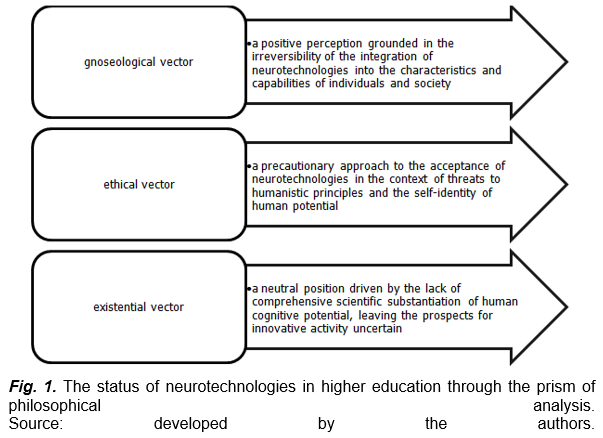
In general, philosophy provides a multidirectional characterisation of innovative trends in the use of neurotechnologies within the higher education system. At the same time, it is precisely the philosophical and ethical dimension that emerges as a restraining factor against the unsystematic integration of neurotechnologies into the educational process. Any innovative proposal encounters the problem of operational management and strategic regulation. These aspects become a critical factor in the emergence of ethical problems.
Ding (2026) emphasises that “the governance of neurotechnologies faces a paradox: the spread of ethical concepts—cognitive liberty, mental privacy, neurorights, mental self-determination—has expanded the normative vocabulary without creating the corresponding institutional capacity to ensure compliance with norms” (p. 93). For the higher education system, this deficit in governance capacity is only intensified by the absence of legal mechanisms for internal regulation. At the same time, such realities reinforce the role and significance of the ethical dimension as a regulator of the use of neurotechnologies in the educational process.
The aim of this scholarly inquiry is to provide a philosophical analysis of the ethical dimension of the use of neurotechnologies in higher education. Philosophical reflection is important for balancing the status of neurotechnologies in relation to their scientific characteristics. The objectives of the study are focused on highlighting the philosophical and ethical dimensions of the use of neurotechnologies in the higher education system and on conducting a comparative analysis of axiological and ethical guidelines alongside epistemological and existential parameters.
Theoretical Framework or Literature Review
In contemporary scientific and philosophical discourse, the issue of innovation in higher education occupies an important and highly relevant place, shaping current trends in educational development (Sanabria-Z et al., 2025). The use of neurotechnologies in the organisation of the educational process, as well as in its instructional and methodological dimensions, creates a need to document the results of such innovations. The scholarly community has launched a number of projects aimed at monitoring and analysing the use of neurotechnologies, including the BRAIN Initiative (Eberwine & Kahn, 2020). One of the important points in the academic literature is the positioning of neurotechnology tools in the functioning of higher education from the perspective of:
educational expediency (Nouri, 2025);
educational development (Privitera & Du, 2022);
scientific activity (Cinel et al., 2019);
philosophical and worldview-based interpretation (Clark, 2003).
In the course of presenting the first results of the implementation of neurotechnologies in the higher education system, responses of an epistemological (Schleidgen et al., 2022), ethical, and existential nature began to emerge. It is worth emphasising separately the distinctive filtering function inherent precisely in the philosophical interpretation of the problem. Neurotechnologies have become a genuine scientific and popular trend of the present day, which has led to the appearance of a large number of publications concerning various aspects of the implementation of this instrument. In this context, the process of differentiating the academic body of work becomes increasingly relevant, with a distinction between studies: that highlight technological characteristics, parameters of practical application, standards of implementation, and the like; that raise questions concerning the value- and meaning-based dimensions of these technological solutions, drawing on cases of neuroethics, identity (or self-identity), and cognitive liberty.
As a result, the first studies and conclusions concerning the status of neurotechnologies in the higher education system acquired the character of philosophical analysis. In examining the ethical dimensions of the implementation of technological and digital solutions, Floridi (2023) points to the excessive systemic popularisation of these innovations and, alongside this, notes the irreversible formation of the infosphere, with its own functional and meaning-related characteristics, which are fully extrapolated to the educational sphere as well. Ricoeur (2004) notes the threat of the excessive influence of neurotechnologies on the human person, highlighting the blurring of the self and the prospect of technology functioning as an analogue of human cognitive potential. In the philosophical and ethical analysis of neurotechnologies in social activity, it is also worth turning to the postmodern tradition, within which Foucault (1995) points to the formation of the concept of biopower and the effective diminishing of the significance of personal potential.
In this context, it is important to consider the practical use of neurotechnologies in educational settings from different psycho-mental, pedagogical, and sociocultural perspectives. Building on the available evidence regarding the influence of neurotechnologies on educational processes, the present study proposes a synergistic approach to their interpretation within the higher education paradigm as a tool for identifying and overcoming the crisis of identity.
Methodology
The methodological framework of the present research is based on two fundamental approaches: the general scientific approach and the philosophical approach. The methodological procedure of the study can be divided into several consecutive stages.
1.Formation of the source cluster and selection criteria. The object of analysis consisted of scholarly publications published between 2015 and 2026 devoted to the implementation of neurotechnologies, including neuromonitoring, brain-computer interfaces (BCIs), and cognitive enhancement in higher education. Publications were identified through Scopus, Web of Science, and Google Scholar using the keywords "neuroethics in education", "cognitive enhancement ethics", and "crisis of self-identity neurotechnology". The principal inclusion criterion was a focus on ethical or existential risks associated with the use of neurotechnologies in educational environments. A total of 40 academic sources were selected and analyzed. In addition, five classical philosophical works examining the ethical foundations of transformative scientific innovations were reviewed.
2.Application of analytical methods. Discourse analysis was employed to establish a comprehensive understanding of the role of neurotechnologies in higher education and to identify the dichotomy between the pragmatic support of neurotechnological innovations and the ethical concerns associated with anthropological freedom and mental privacy. Comparative analysis was used to evaluate the positive and negative manifestations of neurotechnological support in educational processes, particularly through comparison of neuromonitoring, neurointerfaces, and cognitive-enhancement practices in terms of their effects on human cognitive potential. The dialectical method enabled the identification of contradictions between the cognitive benefits of neurotechnologies and the existential risks associated with the loss of the human-centred character of education and the emergence of identity crises. The philosophical-anthropological approach further clarified the role of neurotechnologies as educational instruments that require preservation of the learner’s autonomous cognitive potential.
3.Research conceptualisation stage. The conceptualisation stage involved synthesising the collected data and constructing synergistic models of neurotechnologies in education. Conceptual categories were developed to explain the status of neurotechnologies in higher education, principles of their application, and risk algorithms associated with identity transformation. The resulting framework interprets neuroethics as a system of interaction between natural human cognitive potential and artificial technological tools. Finally, value-oriented guidelines were formulated to minimise ethical risks. A model was developed that compares the scale and intensity of neurotechnological influence with the philosophical assessment of potential loss of subjectivity. Within this framework, neurotechnologies are understood as instruments intended to strengthen the identity of participants in the educational process rather than merely improve learning productivity.
Results and Discussion
Ethical issues have emerged as a major point of debate in the use of neurotechnologies in higher education. At the same time, neuroethics has generated a number of related discourses concerned with the correlation between scientific and technological characteristics and philosophical and worldview-based principles in the educational sphere. The specific nature of higher education presupposes a constant balance between traditional foundational principles and innovative dynamic factors. In this context, neurotechnologies effectively serve as the exemplar of this dichotomy.
It should be noted that the worldview potential of the educational sphere is not yet prepared to resolve problems of this kind, since such contradictions, in institutional terms, are often addressed in an absolute manner: either by the complete prohibition of perceived threats or by their uncontrolled use. The scientific sphere, for its part, makes it possible to standardise the use of any instrument employed in the learning process. Consequently, neurotechnologies have acquired the status of technological support for educational activity and a factor in strengthening the cognitive potential of participants in the educational process. A distinct place in the understanding of the positioning of neurotechnologies within the higher education system is occupied by philosophical discourse. Traditionally, philosophy seeks to identify problematic aspects of a latent or delayed nature.
Educational neurotechnologies perform practical functions within the higher education system:
measuring the effectiveness of pedagogical and academic teaching strategies (Darvishi et al., 2022);
investigating the parameters of the neural correlation between learning and teaching (Peñafiel Villavicencio et al., 2025);
developing diagnostic tools for assessing the cognitive state of participants in the educational environment (Nouri, 2025).
Educational neuroscience not only affects
cognitive activity, but also forms a qualitatively new configuration of
“learning brains”, which become a space for neuropedagogical interventions: the
plastic brain, the synchronised brain, the engaged brain, and the computational
brain (Williamson et al., 2026). These clusters of brain structure encompass, in effect, all the
activities necessary for the learning process. Accordingly, the question arises
as to the potential replacement of human effort, will, and
aspiration by a technological analogue. It is evident that such a pragmatic
approach, though acceptable from a scientific perspective, gives rise to concern within the philosophical community.
A separate cluster of philosophical research on neurotechnologies in higher education is the social factor of innovative development. Vidal (2024) points to the convergence of neurotechnologies and digital technologies in education, while distinguishing the ethical and social problems involved. The key positions of the socio-philosophical analysis of the use of neurotechnologies in higher education are as follows:
legal regulation of the use of innovation in education while preserving human rights to freedom, security, and identity (Ienca, 2021);
ensuring the confidentiality of personal neurobiological data (Sinaci & Hasmatuchi, 2023);
upholding the principles of integrity in neurotechnological activity (Eaton, 2024);
fostering trust in neurotechnologies in education at the individual, professional, and societal levels (Martinez et al., 2022).
The first results and consequences of the use of neurotechnologies in the university learning process have revealed a number of problems of an ethical nature (see Fig. 2).
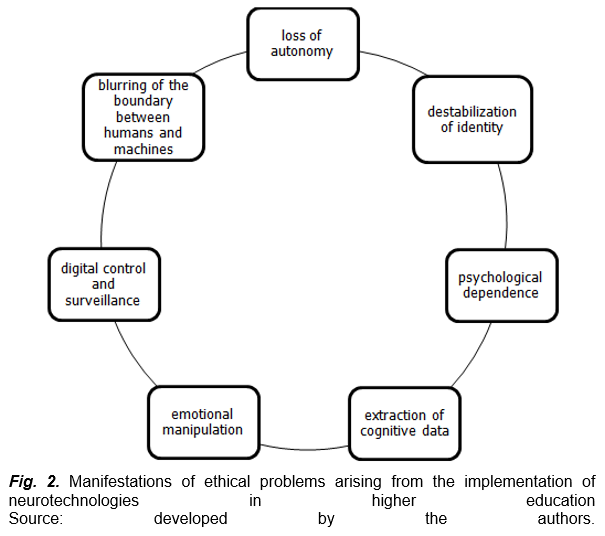
Another socio-philosophical problem associated with the use of neurotechnologies is the disparity between universities in the scale of their adoption of innovative technologies, which is linked to financial capacity and prejudice regarding the use of such instruments (Nouri, 2025). These realities result from the absence of a unified strategy for the use of neurotechnologies in the higher education system, leading to differing levels of perception and understanding of the status of neuro-instruments.
The socio-philosophical discourse of neuroethics in higher education analyses the responses of all its participants. Models of individual, professional, and institutional perceptions of neurotechnologies in the educational process are proposed:
from the perspective of the university, the level of implementation of neurotechnologies is assessed, along with academic readiness to use innovative instruments and control over the moral and integrity standards of the neuroeducational case (Alipoor & Pourrashidi, 2025);
from the perspective of the academic teaching community, the understanding of the expediency of using neurotechnologies and the individual position regarding their practical application are determined, together with the results and consequences of their implementation (Paredes Rosado & Rodríguez Flores, 2025);
from the perspective of higher education students, personal and collective cases of neurotechnological influence are formed, with the identification of algorithms for supporting or enhancing cognitive activity (Nieves-Méndez, 2026).
Philosophical approaches characterise neurotechnologies in terms of the worldview trend of the crisis of self-identity. Further analysis makes it possible to extrapolate these ideas to the use of neurotechnologies in the educational process of higher education (see Table 1).
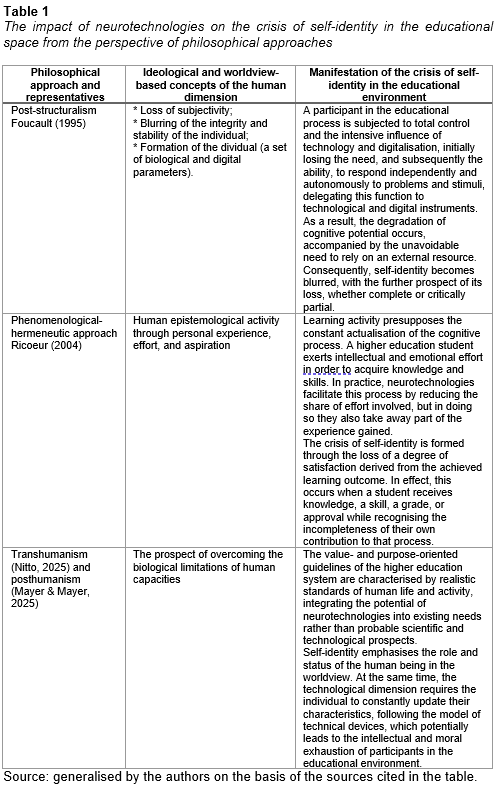
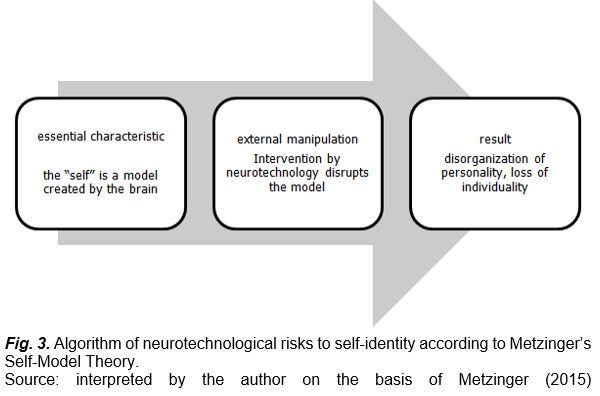
Contemporary innovative philosophical currents also offer their own assessment of neurotechnologies in the higher education system. One influential representative of neurophilosophy, Metzinger (2015), proposes the Self-Model Theory. In this context, an algorithm of risks to self-identity in the use of neurotechnologies in education is constructed (see Fig. 3).
For a fuller understanding of the potential of neurotechnologies in the higher education system, it is appropriate to turn to the term reversibility, which denotes the capacity of a system to return to its initial state. Such an approach partially resolves the ethical problem of preserving human control over cognitive activity (Yang, 2025).
By analogy with a technological device, at any moment, through an act of will, a person is able to return to their original state, rejecting the settings and changes introduced by neurotechnological instruments. Here one may observe an analogy with scientific advances in medicine, according to which, in the case of deep brain stimulation, both the impairment and the restoration of personal identity are possible (Yang & Zhou, 2025). The possibility of reversibility makes it possible to form other activities that are important for organising an effective learning process: the restoration and cancellation of cognitive experience.
Contemporary scientific and philosophical discourse offers a variety of formats for identifying the dominant component in the assessment of neurotechnologies in educational life. In particular, Walker and Mackenzie (2020), discussing neurotechnologies in social activity, note that “framing ethical debates in terms of authenticity is unhelpful” (p. 98), assigning these points instead to problems of autonomy. That is, the individual preserves their own uniqueness in educational activity, while neurotechnologies function as an instrument for enhancing cognitive and intellectual activity.
At present, attempts are being made to redirect the discussion of the advantages and disadvantages of neurotechnologies in education towards a different value- and purpose-oriented domain. In particular, the concept of neurodevelopment is being actively introduced into scientific and philosophical discourse (Astle et al., 2024), which in effect constitutes a synergetic approach to assessing the prospects of this instrument. Neurodevelopment presupposes the convergence of psychology, education, learning technologies, computer science, engineering, and informatics (Parsons, 2019). Neurodevelopment consists of several fundamental components that form the synergistic interaction of an interdisciplinary paradigm:
neuroengineering as a resource of technological solutions (Ramírez-Moreno et al., 2021);
neuroscience as a model for the theoretical verification of technological instruments (Cinelet al., 2019);
neuroeducation as a factor in the correlation between technology and learning (Gracia-Calandín, 2019).
The ethical discussion of educational neurotechnology must also account for recent international governance frameworks. The OECD Recommendation on Responsible Innovation in Neurotechnology, adopted in 2019, provides principles for responsible development and use. UNESCO’s Recommendation on the Ethics of Neurotechnology, adopted in November 2025, extends the discussion explicitly to education. It calls for educational uses to be evidence-based, assessed in advance, aligned with legitimate learning objectives, and subject to informed consent and independent oversight. It also addresses risks of inequality, dependency, and inappropriate use of neurotechnology in the evaluation of students and educators (UNESCO, 2025). A promising line of research is the transition of the philosophical analysis of the use of neurotechnologies in higher education from the ethical case to the existential dimension, with the establishment of new problematic questions (Ridolfi & Santos, 2025). In the synergistic model of the contemporary scientific and philosophical worldview, the case of neurotechnologies is a kind of bifurcation point in the question of the structure of a new human essence. The traditional system of “human being – culture (science, technology)” loses its stability and permanence when examined through the prism of the use of neurotechnologies in the educational process.
The present is in a state of anticipation of a new reality in which neurotechnologies may lead to the emergence of a posthuman technological “self”, which will become the new norm (Giordano et al., 2024). At the same time, Nitto (2025) raises an intriguing question: “is the use of neurotechnologies a genuine evolutionary process, or, in a darker scenario, does it mark the beginning of the disappearance of the human species as we know it?” (p. 4). Evidently, the results and consequences of the implementation of neurotechnologies specifically within the higher education system will constitute the data that make it possible to outline answers to this question. At present, however, the first results and consequences of the implementation of neurotechnologies in higher education point towards optimistic forecasts. Lupton (2019) defines the role of neurotechnologies as a mechanism for forming the concept of the “more-than-human”. On the whole, the philosophical tendency remains to position neurotechnologies in higher education as an enhancing instrument, while fully preserving the cognitive nature and essence of the human being.
The existential dimension of neurotechnology in higher education concerns the conditions under which students and educators remain agents of their own learning, decisions, and self-understanding. Whether and how neurotechnological interventions may transform subjectivity and personal identity remains an open philosophical and empirical question. Their use should therefore be assessed in relation to the scope of the intervention, the individual’s capacity to understand and refuse it, the handling of neural data, and its possible effects on autonomy and self-perception. Legal and ethical safeguards cannot establish in advance that identity will remain unchanged; they can, however, set limits on permissible interventions and require continuing evaluation of their consequences.
Conclusions
Thus, the fundamental philosophical and ethical question regarding the use of neurotechnologies in higher education is not whether they can replace humans, but whether the individual remains the agent of their own decisions and self-determination when a portion of their cognitive processes is delegated to technological systems. It is precisely in this context that the question arises concerning the limits of permissible technological intervention in an individual's cognitive and mental spheres. Although neurotechnologies can enhance human cognitive capabilities, support educational activities, and create new forms of learning, their implementation must not result in a loss of autonomy, mental privacy, the right to make independent decisions, or the ability to critically evaluate technological recommendations. At the same time, the philosophical and ethical position retains a cautionary character because of concerns about the deepening crisis of self-identity caused by the influence of technology on the cognitive potential of students and lecturers. In the question of integrating neurotechnologies, philosophy performs the role of a worldview regulator, responding to threats that multiply under the pressure of the scientific and technological characteristics of artificial neuroactivity. Neuroethics is the result of balancing the positions of epistemological optimism, existentially neutral uncertainty, and the philosophical-axiological filter within the educational environment.
Science is guided by quantitative indicators of improvement in the level of higher education, proposing neurotechnologies as an instrument. Neuromonitoring, neurointerfaces, and cognitive enhancement solutions all constitute a set of instruments that may become a factor in the transformation of higher education in two respects: they may improve the cognitive abilities of participants in the educational process to the point of blurring human identity, while simultaneously provoking unpredictable consequences through the loss of the structural essence of personality; or they may strengthen the cognitive state of the student or lecturer by providing them, under controlled conditions, with standardised—and therefore safe and necessary for the preservation of identity—neurotechnological solutions for the improvement of the intellectual and emotional development of the individual. Philosophy, in turn, through ethical imperatives, performs an operative control and regulatory function, preventing technological solutions from crossing the red lines of the humanistic foundations of the educational space; it also fulfils a strategic mission by preparing the ground for the existential recognition of scientific and technological cases within the conceptual dimensions of higher education.