
Artículo de investigación
La gamificación en la formación del profesorado: Сómo mejorar la motivación de los futuros maestros de primaria
Gamification in teacher education: Enhancing the motivation of pre-service primary school teachers
Recibido: · Aceptado: · Publicado:
Cómo citar: Lystopad, N., Kit, H., Danyliak, R., Mordovtseva, N., & Tsalapova, O. (2026). La gamificación en la formación del profesorado: Сómo mejorar la motivación de los futuros maestros de primaria. Revista Eduweb, 20(3), 171–187. https://doi.org/10.46502/issn.1856-7576/2026.20.03.10
Resumen
La gamificación se ha consolidado como un enfoque pedagógico eficaz para potenciar la motivación y la competencia profesional de los estudiantes en la educación superior. Este estudio tuvo como objetivo desarrollar y evaluar la efectividad de un sistema de instrucción basado en la gamificación, diseñado para mejorar la motivación de los futuros maestros de primaria. Un diseño de investigación de métodos mixtos combinó el análisis teórico con un experimento pedagógico en el que participaron 104 estudiantes de primer año de la carrera de Educación Primaria, asignados aleatoriamente a un grupo experimental (n = 52) y a un grupo de control (n = 52). La intervención integró herramientas digitales de gamificación, actividades de aprendizaje interactivas y condiciones pedagógicas específicas. El grupo experimental demostró una mejora significativamente mayor que el grupo de control. La proporción de estudiantes que alcanzaron niveles creativos y profesionales aumentó del 26,9 % al 73,1 % en el criterio motivacional y del 26,9 % al 71,2 % en el criterio de contenido-actividad, mientras que la proporción en el nivel bajo disminuyó del 42,3 % al 7,7 % y del 40,4 % al 9,6 %, respectivamente. El análisis estadístico confirmó diferencias significativas entre grupos tras la intervención (t > 1,967, p < 0,05). Los resultados demuestran que la integración sistemática de la gamificación en la formación docente con apoyo digital mejora significativamente la motivación y la competencia profesional de los estudiantes.
Palabras clave: gamificación del proceso educativo; motivación; futuros maestros de primaria; entorno digital; educación superior.
Abstract
Gamification has emerged as an effective pedagogical approach for enhancing student motivation and professional competence in higher education. This study aimed to develop and evaluate the effectiveness of a gamification-based instructional system designed to enhance the motivation of pre-service primary school teachers. A mixed-methods research design combined theoretical analysis with a pedagogical experiment involving 104 first-year undergraduate students in Primary Education, randomly assigned to an experimental group (n = 52) and a control group (n = 52). The intervention integrated digital gamification tools, interactive learning activities, and targeted pedagogical conditions. The experimental group demonstrated significantly greater improvement than the control group. The proportion of students achieving creative and professional levels increased from 26.9% to 73.1% for the motivational criterion and from 26.9% to 71.2% for the content-activity criterion, while the proportion at the low level decreased from 42.3% to 7.7% and from 40.4% to 9.6%, respectively. Statistical analysis confirmed significant between-group differences following the intervention (t > 1.967, p < 0.05). The findings demonstrate that the systematic integration of gamification into digitally supported teacher education significantly enhances students' motivation and professional competence.
Keywords: gamification of the educational process; motivation; future primary school teachers; digital environment; higher school.
Introduction
Modern educational realities require the search for innovative methods that combine personality development and learning through emotionally rich, engaging forms. Educational game technologies have gained widespread popularity, thereby defining the didactic game as a method or means of learning.
Classical approaches are receiving new development in the era of digitalization. Therefore, today, gamification is considered in numerous publications to be an innovative technology for productive activity and learning. The growing interest in gamification across various fields is clearly demonstrated by the corresponding Google service, which is classified as a “breakthrough”.
The digital transformation of higher education has fundamentally changed approaches to teaching, learning, and professional training. The integration of digital technologies into educational practice requires innovative pedagogical strategies capable of increasing students' engagement, motivation, and professional competence. Among these strategies, gamification has attracted considerable attention as an approach that incorporates game mechanics into educational environments to stimulate active participation, collaborative learning, and meaningful knowledge construction. In teacher education, gamification is particularly relevant because future primary school teachers are expected to design motivating, learner-centred, and technology-enhanced learning experiences that meet the educational needs of contemporary schoolchildren.
Recent international studies demonstrate that gamification positively influences learners' academic achievement, intrinsic motivation, engagement, and critical thinking. Research has shown that game-based learning environments improve learning outcomes compared with traditional instruction, promote emotional competence, and encourage active participation in educational activities. Moreover, the integration of digital technologies, including learning management systems, interactive platforms, artificial intelligence, and virtual or augmented reality, has expanded the pedagogical potential of gamification by enabling adaptive, collaborative, and personalized learning experiences.
Despite these advances, several research gaps remain. Existing studies primarily examine isolated gamification tools or specific digital platforms, whereas comparatively little attention has been devoted to the development and experimental validation of comprehensive pedagogical systems that integrate digital technologies, instructional strategies, and organizational conditions to enhance the motivation of pre-service primary school teachers. Furthermore, limited empirical evidence is available regarding the effectiveness of such integrated approaches within higher education institutions.
The present study addresses this gap by proposing and experimentally evaluating a comprehensive gamification-based instructional system designed to enhance the motivation of future primary school teachers in a digitally supported educational environment. Unlike previous research focusing on individual digital applications, this study examines the combined effect of pedagogical conditions, digital learning tools, and structured gamified learning activities on students' professional development.
The findings contribute to the growing body of research on digital pedagogy by providing empirical evidence regarding the effectiveness of systematic gamification in teacher education. The study also offers practical recommendations for designing digitally enriched learning environments that foster motivation, engagement, and professional competence among future teachers.
The remainder of this article is organized as follows. The Literature Review synthesizes current international research on gamification, digital learning environments, and teacher motivation while identifying the existing research gap. The Methodology section describes the research design, participants, intervention, research instruments, and statistical procedures. The Results and Discussion section presents the findings of the pedagogical experiment and compares them with previous empirical studies. Finally, the Conclusions summarize the main theoretical and practical contributions of the study, acknowledge its limitations, and outline directions for future research.
Literature Review
The effectiveness of gamification in higher education for increasing the motivation of future primary school teachers is supported by international studies.
Interesting and necessary are the studies by Lampropoulos and Sidiropoulos (2024) on students' motivation and level of involvement, and on the increase in their academic results in gamified learning compared to the traditional educational process.
Wulan et al. (2024) demonstrate a positive impact of students' involvement in the gaming process on learning, reveal ways to improve memorization, and present directions for solving educational problems.
Studies by Cès et al. (2026) systematically show how and to what extent board games contribute to the development of emotional competence in children – in particular, they reduce problematic behavior, improve social interaction, support emotional well-being, and help children learn knowledge better.
Vrcelj et al. (2023) review child-centered learning that includes play-based methods to develop problem-solving, decision-making, and critical thinking skills. They conclude that gamification helps to make learning more interactive and interesting for both students and pupils.
Researchers Khaldi et al. (2023) demonstrate the importance of gamification in education and show ways to use aesthetics, game thinking, and game mechanics to promote student motivation, learning, and the resolution of motivational problems.
Scientists Sáez-López et al. (2022) analyze the application of gamification and game-based learning in primary education, highlighting teachers’ positive attitudes towards these approaches and emphasizing that appropriate resources, lesson planning, and teacher training can enhance student motivation, commitment, and enthusiasm for interactive learning processes.
Researchers Zaric et al. (2021), taking into account the individual characteristics of education seekers, theoretically substantiate the issue of gamified learning.
However, the issue of gamifying the educational process to increase the motivation of future primary school teachers has not been sufficiently investigated.
The purpose of the study is to develop and test the system's effectiveness for implementing gamification in higher education to increase the motivation of future primary school teachers.
Methodology
Research Design
The study employed a mixed-methods research design combining theoretical and empirical approaches. The theoretical component included analysis, synthesis, comparison, systematization, and generalization of scientific literature on gamification, digital technologies, and professional teacher education. The empirical component consisted of a pedagogical experiment conducted during the 2024–2025 academic year to verify the effectiveness of the developed system for implementing gamification in higher education.
Participants
The study involved 104 first-year undergraduate students majoring in Primary Education from higher education institutions in Ukraine. The participants voluntarily agreed to participate in the research and met the inclusion criteria established for the study. They were randomly assigned to two equivalent groups: the experimental group (EG, n = 52) and the control group (CG, n = 52). Random allocation ensured comparable baseline characteristics of both groups before the intervention.
Research Procedure
The pedagogical experiment consisted of two consecutive stages.
During the ascertaining stage, the initial level of students' motivation to use gamification in the educational process was determined.
During the formative stage, the experimental group studied using the developed system of gamification implementation and the proposed pedagogical conditions, whereas the control group continued learning according to the traditional educational approach without systematic implementation of gamification technologies.
Research Instruments
The effectiveness of the developed system was evaluated according to two criteria:
- Motivational.
- Content-activity.
For each criterion, four levels of competence formation were identified:
- Creative.
- Professional.
- Basic.
- Low.
The assessment was carried out using a system of diagnostic methods developed for the purposes of the study. The obtained results were recorded as absolute frequencies (n) and percentages (%) for each level within the experimental and control groups.
Data Analysis
Statistical analysis was performed using descriptive and inferential statistics. Descriptive statistics included frequencies and percentages for each competence level. Differences in the distribution of competence levels between the experimental and control groups were assessed using Pearson's chi-square (χ²) test at a significance level of α = 0.05. The χ² test was applied to determine the homogeneity of the groups at the ascertaining stage and to evaluate the effectiveness of the intervention at the formative stage.
Statistical analysis was performed using descriptive and inferential statistics. Descriptive statistics included absolute frequencies (n) and percentages (%) for each competence level. Since the study variables were categorical (creative, professional, basic, and low levels), Pearson's chi-square (χ²) test was used to compare the distributions between the experimental group (EG) and the control group (CG). The χ² test was applied at the ascertaining stage to verify the initial homogeneity of the groups and at the formative stage to evaluate the effectiveness of the pedagogical intervention. Statistical significance was established at α = 0.05. A p-value greater than 0.05 at the ascertaining stage indicated that no statistically significant differences existed between the groups before the intervention, confirming their baseline equivalence. Conversely, statistically significant differences observed after the intervention (p < 0.05) confirmed the effectiveness of the implemented gamification system.
Ethical Considerations
Participation in the study was voluntary. All participants provided informed consent before the experiment began. The anonymity and confidentiality of respondents were ensured throughout the research, and the collected data were used exclusively for scientific purposes in accordance with generally accepted ethical principles of educational research.
Results and Discussion
Classification of game practices in the educational process of higher education. Advantages and disadvantages of using gamification in education.
An important component of the educational process is game practice, which contributes to the development of key competencies among pupils and students and to the activation of their cognitive activity. Game practices are actively used not only in primary and secondary education, but also in higher education. The types of game practices in higher education are presented much more widely: these are role-playing games that allow playing certain life roles, business games that provide reproduction of the social and subject specifics of a certain professional activity of an individual, talk show technologies in which all participants participate and provide an opportunity to conduct structured discussions, game-exercises provide consideration of various professional situations, various digital tools to increase the motivation of future teachers (Palshkov et al., 2026).
Media games play a key role in the training of future primary school teachers, contributing to a creative approach to problem-solving, the formation of a comprehensively developed personality, and the ability to communicate effectively, think critically, and adapt to changing conditions in the modern information society (Bassanelli et al., 2022). Thus, the classification of game practices in the educational process of higher education is multidimensional and depends on the content of the material, the purpose of learning, and the age characteristics of each individual. The adaptability and flexibility of game methods are evident in the variety of approaches in modern pedagogy for classification.
The use of gamification in education has certain advantages and disadvantages.
The advantages include:
- New information is easily perceived through the game.
- The game brings relaxation and fun to the educational process.
- The element of competition and excitement present in the game allows you to keep and attract the attention of the audience.
- The game allows you to easily move to the generation of ideas, an active creative process.
- There is no external pressure in the game, and no psychological stress.
- Throughout the game, the senses and movement are trained, adaptation mechanisms are developed, and attention and observation are honed, which serves as preparation for the struggle for life (Aris et al., 2024).
- Teamwork to achieve the game’s goal.
- The game develops communication skills.
- Motivation, which is directly derived from the game process, is the primary driver of the student's and child's activity.
- The opportunity to get pleasure and enjoyment from the game, to be equal to all participants in the game process by limiting the freedom of action between players, and conscious acceptance.
Let us name the disadvantages of using gamification:
- Due to the perception of the game as entertainment, a decrease in the level of responsibility, and the lack of recognition as a learning tool.
- Complexity of application (poorly selected games, ignorance of the method of use, unclear rules, etc.).
- Lack of seriousness.
- Opposition from the audience arising from the student's individual, psychological, and pedagogical characteristics.
- In the educational process, the game is not an end in itself.
Based on the different approaches to the use of gamification in education, the teacher’s skill in selecting methods and games for application comes to the fore.
The teacher can, through the game, correct the student's behavior; gradually influence children's character; note certain patterns; improve and develop students' skills and abilities; provide psychosocial support to children according to their emotional state and age; and ensure the preservation and stability of mental health.
Use and classification of digital tools to create an effective digital environment in higher education through gamification.
A variety of digital tools are necessary for creating an effective digital environment through gamification (Li et al., 2024). Based on their primary functions, these tools can be broadly classified by the role they play in supporting gamified learning. allowing learners to interact with educational content actively:
- Tools, using game functions, designed to provide content (repositories and electronic libraries, online course platforms, mobile educational applications).
- Tools that provide feedback and assessment of learning achievements, in order to motivate and encourage higher education students to improve their knowledge and practical skills (learning management systems, quizzes, online tests).
- Tools designed to facilitate communication and teamwork (online brainstorming boards, file-sharing platforms, and video conferencing) are important in many gamified scenarios.
Digital tools are characterized by their adaptability and technical sophistication, allowing educators to design higher education learning processes in line with group dynamics and the individual needs of higher education students. Some tools offer simple interfaces designed to motivate higher education students, using icons and points, while others include advanced analytics. Developing teamwork and communication skills can promote collaborative learning through team competitions, Edmodo, Google Classroom, and Moodle, with gamification plugins that combine educational content with motivating game elements to create a more effective and attractive learning environment. For example, Moodle allows you to store data on learners' educational achievements, administer tests, create interactive courses, and collect feedback (Kuchai et al., 2017).
The ability to integrate gamification plugins, such as Stash, Game, and Level Up!, is particularly valuable, as they allow you to move to a higher level for completing tasks and to add awards and points for education seekers.
Google Classroom provides distribution and quick task creation, communication among students, and assessment. This platform, in combination with other Google tools, enables the organization and monitoring of individual student progress and the building of their educational trajectories.
Edmodo is a system with social network functions that aims to manage learning, support resource sharing and learning communities, and help conduct final and thematic testing for students. Game platforms play a key role in personally oriented learning in educational digital environments, focusing on the student's internal motivation, placing him at the center of the educational process and learning activities, and using game tasks to develop critical thinking skills and to ensure cooperation, communication, and independence.
Game platforms can be adapted to different academic disciplines: mathematics, natural sciences, languages, history, etc.
One example of a game platform is Kahoot!, a widely used game-based learning platform that offers interactive tasks and quizzes, making it particularly effective for personally oriented learning (Sinnivasagam & Hua, 2023).
Wordwall is used to develop exercises to consolidate and repeat material, create quizzes, and interactive games (Halatsyn & Feshchuk, 2024). This platform allows you to choose several game formats at the same time, including quizzes or crosswords, "Paired cards", "Spin the wheel", and "Word clouds". The advantages of Wordwall are the ability to adapt tasks to age, ease of use, competition, and instant feedback.
LearningApps is useful across different educational disciplines for developing interactive exercises (Stefaniak & Carey, 2019).
A special educational environment is created by immersive technologies, including augmented and virtual reality tools, that combine them with digital or simulated versions of the real world. Yes, such technologies can merge objects from the real environment with the virtual one and project a variety of digital information beyond the boundaries of device screens. It is enough for students to have only a mobile phone for work. At the same time, the user is transported to the artificial world of virtual reality. A necessary condition for working with such technologies is the availability of special tools. Augmented and virtual reality tools are used to study complex processes and objects (Beheshti et al., 2024).
Students can actively communicate in a virtual environment with virtual characters, working in a setting close to the real one. To increase the motivation of students, augmented and virtual reality tools are used in competitions, ratings, points, and virtual awards, which create an interactive educational environment in which students can receive hints, interact with other objects or subjects, and work with emotional involvement in educational scenarios that form the context (Cabrera-Solano, 2022).
The educational virtual reality platform ClassVR contains a large library, uses VR headsets with built-in screens (specialized equipment), and does not require computers or smartphones. ClassVR has a teacher control panel and offers hundreds of videos and interactive images for use across various educational disciplines (Su et al., 2022).
Discord is a cross-platform text messaging program for organizing video and audio conferences and for uniting in communities.
Discord allows you to create virtual communities, where you can integrate additional educational tools, organize channels by topic, communicate in chat or live, and exchange files (Zhang & Huang, 2024).
The use of virtual and augmented reality technologies, digital platforms, and adaptive learning systems supports diverse learning styles and promotes personalized education. Therefore, it can be argued that gamification is shaping a new educational landscape focused on the comprehensive development of the individual (Vera-Monroy et al., 2024). Recent research on distance and blended learning indicates that integrating gamification into STEAM education has the potential to significantly enhance the effectiveness of the educational process.
Organization and methodology of experimental work.
The use of empirical research methods in the form of a pedagogical experiment is a supplement to the theoretical research, which provided proof of the effectiveness of the developed system for implementing gamification in the educational process to increase the motivation of future primary school teachers, thereby verifying the proposed research goal.
The purpose of the experimental work is to develop and verify the effectiveness of the system for introducing gamification into the higher school educational process to increase the motivation of future primary school teachers through its implementation and approval in higher education institutions.
The plan of the pedagogical experiment outlined separate main stages, each characterized by a sub-goal and a set of tasks.
The ascertaining stage aimed to determine the current state of gamification implementation in the educational process at a higher school to increase the motivation of future primary school teachers.
The goal of the formative stage was to introduce into the educational process of higher education institutions the developed optimal system and pedagogical conditions for implementing gamification of the higher school educational process to increase the motivation of future primary school teachers.
At the ascertaining stage, a preliminary survey was conducted among 78 respondents, including university teachers and future primary school teachers, to determine their awareness of the content, advantages, and methods of implementing gamification in higher education. The results of this survey were used to identify the current state of the problem and to refine the design of the pedagogical experiment.
To the question to teachers and students, "What advantages do you think gamification of the educational process has compared to traditional approaches to education?" the following results were obtained:
- 84.6% of respondents noted the importance of using Internet resources and emphasized the need to create an effective digital environment of higher education through gamification.
- 79.5% of respondents indicated that future primary school teachers should develop their own lifelong learning trajectories through gamification.
- 61.5% of respondents noted the need to use innovative pedagogical activities, including introducing game-based practices into the educational process and adopting an individual approach to each student.
- 55.1% of respondents noted the importance of introducing STEAM education in higher schools as a key direction for improving the educational process, to motivate students and free up classroom time for implementing game-based methods.
Based on the results of the ascertainment section, we see that students and teachers clearly understand the advantages of implementing game-based practices in the educational process and focus on the necessary professional qualities of a 21st-century specialist.
Let us emphasize the answers to the questionnaire that we received from students.
- 80.8% of future specialists agreed with the statement that “Gamification tools provide students with the opportunity to use the knowledge acquired in practice more effectively”.
- 97.4% of respondents, to demonstrate their understanding of the significance of gamification tools, strongly agreed with the statement: “Gamification tools motivate students to study the discipline more than traditional approaches”.
So, we say that students clearly understand the need to use gamification tools in the educational process because they enhance their competitiveness in the labor market and positively affect their professional competence.
Within the framework of the ascertaining stage, the final step was to determine the initial level of motivation formation among future primary school teachers to use gamification in the educational process to increase professional competence.
We have developed a system of criteria (motivational, content-activity) and levels (creative, professional, basic, low).
The levels of motivation formation of future primary school teachers to apply gamification in the educational process to increase professional competence, according to the motivational criterion, at the ascertaining stage of the pedagogical experiment are shown in Table 1.
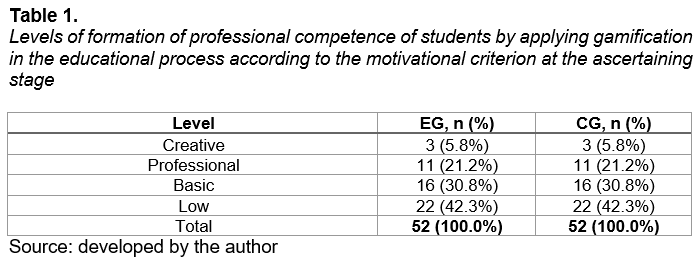
Having analyzed the results obtained at the ascertaining stage in the EG and CG according to the motivational criterion, we can state that the majority of respondents in both groups have a basic and low level of formation of the outlined phenomenon according to this criterion, which indicates a vague understanding of the ways of using gamification, the values of their own professional activities and insufficient motivation of students to master the profession.
Monitoring of formation in accordance with the content-activity criterion was carried out, taking into account the peculiarities of the professional training of future primary school teachers.
Two indicators were evaluated according to the content-activity criterion:
- Systematicity and thoroughness of theoretical, general professional, and practical narrowly professional skills, abilities, and knowledge through positive motivation of future primary school teachers.
- Effective use of gamification in the educational process to improve professional knowledge, abilities, and skills in situational professional activity.
The levels of motivation formation of future primary school teachers to use gamification in the educational process to increase professional competence, according to the content-activity criterion, at the ascertaining stage of the pedagogical experiment are shown in Table 2.
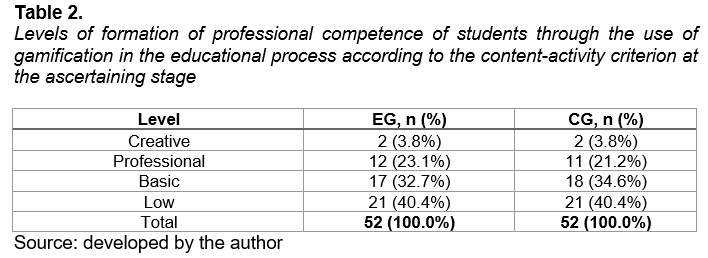
Having analyzed the results obtained at the ascertaining stage in the EG and CG according to the content-activity criterion, we can state that the majority of respondents in both groups, according to this criterion, have a low and basic level of formation of the outlined phenomenon, which indicates insufficient use of gamification, values of their own professional activity and insufficient motivation of students to use gamification in professional activity.
The average values of the formation indicators were calculated similarly for the EG and CG, according to the content-activity criterion (Table 2).
The study showed that, according to the content-activity criterion, there is no statistically significant difference in the average results between the EG and CG; that is, the difference is random.
Thus, according to the results of the ascertaining stage of the pedagogical experiment, we observe in both groups of students a basic and low level of formation of the outlined phenomenon, which indicates the relevance of the formative stage of the study.
Implementation of an experimental optimal system and pedagogical conditions for implementing gamification of the higher school educational process to increase the motivation of future primary school teachers.
Rather than being implemented as isolated digital tools, the selected applications were integrated into a coherent pedagogical framework aligned with the curriculum of the Primary Education programme. The instructional design followed the principles of constructive alignment, ensuring that each digital resource supported specific learning outcomes, instructional activities, and assessment procedures.
The gamified learning process was organized into four interconnected stages. During the orientation stage, interactive polling and diagnostic tools (e.g., Mentimeter and Quizizz) were used to activate prior knowledge, identify students' initial understanding, and increase engagement at the beginning of each learning module. During the knowledge construction stage, collaborative platforms and digital content creation tools (e.g., Genially, Canva, and Powtoon) enabled students to develop educational materials, solve authentic pedagogical tasks, and collaboratively construct knowledge through project-based activities.
The practice stage incorporated simulation-based and game-oriented applications, including AI-supported environments and role-playing activities, allowing students to apply theoretical knowledge to realistic teaching situations, develop decision-making skills, and reflect on classroom practice. Finally, the assessment and reflection stage employed formative assessment platforms such as Quizizz, Socrative, and Formative to provide immediate feedback, monitor learning progress, and support students' self-regulation throughout the intervention.
To avoid cognitive overload, only a limited number of digital applications were introduced within each instructional module, and each platform served a clearly defined pedagogical purpose. The same core set of digital tools was used consistently across the intervention, allowing students to become familiar with the learning environment while gradually developing professional competence rather than spending time adapting to new technologies. Consequently, digital technologies functioned as pedagogical instruments embedded within the curriculum rather than as independent learning objectives, ensuring that gamification enhanced rather than distracted from the educational process.
Dynamics of developing students' professional competence through the creation of optimal systems and pedagogical conditions for introducing gamification into the higher education process to increase the motivation of future primary school teachers.
The formative stage of the pedagogical experiment took place during 2024-2025. Its goal was to verify the effectiveness of the developed system and the pedagogical conditions of the outlined phenomenon.
The pedagogical experiment provided for two control points: the ascertaining and formative stages.
We also used a comparative method of scientific research in the control and experimental groups, which enabled comparison of diagnostic results for the level of formation of the outlined phenomenon during the pedagogical experiment. A comparative analysis of changes in the level of formation of students' professional competence after the completion of the implementation of the created optimal system and pedagogical conditions for the implementation of gamification of the educational process of higher school to increase the motivation of future primary school teachers was carried out according to each of the specified criteria separately. were identical for the formative and ascertaining stages of the methodology for diagnosing the level of formation of the outlined phenomenon.
Let us consider the results of the diagnostics of the formation of the outlined phenomenon at the formative stage. The levels of motivation of future primary school teachers to use gamification in the educational process to increase professional competence, according to the motivational criterion, at the formative stage of the pedagogical experiment are shown in Table 3.
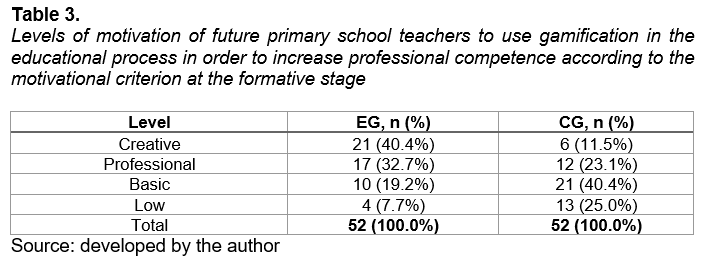
Having analyzed the results obtained at the formative stage in the EG and CG by the motivational criterion, we can state that the majority of the EG group respondents have a creative and professional level, and the CG respondents have a basic and low level of formation of the outlined phenomenon by this criterion, although their results have improved. This indicates a significant increase in the motivation of future primary school teachers in the EG to use gamification in the educational process.
The levels of formation of the motivation of future primary school teachers to use gamification in the educational process to increase professional competence, according to the content-activity criterion, at the formative stage of the pedagogical experiment are shown in Table 4.
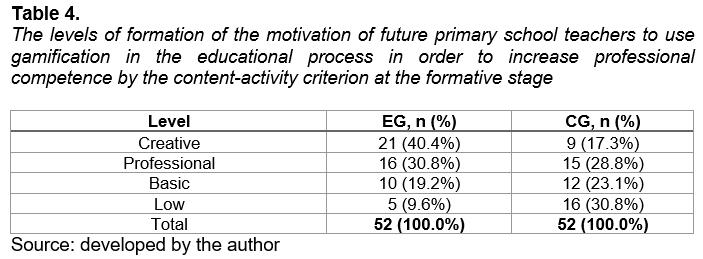
Having analyzed the results obtained at the formative stage in EG and CG according to the content-activity criterion, we can say that in EG, the majority of respondents are at the creative and professional levels. Among CG respondents, a low and basic level of formation of the described phenomenon prevails. However, we also observe a positive shift in CG.
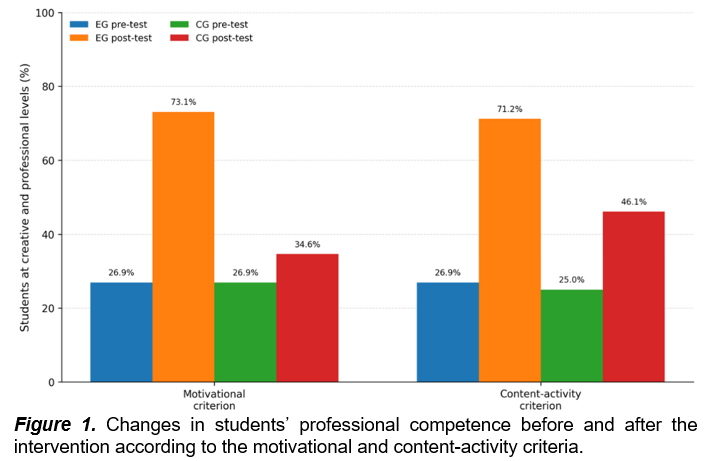
The comparative dynamics of the results obtained in the experimental and control groups demonstrate a substantial increase in the proportion of students who achieved creative and professional levels in the experimental group after the intervention. The changes in the control group were considerably less pronounced, confirming the effectiveness of the proposed pedagogical conditions and the systematic integration of gamification into the educational process. The average values of the formation indicators were calculated in the same way for EG and CG across all criteria, as in the ascertainment experiment.
The average values of the formation indicators were calculated for the EG and CG across all criteria in the same way as in the ascertainment experiment.
Although the results demonstrated a statistically significant improvement in students' professional competence following the implementation of gamification, these findings should be interpreted in light of several pedagogical challenges reported in previous studies. Researchers have noted that some students initially perceive game-based learning as less academically rigorous than conventional instruction, which may reduce motivation among learners who prefer traditional educational approaches. In addition, resistance to unfamiliar digital environments, differences in digital literacy, and concerns about excessive competition have been identified as potential barriers to successful implementation.
These challenges were also observed during the initial stage of the intervention, particularly among students who had limited prior experience with gamified learning environments. However, their influence gradually diminished as participants became familiar with the instructional format and recognized the educational value of game-based activities. To minimize these risks, gamification was integrated into the curriculum as a pedagogical strategy rather than as an independent instructional objective. Competitive elements were balanced with collaborative learning tasks, reflective activities, and continuous formative feedback, ensuring that learning outcomes remained the primary focus of the educational process.
Therefore, the positive outcomes obtained in this study should not be interpreted as evidence that gamification is universally effective in all educational contexts. Its pedagogical value depends on thoughtful instructional design, alignment with curricular objectives, students' digital readiness, and the balanced integration of motivational and cognitive learning activities. These considerations highlight the importance of adapting gamification to the characteristics of learners and institutional contexts rather than treating digital game elements as universally applicable educational solutions.
The findings of the present study are consistent with previous international research demonstrating the positive educational impact of gamification in higher education. In particular, the significant increase in students' motivation and professional competence observed in the experimental group confirms the conclusions of Lampropoulos and Sidiropoulos (2024), who reported that gamified learning environments produce higher academic performance than traditional instructional approaches.
Our findings also support the systematic review by Khaldi et al. (2023), which identified gamification as an effective strategy for enhancing student engagement and motivation in higher education. Similarly, the positive role of digital educational tools identified in this study corresponds to the results of Li et al. (2024), who demonstrated that learning engagement mediates the relationship between digital games and students' motivation. The present findings are further aligned with the conclusions of Sáez-López et al. (2022), who emphasized that successful implementation of gamification depends on appropriate pedagogical design and teacher preparedness. Moreover, our results support the observations of Vrcelj et al. (2023), who concluded that game-based learning promotes active participation, critical thinking, and learner-centred educational practices.
Unlike many previous studies that focused primarily on individual gamification tools or separate digital applications, the present research demonstrates the effectiveness of a comprehensive pedagogical system integrating digital platforms, collaborative learning, formative assessment, and structured pedagogical conditions within teacher education. Therefore, the study extends the existing evidence by showing that the systematic pedagogical integration of gamification contributes not only to higher student motivation but also to the development of professional competence among future primary school teachers.
Conclusions
This study confirmed the effectiveness of a pedagogically designed gamification approach for developing the professional competence of future primary school teachers in higher education. The findings demonstrated that integrating digital game-based strategies into the curriculum contributes to higher levels of student engagement, collaborative learning, reflective practice, and the acquisition of professionally relevant competencies. The statistically significant differences identified between the experimental and control groups after the intervention indicate that the proposed instructional model produced measurable educational benefits.
A key contribution of the study lies not in the use of individual digital applications but in the development of a coherent pedagogical framework that systematically integrates gamification into the educational process. The instructional design aligned digital tools with learning objectives, collaborative activities, formative assessment, and continuous feedback, ensuring that game elements functioned as instruments for achieving educational outcomes rather than as independent learning goals. This methodological approach reduced the risk of cognitive overload and supported the gradual development of students' professional competence.
The obtained findings are consistent with previous research highlighting the educational potential of gamification while also extending existing knowledge by demonstrating that its effectiveness depends primarily on pedagogically meaningful integration within the curriculum. At the same time, the study acknowledges that the successful implementation of gamification is influenced by students' digital readiness, teachers' methodological competence, and institutional support. Consequently, the positive outcomes should not be interpreted as universally transferable to all educational contexts without appropriate pedagogical adaptation.
The practical significance of the study lies in providing higher education institutions with an evidence-based model for integrating gamification into teacher education programmes. The proposed approach may be used to redesign professional training courses, improve student motivation, strengthen formative assessment practices, and foster the development of professional competencies required in contemporary digital learning environments.
Several limitations should be considered when interpreting the findings. The study was conducted within a single institutional context and focused on one field of teacher education, which may limit the generalizability of the results. Furthermore, the intervention evaluated short-term educational outcomes, whereas the long-term sustainability of competence development was not investigated.
Future research should examine the longitudinal effects of gamification on professional competence, compare the effectiveness of different gamification models across disciplines and educational levels, and investigate how individual learner characteristics, digital competence, and institutional factors moderate the educational impact of game-based learning strategies. Such studies would contribute to refining evidence-based approaches to the pedagogically meaningful integration of gamification in higher education.