
Artículo de investigación
Tecnologías digitales en la educación universitaria: Mejora de la competencia digital y la cultura digital de los estudiantes
Digital technologies in university education: Enhancing students' digital competence and digital culture
Recibido: · Aceptado: · Publicado:
Cómo citar: Koval, M., Barbashova, I., Kusiy, M., Rublova, N., & Koromysel, M. (2026). Digital technologies in university education: Enhancing students' digital competence and digital culture. Revista Eduweb, 20(3), 131–148. https://doi.org/10.46502/issn.1856-7576/2026.20.03.8
Resumen
La transformación digital de la educación superior requiere enfoques eficaces para desarrollar la competencia y la cultura digital del alumnado. El objetivo de este estudio fue evaluar la eficacia de un modelo pedagógico integrado, basado en tecnologías digitales contemporáneas y condiciones pedagógicas específicas, para el desarrollo de la competencia digital y la cultura digital de los estudiantes universitarios. Se empleó un diseño cuasiexperimental de métodos mixtos, que combinó métodos teóricos, empíricos y estadísticos. El estudio incluyó a 184 estudiantes universitarios, asignados equitativamente a un grupo experimental (n = 92) y a un grupo de control (n = 92). La intervención incluyó un curso especialmente diseñado sobre realidad aumentada, tecnologías en la nube, inteligencia artificial, gamificación, Google Glass y laboratorios virtuales, apoyado por un entorno de aprendizaje digital adaptativo, aprendizaje autodirigido guiado digitalmente y monitorización digital de las actividades educativas del alumnado. La cultura digital del alumnado se evaluó mediante criterios motivacionales, de contenido e información, y de actividad, antes y después de la intervención. Tras la implementación del modelo pedagógico, la proporción de estudiantes que alcanzaron un alto nivel aumentó en el grupo experimental del 3,3% al 55,4% en el criterio motivacional, del 5,4% al 57,6% en el criterio de contenido-información y del 5,4% al 56,5% en el criterio de actividad, mientras que las mejoras en el grupo de control fueron sustancialmente menores (19,6%, 13,0% y 26,1%, respectivamente). La prueba χ² de Pearson confirmó diferencias estadísticamente significativas entre los grupos después de la intervención. El estudio aporta un modelo pedagógico validado empíricamente que demuestra que la integración de tecnologías digitales innovadoras con apoyo didáctico específico mejora eficazmente la competencia digital y la cultura digital de los estudiantes en la educación superior.
Palabras clave: tecnologías digitales; educación universitaria; formación de estudiantes; alfabetización digital; cultura digital.
Abstract
The digital transformation of higher education requires effective approaches to developing students' digital competence and digital culture. This study aimed was to evaluate the effectiveness of an integrated pedagogical model based on contemporary digital technologies and targeted pedagogical conditions for developing university students' digital competence and digital culture. A mixed-methods quasi-experimental design was employed, combining theoretical, empirical, and statistical methods. The study involved 184 university students, equally assigned to an experimental group (n = 92) and a control group (n = 92). The intervention included a specially designed course on augmented reality, cloud technologies, artificial intelligence, gamification, Google Glass, and virtual laboratories, supported by an adaptive digital learning environment, digitally guided self-directed learning, and digital monitoring of students' educational activities. Students' digital culture was assessed using motivational, content-information, and activity criteria before and after the intervention. Following the implementation of the pedagogical model, the proportion of students achieving a high level increased in the experimental group from 3.3% to 55.4% for the motivational criterion, from 5.4% to 57.6% for the content-information criterion, and from 5.4% to 56.5% for the activity criterion, whereas improvements in the control group were substantially smaller (19.6%, 13.0%, and 26.1%, respectively). Pearson's χ² test confirmed statistically significant differences between the groups after the intervention. The study contributes an empirically validated pedagogical model demonstrating that integrating innovative digital technologies with targeted instructional support effectively enhances students' digital competence and digital culture in higher education.
Keywords: digital technologies; university education; student training; digital literacy; digital culture.
Introduction
The digital transformation of higher education has fundamentally changed the requirements for graduates' professional competencies. Universities are expected not only to integrate digital technologies into teaching but also to foster students' digital competence and digital culture, which are essential for effective learning, professional collaboration, and lifelong development. Consequently, identifying effective pedagogical approaches that support the systematic development of these competencies has become a priority for educational research.
Recent studies have demonstrated the educational potential of artificial intelligence, cloud computing, virtual and augmented reality, gamification, and learning management systems in improving student engagement and learning outcomes. However, most existing research investigates these technologies separately or focuses primarily on technological implementation rather than on their pedagogically integrated application. Moreover, relatively little empirical evidence is available regarding comprehensive pedagogical models that combine multiple digital technologies with specific instructional conditions and evaluate their effectiveness in developing students' digital competence and digital culture using controlled experimental designs. This methodological gap limits the generalizability of existing findings and the development of evidence-based recommendations for higher education institutions.
To address this gap, the present study evaluates the effectiveness of an integrated pedagogical model that combines innovative digital technologies with targeted pedagogical conditions to enhance university students' digital competence and digital culture. The study employs a mixed-methods quasi-experimental design to determine whether the proposed approach produces statistically significant improvements compared with traditional instructional practices. By providing empirical evidence for the effectiveness of this integrated model, the research contributes to the advancement of digitally transformed higher education and offers practical guidance for curriculum design and instructional innovation.
Literature Review
Existing studies consistently demonstrate that digital technologies improve learning engagement, accessibility, and educational outcomes. Digital communication platforms and social media facilitate knowledge exchange and professional networking, allowing students to access current disciplinary developments and participate in collaborative learning communities (Dietrich et al., 2020). Similarly, online learning environments, webinars, and distance education expand educational accessibility and support flexible learning pathways, particularly in international higher education contexts (Lytras et al., 2022). Virtual and augmented reality further strengthen experiential learning by enabling authentic simulations and multimodal instruction that improve conceptual understanding and practical skill acquisition (Philippe et al., 2020; Taherdoost & Madanchian, 2022).
Recent studies have shifted attention from individual digital tools toward integrated digital ecosystems. Smart educational environments supported by artificial intelligence, the Internet of Things, cloud computing, and big-data technologies improve institutional management, personalize learning, and optimize educational decision-making (García Camargo et al., 2025; Sherman et al., 2022). Likewise, mobile applications, simulation technologies, virtual laboratories, and remote monitoring systems create authentic learning experiences that facilitate professional skill development while reducing the gap between academic preparation and workplace requirements (Gómez-García et al., 2023; Jaramillo-Arévalo et al., 2023; Novoa-Echaurren et al., 2025). Cloud-based learning environments further enhance access to educational resources and support collaborative learning regardless of time and location constraints (Núñez-Solís et al., 2026; Rioseco-Pais et al., 2024; Sangrà et al., 2023).
Another important research direction concerns the application of artificial intelligence and gamification in higher education. AI-driven systems enable adaptive learning, automated assessment, and personalized instructional support, whereas gamification enhances students' motivation, engagement, and active participation in learning activities (Graham et al., 2023; Thomason, 2021). Similarly, augmented reality, Google Glass, and virtual laboratories provide immersive educational experiences that improve visualization, experimentation, and practical problem-solving (Palshkov et al., 2026; Pegalajar Palomino & Rodríguez Torres, 2023).
Despite these advances, previous studies reveal several important methodological and conceptual limitations. Most investigations evaluate individual digital technologies independently rather than examining their combined pedagogical implementation. Consequently, little empirical evidence exists regarding comprehensive instructional models integrating multiple digital technologies within a coherent pedagogical framework. Furthermore, research primarily evaluates technological effectiveness, whereas comparatively less attention has been devoted to understanding how integrated digital environments influence the simultaneous development of students' digital competence and digital culture through controlled experimental studies.
An additional limitation concerns the inconsistent use of key conceptual terms. Although the concepts of digital literacy, digital competence, and digital culture are frequently used interchangeably, they represent different levels of digital development. Digital literacy refers to the basic ability to locate, access, understand, and use digital information and technologies effectively. Digital competence extends beyond operational skills and encompasses the knowledge, critical thinking, ethical awareness, communication, problem-solving, and responsible use of digital technologies in academic and professional contexts. Digital culture represents the broadest construct, integrating digital competence with values, digital citizenship, collaboration, creativity, responsible online participation, and continuous adaptation to technological change. Thus, digital literacy constitutes the technological foundation of digital competence, whereas digital competence serves as the core component of digital culture.
The analysis of previous research indicates an emerging trend toward holistic digital transformation of higher education; however, a significant research gap remains regarding empirically validated pedagogical models that integrate contemporary digital technologies with targeted instructional conditions to develop students' digital competence and digital culture simultaneously. Addressing this gap, the present study proposes and experimentally validates an integrated pedagogical model combining augmented reality, cloud technologies, artificial intelligence, gamification, Google Glass, and virtual laboratories within a structured educational framework. By evaluating this model through a quasi-experimental design, the study contributes new empirical evidence supporting the effective development of students' digital competence and digital culture in higher education.
The aim of this study was to evaluate the effectiveness of an integrated pedagogical model based on contemporary digital technologies and targeted pedagogical conditions for developing university students' digital competence and digital culture.
Methodology
Research Design
The study employed a mixed-methods quasi-experimental design combining theoretical, empirical, and statistical approaches to evaluate the effectiveness of a system of pedagogical conditions for integrating digital technologies into the university educational process. The experimental research was conducted from 2023 to 2025 and consisted of four consecutive stages: analytical, diagnostic, formative, and analytical-generalizing.
Participants and Sampling
The study involved 184 undergraduate students enrolled in teacher education and related educational programmes at Ukrainian higher education institutions during the 2023–2025 academic years. Participants were selected using purposive sampling, as they were required to be enrolled in programmes where digital technologies constituted an integral component of professional training. The inclusion criteria were: (a) enrolment in the second to fourth year of study; (b) regular attendance of academic courses; (c) willingness to participate voluntarily; and (d) completion of both the pre-test and post-test assessments. Students who failed to complete the intervention or submitted incomplete assessment materials were excluded from the final analysis.
The participants were assigned to an experimental group (EG, n = 92) and a control group (CG, n = 92). Prior to the intervention, the equivalence of both groups regarding the initial level of digital competence and digital culture was confirmed using Pearson's χ² test, indicating no statistically significant baseline differences.
Research Methods
The study employed general theoretical methods, including the analysis, synthesis, comparison, and generalization of psychological-pedagogical, socio-philosophical, scientific, and methodological literature. Empirical methods included pedagogical observation, interviews, questionnaires, and pedagogical experimentation. Qualitative and quantitative analyses of students' learning outcomes were conducted to evaluate the effectiveness of implementing digital technologies and the proposed pedagogical conditions within the university educational process.
Procedure
The research was carried out in four stages.
Stage 1 – Analytical. The current state of digital technology implementation in higher education was examined. Educational programmes and course content were analysed, and professionally oriented learning activities were designed to support digital transformation.
Stage 2 – Diagnostic. The initial level of students' digital culture was assessed through observations and diagnostic procedures. Evaluation criteria, indicators, and levels of digital culture formation were established. The results demonstrated a predominance of the initial level in both the experimental and control groups.
Stage 3 – Formative. The experimental group studied the specially developed course "The Role of Augmented Reality (AR), Cloud Technologies, Artificial Intelligence (AI), Gamification, Google Glass, and Virtual Laboratories in Education and Professional Activities." During this stage, the developed pedagogical conditions were implemented, contemporary digital technologies were integrated into the educational process, and a digital educational environment was created to enhance students' digital literacy, competence, and culture.
Stage 4 – Analytical and Generalizing. The empirical data collected during the experiment were processed, compared, and interpreted to evaluate the effectiveness of the implemented pedagogical conditions and digital technologies.
Data Collection Instruments
Data were collected using a combination of complementary instruments designed to assess students' digital competence and digital culture from multiple perspectives.
The principal instrument was a structured questionnaire comprising 36 items, organised into three dimensions corresponding to the assessment framework: motivational (12 items), content-information (12 items), and activity (12 items). Responses were recorded using a five-point Likert scale ranging from 1 ("strongly disagree") to 5 ("strongly agree"). Higher scores indicated higher levels of digital competence and digital culture.
To complement the questionnaire data, structured pedagogical observation was conducted throughout the intervention using standardized observation protocols assessing students' engagement, collaboration, autonomous learning, and effective application of digital technologies during classroom and project activities. Semi-structured interviews with instructors were additionally used to triangulate the quantitative findings and obtain qualitative evidence regarding students' progress.
The questionnaire underwent content validation by a panel of five experts in educational technology and higher education pedagogy. Based on their recommendations, several items were linguistically refined to improve clarity and construct alignment. Prior to the main study, the instrument was piloted with 30 students who did not participate in the principal experiment. Internal consistency demonstrated satisfactory reliability (Cronbach's α = 0.89 for the overall scale), while reliability coefficients for the three dimensions ranged from 0.84 to 0.91, indicating high internal consistency.
Ethical Considerations
The research was conducted in accordance with internationally accepted ethical principles for educational research. Participation was entirely voluntary, and all students provided written informed consent before data collection. Participants were informed about the purpose of the study, confidentiality procedures, the anonymous processing of research data, and their right to withdraw from the study at any stage without academic consequences.
Results and Discussion
Organization and method of conducting a pedagogical experiment.
During the pilot survey, based on quantitative and qualitative analyses of the research results, a program of experimental work was developed to assess the effectiveness of the system's creation and the pedagogical conditions for the introduction of digital technologies into the university's educational process for the high-quality training of specialists.
Research and experimental work was carried out in 2023 – 2025. 184 students participated in the study.
The first stage of research and experimental work is analytical, focusing on the main problems in implementing digital technologies, designing the content of disciplines across all training cycles, and planning professionally oriented work with students.
The second stage is diagnostic, as the observation was carried out to evaluate the ways of introducing digital technologies and to determine, in the students' activities, the indicators of the formation of digital culture across all criteria.
The third stage of research and experimental work – was defined as a formative stage – the study of additional elements of the content of digitalization of education was introduced into the content of the educational process, the study by EG students of the special course "The role of augmented reality (AR), cloud technologies, artificial intelligence (AI), gamification, Google Glass glasses, virtual laboratories in education and professional activity" was organized and the implementation of the developed pedagogical conditions. As a result, a digital environment for the university was created, and awareness of digital values was raised by including students in organized educational and professional activities across various forms of digitalization.
The fourth stage – analytical and generalizing allows for the generalization of all empirical data, making an interpretation of the experiment and description, and formulating conclusions of the results of research and experimental work.
To achieve the goal of the experimental work – implementation of the system and pedagogical conditions of the outlined problem in the monitoring mode, the evaluation parameters are selected for the phenomenon under study – the criteria, indicators, and levels of manifestation of the formation of the digital culture of students are outlined.
We will describe the criteria and their indicators and show the results obtained at the ascertainment stage of the experiment for each criterion.
Motivational criterion.
Indicators – the presence of a stable internal motivation for the digitalization of education and the professional development of students' digital culture; awareness of the need in the professional field for continuous education of each individual; the ability to critically assess one's own achievements and engage in self-reflection.
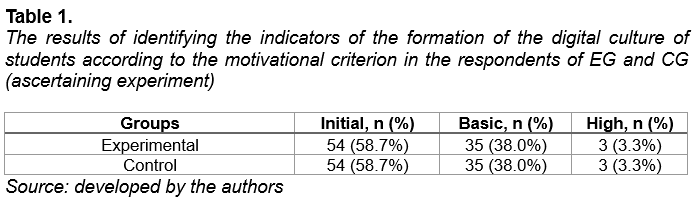
We see a clear predominance of the initial level among EG and CG students.
Content-information criterion.
Indicators: depth and scope of knowledge in the professional field, mastery of modern digital technologies for education and professional activity, ability to independently analyze professional literature, methods and techniques for forming digital culture;
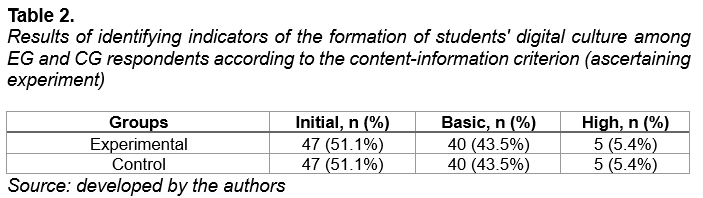
We see a clear predominance of elementary-level students of EG and СG.
Activity criterion.
Indicators: the ability to independently search for and process information, evaluate it critically, the ability to organize one's own process of educational and professional activity (time management, planning, self-control), and using various digital technologies and teaching methods.
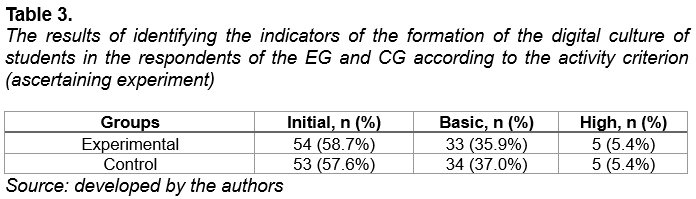
We see a clear predominance of the initial level among EG and CG students at the ascertaining stage of the study.
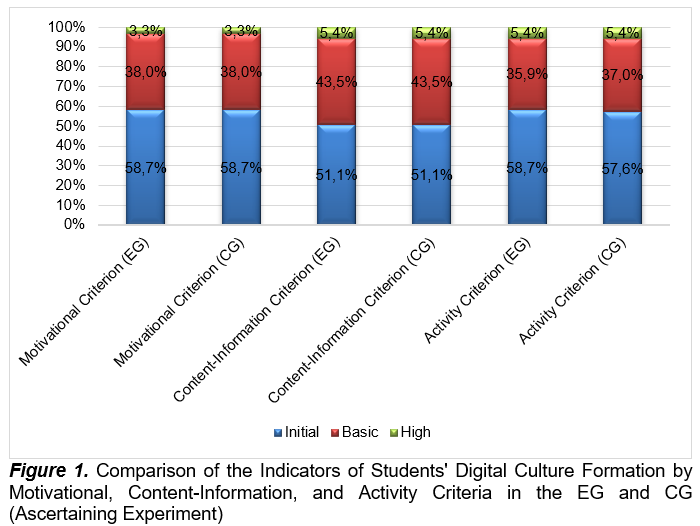
Before tracing the formation of digital culture at the formative stage of the research and experimental work among EG and CG respondents and the effectiveness of the pedagogical conditions for the formation of digital culture, let's check whether the selected EG and CG with the indicated levels of formation of the outlined phenomenon and distributions at the ascertaining stage of the experimental work can be analyzed as identical in composition and do not have truly statistically significant differences.
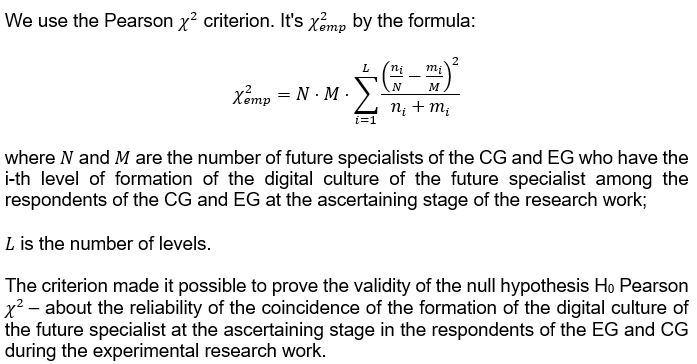
Let's characterize the hypotheses:
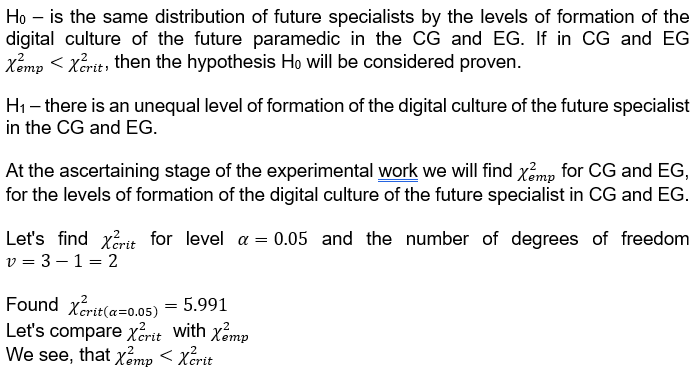
We conclude that the future specialists who participated in the experiment in the EG and CG are qualitatively the same.
Results of experimental work on the formation of the digital culture of future specialists in the process of professional training (formative stage). Having received at the ascertaining stage of the study a clear predominance of the initial level among EG and CG students, to qualitatively train specialists in the EG educational process at the formative stage of the study, we introduced developed pedagogical conditions, a special course, and digital technologies that created an innovative system for the development of digital literacy and competence among students:
- Reflection of the dynamics of development during the training of digital competencies.
- Visualization of the relationship between competency levels and educational components using automated software
- Implementation of specific examples of digital competencies in the university space, which makes training more accessible and interesting.
- Placement of methods for developing competencies in digital literacy among students.
- General characteristics of profile software.
In addition to the above-mentioned study, EG students were offered a special course “The role of augmented reality (AR) technology, cloud technologies, artificial intelligence (AI), gamification, Google Glass, virtual laboratories in education and professional activities”.
EG students mastered practical skills using interactive case-study technology in training mode. Students were offered:
- Study the impact of various educational technologies (for example, virtual reality and simulation learning) on the effectiveness of developing digital competencies in future specialists.
- Development of interdisciplinary training modules that integrate digital technologies into professional disciplines, with the aim of in-depth formation of digital professional skills.
- Study of specialists' expectations and needs regarding students' digital competence, and comparison with the results of studies at universities.
- Analysis of international experience in the professional field of preparing students to work in a digital environment.
- Studying the psychological aspects of introducing digital technologies into the university’s educational process and their impact on students’ motivation and interest in their chosen major.
- Developing and testing specific professional methods for assessing students’ digital competence at different stages of study.
In the higher education process, EG students used a variety of software products, tools, and online platforms. The most popular were the following:
- Platforms for exchanging documents and creating them (Microsoft 365 cloud computing platform) and tools for exchanging and storing data and working together.
- Educational activity management systems that allow students to create tasks and tests, online courses, provide reports, and track progress (Moodle system – open-source software).
- Platforms for conferences and video communication (Zoom and Skype).
- Programs for team collaboration and communication with messaging capabilities, video conferencing, virtual "whiteboards", etc. (Google Classroom, Kahoot, Google Forms, Classtime, Microsoft Teams, which can be used as a standalone product and integrated into Microsoft 365).
- Educational and training resources currently available on the Internet; learning management systems and online platforms for effective interaction between students and teachers, 24-hour access to educational material in asynchronous and synchronous modes, monitoring, effective control and assessment of student knowledge.
Teachers in the EG actively used webinars and virtual lectures, developed their own educational modules and interactive online courses.
In the innovative system created for training EG students, pedagogical conditions for developing digital literacy among students were developed and implemented.
Condition 1. Open adaptive information environment of the university, integrated for personalized learning with digital resources and platforms.
For the high-quality training of future specialists and the development of their digital literacy and competence, it is necessary to create an educational environment that ensures constant access to diverse, high-quality sources of professional information and promotes the development of individual students' educational trajectories.
In the context of such a pedagogical condition, we considered an open, adaptive educational environment as an integrated, flexible system of resources and services necessary to adapt to the educational needs of each future specialist and to support each student's independent cognitive activity.
The adaptability of the university's information environment suggests that it is not static but responds to students' individual characteristics and requests: the pace of material assimilation, the level of training, and the need for additional resources. This approach is achieved through systems (automated progress-monitoring systems, learning platforms with adaptive algorithms) that personalize the educational process.
The openness of the environment supports the principle of continuity of learning. It provides students with access to a range of external and internal resources, including scientific databases, professional online communities, digital libraries, and open educational courses.
Condition 2. Management of students' self-educational activities based on digital support. In the modern educational environment, students' self-educational activities cannot be effective without professional pedagogical support. Competent guidance provides the student with a gradual transition from external motivation to educational autonomy, to responsibility for their own development and self-reflection; it provides tutoring support, where the teacher performs the function of a coordinator: supports regular self-assessment, does not suppress the student's initiative, helps to plan, analyze, determine individual learning goals, and contributes to the correction of the educational trajectory.
Students' self-educational activities were implemented in the EG through video lectures, interactive platforms for accessing educational content, scientific articles, electronic textbooks, and professional protocols. The use of mobile applications and online testing allowed students to choose the pace of material processing, plan their own learning trajectory, and regularly assess their knowledge. Of particular value to EG students were personalized learning services, through which they could adapt their educational path based on their level of training and individual needs.
Collective self-educational activities have enhanced students' interaction and teamwork skills in a professional environment. In particular, this includes students' participation in online discussions, joint educational projects, virtual field excursions, and webinars, which contributed to the exchange of experience, the development of critical thinking, and the collective solution of the tasks set. Digital communication platforms (Google Workspace, Microsoft Teams, Zoom) have provided students with convenient ways to interact and to create an environment for professional, continuous communication.
Condition 3. Digital monitoring of students' educational activity. Modern digital technologies open up new opportunities for personalized support of students' educational and professional activities. The use of platforms for educational analytics, individual planning tools, electronic diaries, and artificial intelligence tools has significantly increased the effectiveness of tutoring support for students.
The introduction of automated monitoring systems made it possible to analyze students' behavioral parameters and record progress in mastering professional knowledge, including activity in educational modules, compliance with task deadlines, regularity of system logins, and participation in group discussions and forums. Such systems used educational analytics tools to collect and interpret data to form a holistic view of each student's dynamics in the educational process. Personalized feedback was a key element of such a system, which was based on established criteria for assessing the development of digital competence, not only the level of professional knowledge. This allowed each student to receive specific recommendations to eliminate the identified gaps in skills and knowledge and improve their own educational strategy. Integration of digital tools with educational communities for high-quality training of specialists turns the process of forming students' digital competence into a multi-vector one: the student actively participates in the creation and dissemination of knowledge and does not consume information in isolation, learning in a circle of like-minded people. This format of student interaction develops digital competence, social responsibility, academic competencies, the ability for professional mobility, and partnership cooperation.
The inclusion of students in creative, reflective digital activities in the implementation of the formative stage of experimental research using digital methods, developed pedagogical conditions, a special course, digital technologies that created an innovative system for the development of digital literacy and competence among students allowed us to observe positive manifestations of indicators of the formation of digital culture in the educational and professional activities of EG respondents. In CG, we observe minor positive changes.
Let us present the results of the formative stage of the study.
Motivational criterion.
Indicators – the presence of stable internal motivation for the digitalization of learning and the professional development of students' digital culture; awareness of the need for continuous learning in the professional sphere of each individual; the ability to critically assess one's own achievements and engage in self-reflection.
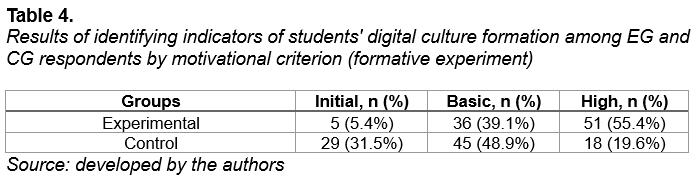
We see a clear predominance of high levels among EG students and a significant decrease in the initial level in EG. In the control groups, we observe no significant changes compared to EG.
Content-information criterion.
Indicators: depth and scope of knowledge in the professional field, mastery of modern digital technologies for education and professional activity, ability to independently analyze professional literature, methods and techniques for forming digital culture.
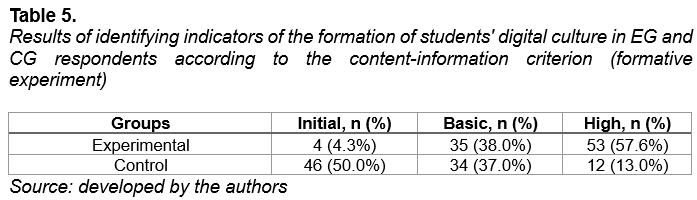
We see a clear predominance of high levels among EG students and a significant decrease in the initial level in EG. In the control groups, we observe no significant changes compared to EG.
Activity criterion.
Indicators: the ability to independently search, process information, critically evaluate it, the ability to organize one's own process of educational and professional activity (time management, planning, self-control); use of various digital technologies and teaching methods.
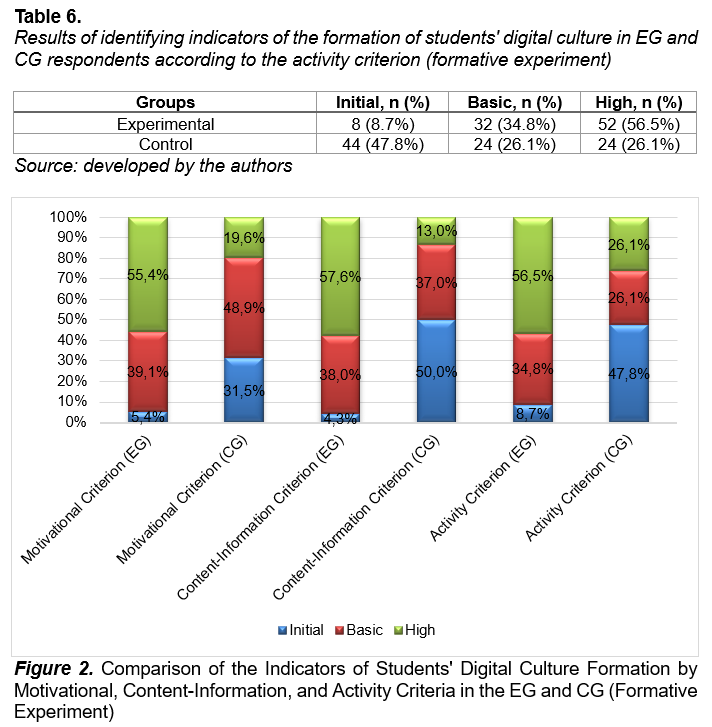
As a result of the formative experiment, we observe a clear predominance at a high level among EG students and a significant decrease from the initial level in EG. In the control groups, we observe no significant changes compared to EG.
The cross-sectional results on the level of digital culture formation among students in EG and CG at the formative stage of the experiment showed that quantitative changes occurred in the experimental groups.
The final diagnostics showed that changes occurred in EG towards an increase in the high level of students' digital culture.
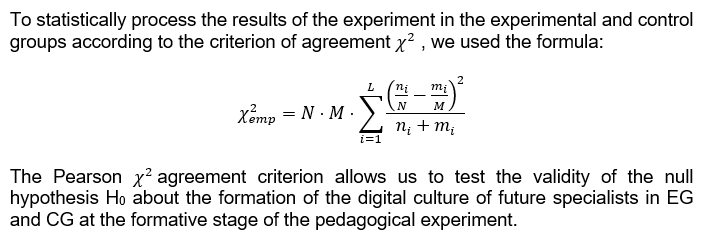
Let's characterize the hypotheses:

H1 assumes that the level of digital culture formation among students in EG and CG differs.
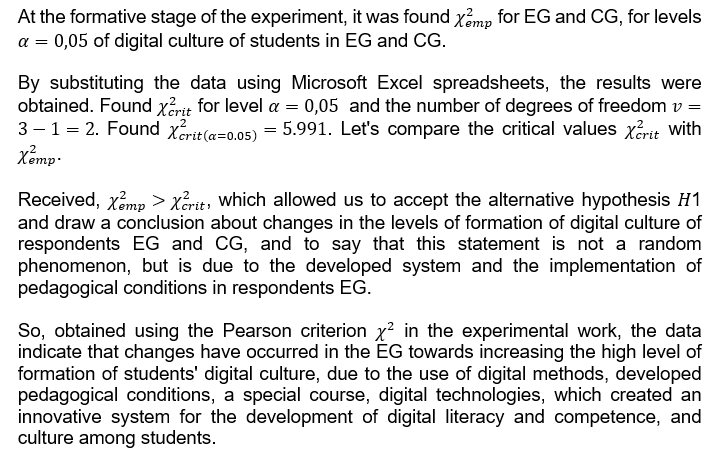
The findings demonstrate that the integrated pedagogical model significantly improved students' digital competence and digital culture across the motivational, content-information, and activity dimensions. Compared with the control group, students in the experimental group achieved substantially higher proportions of high-level performance after completing the intervention, indicating that combining multiple digital technologies with targeted pedagogical conditions is more effective than using conventional instructional approaches.
These findings are consistent with previous studies demonstrating that digital technologies increase student engagement and learning effectiveness. Graham et al. (2023) reported that comprehensive digital transformation strategies improve students' readiness for blended learning environments, while Pegalajar Palomino and Rodríguez Torres (2023) found positive relationships between systematic use of digital technologies and university students' digital competence. Likewise, Sangrà et al. (2023) emphasized that innovative digital methodologies promote autonomous learning and facilitate the acquisition of professional digital skills. The present findings extend this evidence by demonstrating that the greatest educational benefits emerge when digital technologies are implemented as components of an integrated pedagogical system rather than as isolated instructional tools.
The obtained results also support studies highlighting the educational potential of artificial intelligence, augmented reality, cloud technologies, and virtual laboratories. Previous research has shown that these technologies improve students' motivation, practical engagement, and conceptual understanding (Falloon, 2020; Gómez-García et al., 2023; Philippe et al., 2020; Taherdoost & Madanchian, 2022; Zhao et al., 2021;). However, unlike many earlier investigations that evaluated individual technologies separately, the present study examined their combined implementation within a structured pedagogical framework supported by adaptive learning environments, guided self-directed learning, and continuous digital monitoring. This integrated approach may explain the considerably larger improvements observed in the experimental group.
Some differences from previous studies should also be noted. Whereas many earlier investigations primarily assessed technological effectiveness or students' satisfaction with digital tools, the present research evaluated broader educational outcomes by simultaneously examining motivational, cognitive, and activity-related components of digital culture. This multidimensional assessment provides a more comprehensive understanding of students' digital development and demonstrates that sustainable improvements require not only access to digital technologies but also pedagogically structured learning experiences and systematic instructional support.
Several factors may explain the effectiveness of the proposed intervention. First, the combination of diverse digital technologies created authentic learning situations that encouraged active participation and collaborative problem-solving. Second, adaptive digital learning environments enabled students to regulate their own learning pace and receive individualized feedback. Third, continuous pedagogical support and digital monitoring strengthened students' motivation, self-regulation, and reflective learning, which are recognized as essential components of digital competence development.
From a theoretical perspective, this study contributes to the growing body of research advocating integrated models of digital transformation in higher education. Rather than conceptualizing digital competence as merely technological proficiency, the findings support a holistic understanding that incorporates motivational, cognitive, behavioural, and ethical dimensions of digital culture. The proposed pedagogical model therefore expands existing theoretical approaches by demonstrating how multiple digital technologies can function synergistically within a coherent educational framework.
The practical implications of the study are equally significant. Higher education institutions may apply the proposed pedagogical model when designing digitally enriched curricula, developing professional training programmes, and improving students' digital competence. The identified pedagogical conditions – including adaptive digital learning environments, digitally supported self-directed learning, and continuous digital monitoring – may also serve as practical guidelines for university instructors seeking to enhance student engagement and learning outcomes during digital transformation initiatives.
The originality of this study lies not in evaluating individual digital technologies, which has been widely addressed in previous research, but in experimentally validating a comprehensive pedagogical model that integrates multiple contemporary technologies within a unified instructional system. By combining artificial intelligence, augmented reality, cloud technologies, gamification, virtual laboratories, and structured pedagogical support in a quasi-experimental design, the study provides empirical evidence for an integrated approach to developing university students' digital competence and digital culture. This contribution addresses an important gap identified in previous literature and offers an evidence-based framework for future educational innovation.
Conclusions
This study demonstrated that the integration of contemporary digital technologies within a structured pedagogical model significantly enhances university students' digital competence and digital culture. Compared with conventional instructional practices, the proposed approach produced substantially greater improvements in the motivational, content-information, and activity dimensions of digital culture, confirming the effectiveness of combining adaptive digital learning environments, digitally supported self-directed learning, and continuous digital monitoring within a unified educational framework.
The principal scientific contribution of this research lies in the experimental validation of an integrated pedagogical model that combines artificial intelligence, augmented reality, cloud technologies, gamification, Google Glass, and virtual laboratories with targeted pedagogical conditions. Unlike previous studies that primarily examined individual digital technologies in isolation, this research demonstrates that their coordinated pedagogical integration produces more comprehensive improvements in students' digital competence and digital culture. Consequently, the study contributes new empirical evidence supporting holistic approaches to digital transformation in higher education.
The practical implications of the findings are significant for universities seeking to modernize educational programmes. The proposed pedagogical model may be adopted in curriculum design, teacher professional development, and institutional digital transformation strategies. Furthermore, the identified pedagogical conditions provide practical guidance for instructors aiming to foster students' digital competence through technology-enhanced, student-centred learning environments.
Several limitations should be acknowledged. The study was conducted within a limited number of Ukrainian higher education institutions using a quasi-experimental design; therefore, caution should be exercised when generalizing the findings to different educational systems or cultural contexts. In addition, the study evaluated learning outcomes immediately after the intervention and did not investigate the long-term sustainability of the observed improvements.
Future research should examine the long-term development of digital competence through longitudinal studies, validate the proposed pedagogical model across different academic disciplines and international educational contexts, and investigate the contribution of specific technologies, including generative artificial intelligence, immersive virtual reality, and learning analytics, to different components of students' digital competence and digital culture.