
Artículo de investigación
Tendencias innovadoras en la formación de futuros trabajadores sociales en el contexto de la transformación digital de la educación
Innovative trends in the training of future social workers in the context of the digital transformation of education
Recibido: · Aceptado: · Publicado:
Cómo citar: Teslenko, V., Sabat, N., Yashnyk, S., Bondarenko, H., & Zozuliak-Sluchyk, R. (2026). Tendencias innovadoras en la formación de futuros trabajadores sociales en el contexto de la transformación digital de la educación. Revista Eduweb, 20(3), 111–130. https://doi.org/10.46502/issn.1856-7576/2026.20.03.7
Resumen
El artículo describe los requisitos de la sociedad para la formación profesional de los trabajadores sociales en el contexto de la transformación digital. Se revelan el propósito, las características principales y los niveles de preparación de los futuros trabajadores sociales para las condiciones de la transformación digital de la educación. Se caracterizan las funciones y los principios didácticos básicos de la actividad profesional de los trabajadores sociales en las condiciones de la transformación digital de la educación. En la etapa experimental, implementamos el sistema desarrollado para desarrollar la preparación profesional de los futuros trabajadores sociales para las condiciones de la transformación digital en la educación mediante la creación de condiciones pedagógicas y un entorno educativo digital universitario. Para probar la hipótesis de investigación, utilizamos criterios no paramétricos estableciendo criterios paramétricos: criterio de Pearson, criterio F de Fisher, criterio t y análisis de correlación. En el punto de corte de determinación, los estudiantes en los grupos de control y experimental estaban aproximadamente en el mismo nivel de preparación descrita; Tras realizar un trabajo experimental en el grupo experimental, observamos mejores resultados y concluimos que el nivel de los estudiantes aumenta significativamente al implementar un sistema experimental para formar la preparación profesional de los futuros trabajadores sociales para las condiciones de la transformación digital de la educación, mediante el desarrollo de condiciones pedagógicas y la creación de un entorno educativo digital en la universidad.
Palabras clave: tendencias innovadoras; formación de trabajadores sociales; transformación digital de la educación; entorno educativo digital de la universidad; recursos digitales.
Abstract
The article outlines society's requirements for the professional training of social workers in the context of digital transformation. The purpose, main features, and levels of readiness of future social workers for the conditions of digital transformation of education are revealed. The functions and basic didactic principles of the professional activity of social workers in the conditions of digital transformation of education are characterized. At the experimental stage, we implemented the developed system to develop the professional readiness of future social workers for the conditions of digital transformation in education by creating pedagogical conditions and a university's digital educational environment. To test the research hypothesis, we used non-parametric criteria by establishing parametric criteria: Pearson's criterion, Fisher's F-criterion, t-criterion, and correlation analysis. At the ascertaining cut, students in the control and experimental groups were at approximately the same level of outlined readiness; after conducting experimental work in the experimental group, we see higher results, and we conclude that the level of students significantly increases when implementing an experimental system for forming professional readiness of future social workers for the conditions of digital transformation of education, by developing pedagogical conditions and creating a digital educational environment of the university.
Keywords: innovative trends, training of social workers, digital transformation of education, digital educational environment of the university, digital resources.
Introduction
The changes that have occurred in society in recent years are accompanied by numerous social, political, and economic problems that, to some extent, affect the life of a person who is sensitive to functional and structural transformations and fully reproduces all aspects of society. The rapid development of social education has become a response to the demands of the time, which, by its content and essence, through the performance of a preventive, anticipatory function of preparing each member of society for life, is designed to ensure the social security of society in a period of change and to ensure the upbringing and training of a person oriented towards professional activity in the social sphere (Bjerregaard et al., 2018; Joiner, 2019).
In the context of the digital transformation of education, the requirements for professional training of social workers are increasing, which is caused by the modernization of higher education, the introduction of innovative trends in the training of social workers, an increase in the number of categories of the population that, in the context of the digital transformation of education, need social protection, socio-economic changes in society (Pinazo-Hernandis & Carcavilla-González, 2026).
The purpose of professional training for future social workers in higher education institutions is to create an optimal educational and digital environment for the professional and personal formation of the future specialist and to assess the adequacy of the level of professional training for the future workplace (Chiner et al., 2022; Pérez-Durán et al., 2025).
The main feature of the professional readiness of social workers is the ability to address innovative trends in training, complex, specialized tasks under the conditions of the digital transformation of education, and practical problems in the field of professional activity or in the learning process that involve the use of innovative pedagogical conditions. The professional activity of a social work specialist consists of implementing general functions by making operational decisions within their competence; introducing digital technologies for operational, organizational, and heuristic work procedures; and preparing information for the professional activity program (Chakradhar, 2018; Correa Arias & García Híjar, 2021).
The development of digital technologies and the growing demand for higher education today are stimulating the emergence of a new type of mega-university and a network of universities without borders. Modern society sets new and innovative requirements for the professional qualities and personality of a social work specialist. Digitalization, while affecting various aspects of training, changes educational processes, which is especially relevant in the context of reform and decentralization of the social service provision system.
High-quality education in the modern conditions of a digital society is a key guarantee of the realization of social workers' intellectual potential, an indicator of the level of training in higher education, and a factor in their professional competitiveness. A graduate who is preparing to master the profession of a social work specialist must have digital competencies, not only deep subject knowledge, but also the ability to effectively use digital transformations of education and online services in the educational process. Digitalization plays an important role in transforming the educational process, as modern society requires the education sector to use digital tools for learning and to provide convenient access to knowledge through social networks and online platforms for communication, knowledge exchange, and collaboration (Halász, 2018).
Despite the growing integration of digital technologies into higher education, the preparation of future social workers remains largely focused on traditional professional competencies, while the systematic development of digital readiness for professional practice has received insufficient empirical attention. Existing studies primarily examine individual aspects of digital competence, ICT use, or digital literacy among social work students; however, limited evidence exists regarding comprehensive pedagogical systems that combine pedagogical conditions with a university digital educational environment to develop professional readiness for digital transformation.
Furthermore, previous research has predominantly described the importance of digital technologies in social work education without experimentally evaluating their effectiveness through structured pedagogical interventions. Consequently, there remains a lack of empirically validated models capable of improving future social workers' motivational, cognitive, and activity readiness for professional practice in digitally transformed educational contexts.
Addressing this research gap is important because higher education institutions require evidence-based approaches that can effectively prepare future social workers to meet the challenges of digitalized professional practice while supporting the modernization of social work education.
The aim of this study was to evaluate the effectiveness of a pedagogical system designed to enhance the professional readiness of future social workers for the digital transformation of education by implementing evidence-based pedagogical conditions and establishing a university digital educational environment. Specifically, the study sought to determine whether the proposed intervention significantly improves students' motivational, cognitive, and activity readiness compared with traditional educational practices.
Literature Review
The digital transformation of higher education has substantially changed the professional preparation of social workers, requiring graduates to possess not only disciplinary knowledge but also advanced digital, collaborative, and problem-solving competencies. Although previous studies consistently acknowledge the growing importance of digital technologies in social work education, they differ considerably regarding the pedagogical approaches considered most effective for developing these competencies.
Several researchers agree that digital competence has become an essential prerequisite for successful professional practice. López Peláez et al. (2020) demonstrated that a substantial gap persists between the digital skills required in contemporary social work and the actual competencies of both students and practicing professionals. Similarly, Gómez-Poyato et al. (2022) found that although university students are often considered "digital natives," their technological proficiency does not automatically translate into professional digital competence. These findings consistently indicate that digital literacy develops through structured educational experiences rather than through everyday technology use alone.
A similar conclusion is presented by Kamrujjaman et al. (2023), whose systematic review emphasizes that professional readiness depends on the integration of theoretical knowledge with practical experience, critical thinking, and evidence-based decision-making. Likewise, Joiner (2019) argues that digital transformation should be accompanied by ethical and responsible use of digital technologies, highlighting digital ethics as an indispensable component of professional education. Collectively, these studies support the need for comprehensive educational strategies rather than isolated digital skills training.
Despite this general consensus, researchers differ regarding the most effective pedagogical mechanisms for developing professional readiness. Winardy and Septiana (2023) emphasize game-based learning and role-playing as effective approaches for developing communication and decision-making skills, whereas Pérez-Durán et al. (2025) highlight active learning and educational games for strengthening professional engagement and collaborative problem-solving. In contrast, Lichtenberger-Majzikné and Fischer (2017) consider reflective practice and feedback mechanisms to be the primary drivers of professional competence development. These differing perspectives suggest that no single instructional strategy is sufficient to address the multidimensional nature of professional readiness in digitally transformed educational environments.
Another unresolved issue concerns the conceptualization of digital competence itself. Some studies primarily treat digital competence as technological proficiency and ICT literacy (Gómez-Poyato et al., 2022), whereas others define it more broadly by incorporating communication, collaboration, ethical decision-making, lifelong learning, and professional adaptability (Joiner, 2019; López Peláez et al., 2020). This conceptual inconsistency complicates the comparison of empirical findings and limits the development of standardized approaches to evaluating professional readiness. The study by Pradeep and Sathyamurthi (2017) is devoted to the work of social workers with the community. The professional activities of social workers are revealed, seeking to encourage the vitality of families, individuals, and communities and to create positive change. The authors consider the work of a social worker to be such that society changes for the better, that the work itself benefits the community, and that it is full-fledged for those who need it.
Furthermore, the majority of previous investigations have adopted descriptive, survey-based, or cross-sectional research designs that identify competency deficits without experimentally testing educational interventions capable of addressing them. Although existing research convincingly demonstrates the importance of digital technologies in social work education, considerably less attention has been devoted to evaluating integrated pedagogical systems that combine pedagogical conditions, institutional digital environments, and structured instructional interventions within controlled educational settings.
Therefore, a significant research gap remains regarding the experimental validation of comprehensive pedagogical models designed to improve future social workers' professional readiness for digital transformation. Specifically, there is insufficient empirical evidence concerning the effectiveness of integrating pedagogical conditions with a university digital educational environment in simultaneously developing motivational, cognitive, and activity components of professional readiness.
The present study addresses this gap by experimentally evaluating a comprehensive pedagogical system implemented within higher education institutions. Unlike previous descriptive investigations, this research examines whether the integration of targeted pedagogical conditions and a digitally enriched educational environment produces statistically significant improvements in the professional readiness of future social workers for practice in digitally transformed educational contexts.
Methodology
Research Design
This study employed a quasi-experimental mixed-methods research design to evaluate the effectiveness of a pedagogical system aimed at developing the professional readiness of future social workers for the digital transformation of education. The research combined quantitative methods to measure changes in students' readiness levels and qualitative methods to obtain a deeper understanding of participants' learning experiences during the intervention.
The experimental design included two parallel groups: an experimental group that participated in the developed pedagogical intervention and a control group that continued studying according to the traditional curriculum. Measurements were conducted before and after the intervention using identical assessment procedures, enabling the comparison of learning outcomes between groups.
Participants
The study involved 189 undergraduate students majoring in Social Work from higher education institutions in Ukraine. Participants were divided into an experimental group (EG, n = 98) and a control group (CG, n = 91). Students were enrolled in comparable educational programmes and had similar academic backgrounds. Before the intervention, no statistically significant differences were observed between the groups regarding their overall level of professional readiness, confirming the comparability of the samples.
Participation in the research was voluntary. All participants were informed about the objectives of the study and provided informed consent before data collection.
Assessment Framework
Professional readiness for work under conditions of digital transformation was conceptualized as a multidimensional construct consisting of three interrelated components:
- Motivational component – students' professional motivation, readiness for continuous professional development, openness to educational innovation, and positive attitudes toward digital transformation.
- Cognitive component – theoretical knowledge of digital technologies, digital educational resources, ICT integration, digital communication, and contemporary approaches to social work education.
- Activity component – practical skills in applying digital technologies, collaborative online work, digital communication, problem-solving, and implementation of digital educational tools in professional practice.
For each component, corresponding criteria, indicators, and three levels of readiness (high, medium, and low) were established before the experiment.
Research Instruments
Data were collected using complementary quantitative and qualitative instruments.
The principal quantitative instrument was a structured questionnaire designed according to the three-component model of professional readiness. The questionnaire assessed motivational attitudes, theoretical knowledge, and practical digital competencies using standardized rating scales.
The questionnaire was supplemented by pedagogical observation, semi-structured interviews, diagnostic surveys, and criterion-based achievement tests. Pedagogical observation focused on students' engagement, collaboration, digital communication, and participation in technology-supported learning activities throughout the intervention. Interviews provided qualitative evidence regarding students' perceptions of digital learning and professional development.
Content validity of the assessment instruments was established through expert review involving specialists in pedagogy, digital education, and social work. Prior to the main experiment, the instruments were piloted with a separate group of students to evaluate clarity, comprehensibility, and feasibility of administration. Necessary revisions were introduced following expert recommendations and pilot feedback.
The use of several complementary instruments enabled methodological triangulation and increased the credibility of the findings.
Educational Intervention
The pedagogical intervention was implemented only in the experimental group throughout the formative stage of the study. The intervention integrated four interconnected pedagogical conditions:
- Creation of an innovative university digital educational environment.
- Organization of collaborative interaction between teachers and students through digital technologies.
- Support of students' continuous professional self-development in a digital learning environment.
- Modernization of instructional methods through the integration of innovative digital technologies.
The intervention incorporated learning management systems, online educational platforms, multimedia learning resources, videoconferencing, cloud-based collaboration tools, digital assessment instruments, electronic educational materials, virtual learning environments, research-oriented learning, project-based activities, collaborative problem-solving, and interactive communication technologies.
Students in the control group completed the same academic programme but without implementation of the experimental pedagogical system.
Data Analysis
Quantitative data were analysed using IBM SPSS Statistics.
Descriptive statistics (frequencies, percentages, means, and standard deviations) were calculated to describe participants' readiness levels.
Pearson's chi-square (χ²) test was applied to compare the distribution of readiness levels between the experimental and control groups. Student's t-test was used to evaluate differences in continuous variables where appropriate, while Fisher's criterion was applied to verify the significance of experimental effects. Statistical significance was established at p < .05.
Qualitative data obtained from interviews and pedagogical observations were analysed using thematic analysis and were used to complement the quantitative findings.
Validity and Reliability
Several procedures were employed to enhance the methodological rigor of the study. Internal validity was supported through identical assessment procedures for both groups, standardized implementation of the intervention, and equivalent learning conditions except for the experimental treatment.
Content validity was ensured through expert evaluation of the research instruments. Methodological triangulation was achieved by combining questionnaires, interviews, observations, and achievement tests. Pilot testing confirmed the clarity and applicability of the instruments before the main study.
Reliability was strengthened by using standardized data collection procedures, consistent assessment criteria, identical testing conditions, and statistical verification of the obtained results.
Ethical Considerations
The research complied with the ethical principles governing educational research. Participation was voluntary, informed consent was obtained from all participants, confidentiality of personal information was maintained throughout the study, and all collected data were anonymized prior to statistical analysis. Participants were informed that they could withdraw from the study at any stage without academic consequences.
Results and Discussion
In the process of the study, we identified two groups of future social workers who participated in the experiment to determine the level of their professional readiness for the conditions of digital transformation of education (CG, EG):
- The control group (CG), which included such future social workers that the process of their professional training was not subject to changes (for the final experiment as a standard for comparison);
- The experimental group (EG), which included future social workers, was subject to a process of professional training that was pedagogically and experimentally influenced, that is, the implementation of an experimental system for forming the professional readiness of future social workers for the conditions of digital transformation of education, by developing pedagogical conditions and creating a digital educational environment of the university.
The number of participants in the experiment was 98 in the EG and 91 in the CG.
We identified the components, criteria, and indicators of the readiness of future social workers:
Motivational component. Main criteria: motivation, tolerance, initiative. Indicators: aspirations, interests, orientation, awareness, attitude, need, recognition.
Cognitive component. Main criteria: Psychological-pedagogical and socio-pedagogical knowledge in the field of social work and digital transformation of education. Indicators: level of special knowledge, level of basic knowledge.
Activity component. Main criteria: mastering the methodology for forming professional readiness by future social workers in the conditions of digital transformation of education and creating a digital educational environment. Main indicator: skills.
Organization of the ascertaining stage of experimental research.
At the ascertainment stage of the study, a survey, an interview, and a questionnaire were conducted. Based on the results obtained, conclusions were drawn regarding the level of formation of the motivational component of readiness:
1. Future social workers:
- Do not realize the significance and necessity of developing skills and abilities to implement an experimental system for building professional readiness for the conditions of digital transformation of education, by developing pedagogical conditions and creating a digital educational environment with parents, communities, and individuals.
- Do not show a desire for self-improvement and professional growth in inclusive education.
- Perform an objective self-assessment of the ability to select effective forms, methods, techniques, and means of interaction with parents in inclusive education.
- Do not show interest in or concern for interaction with parents under the conditions of the digital transformation of education.
2. At the same time, future social workers realize what pedagogical conditions their professional training depends on.
The application of the Pearson criterion in the process of the ascertaining stage of the experiment showed the following results of the level of formation of the motivational component of the readiness of future social workers to the conditions of the digital transformation of education:
- Low level of readiness of future social workers in 60.8% of students.
- Average level of readiness of future social workers in 27.0% of students.
- High level of readiness of future social workers in 12.2% of students.
The data presented indicate a low and average level of formation of the motivational component under the conditions of the digital transformation of education and underscore the need to implement an experimental system.
The next stage of the study (the ascertaining stage) was to identify the state of formation of the cognitive component of the readiness of future social workers to the conditions of the digital transformation of education in accordance with the specified criteria and indicators. For this, we developed control and test questions.
The following results of the ascertaining section were obtained:
- Low level of readiness of future social workers in 52.4% of students.
- Average low level of readiness of future social workers 34.4% of students.
- High level of readiness of future social workers 13.2% of students.
The data presented also indicate the prevalence of low and average levels of cognitive component formation among future social workers in the context of the digital transformation of education and underscore the need to implement an experimental system.
At the next stage of the ascertaining experiment, we clarified the state of formation of the activity component of readiness of future social workers to the conditions of digital transformation of education.
The following results of the ascertaining section were obtained:
- Low level of readiness of future social workers – 51.3% of students.
- Average low level of readiness of future social workers – 34.4% of students.
- High level of readiness of future social workers – 14.3% of students.
The data presented in the ascertaining section indicate the predominance of low and average levels in the formation of the activity component of readiness among future social workers in the context of the digital transformation of education and underscore the need to implement an experimental system.
The next parameter investigated in the ascertaining experiment was the speed of task completion. Methods of mathematical statistics were used at this stage.
The relative costs of training time (t*) were determined using the formula:

Relative costs of learning time – a value that is inverse to the coefficient of mastering the activity and is reflected in the corresponding scale.
The high cost of learning time t* is demonstrated by experimental data.
The next parameter determined in the ascertaining experiment was the number of options for methods and forms of interaction proposed by future social workers in the conditions of digital transformation of education. The relative creativity indicator was used:
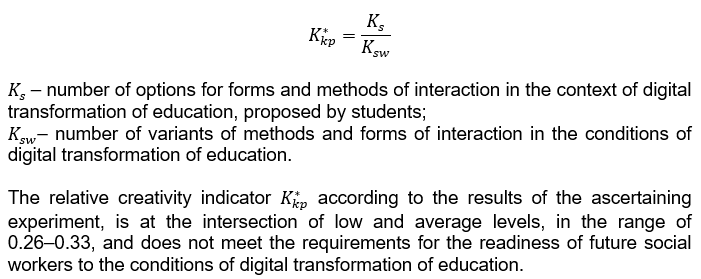
The relative creativity indicator according to the results of the ascertaining experiment, is at the intersection of low and average levels, in the range of 0.26–0.33, and does not meet the requirements for the readiness of future social workers to the conditions of digital transformation of education.
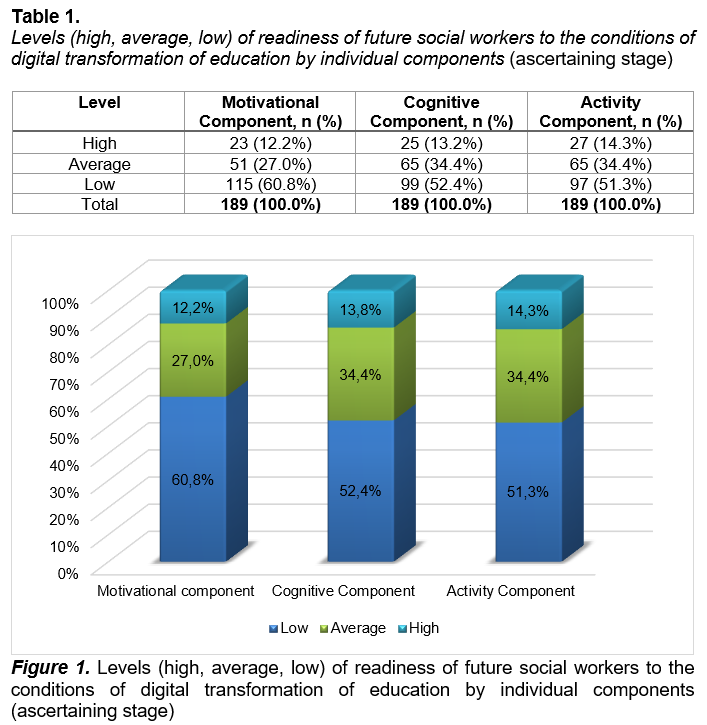
The generalization of the measurement results at the ascertaining stage of the study indicates the ineffectiveness of the traditional organization of professional training of future social workers in higher education institutions in terms of the formation of the components we are studying.
Taking into account the rapid development of the social sphere, innovative trends in the training of social workers in the context of the digital transformation of education, there is a need for a clear awareness of the possibilities of the educational digital space of higher education institutions in order to implement professional training that will allow the field of social work to integrate innovative conditions, means, and resources to ensure the innovation of education.
For these reasons, we created an innovative digital educational environment that was implemented in EG students’ work. We provided a significant increase in the effectiveness of social worker training and optimal productivity for all participants in educational activities. The creation and functioning of a digitally innovative educational environment for training in higher education institutions for social workers reflected the digital and social nature. They incorporated educational innovations to improve the educational process.
In the experimental study, we consider the innovative digital educational environment of the university as a set of digital resources that actualizes innovative tools necessary for EG students in order to improve their professional activities, scientifically and methodologically support the training of future specialists, by introducing digital technologies into the educational environment, such as electronic platforms, video conferences, video lessons, document sharing, systems for tracking academic achievements, virtual laboratories, and the creation of a virtual (digital) educational.
The creation of such a digital educational environment is the primary pedagogical condition for high-quality, innovative training of future social workers.
The emergence of a special content of interaction between teachers and future social workers is defined as the second pedagogical condition for high-quality and innovative training.
The influence of the individual's continuous professional development on the creation of an innovative digital educational environment at the university and its further effective functioning is the third significant pedagogical condition that leads to a qualitative improvement in the digital educational process for training specialists.
Methodological and organizational-structural improvement of the educational process and teaching, which is manifested in the university educational environment, is the fourth significant pedagogical condition introduced, alongside the previous pedagogical conditions in the educational process of the EG.
Using the innovative trends in the training of social workers in the EG, we have built an educational environment in the university space and integrated research into the process of professional training directly in the conditions of the digital transformation of education, such as:
- Formation of teaching techniques and research skills, which is focused on research (research-oriented learning).
- Involvement of students in the scientific search for innovations in teaching and research, which are based on research (research-based learning).
- Familiarization of students with the results of modern research when studying professional disciplines − research-led learning.
- Student involvement in scientific discussions, essay writing, and training is carried out under scientific guidance (research-tutored learning).
We will describe the process of training social workers in the context of the digital transformation of education and the key changes that have occurred in the organization of the educational process at EG as a result of the digitalization of the higher education environment.
- The use of digital technologies (video lessons, online platforms, electronic textbooks) provided EG students, regardless of their location, with access to educational materials.
- The formation of an educational open space for training social workers, where ideas and information were exchanged between all participants in the educational process – students, teachers, parents, allowed the exchange to take place at a fast pace and effectively.
- Digital technologies changed teaching methods and enabled the introduction of interactive teaching methods in the training of social workers (use of multimedia resources, project-based learning, collective research), which contributed to the development of critical thinking and increased involvement of EG students in the educational process.
- The development of innovative work skills enabled future social workers of the EG to critically evaluate information sources and solve research and practical tasks.
- The use of learning management systems (LMS), electronic journals, and other digital tools enabled social workers to implement technologically innovative solutions for organizing the digital educational process and to optimize educational and administrative processes.
- The use of analytical platform tools by teachers enabled continuous monitoring of teaching quality during the training of social workers, allowing timely adjustments and analysis of the effectiveness of educational practices in accordance with social workers' educational needs.
As part of our study, we will address the mechanisms of digitalization in higher education, in which the university's educational environment is perceived as a tool for influencing the personal development of social workers and for shaping a subject in the field of social work during professional activity. Therefore, such an environment was designed to support the personal growth and professional development of social workers.
Since the innovative educational digital environment is a structural component of modern higher education, we have meaningfully presented a new structure in the EG with the following characteristics:
- Openness for the dynamic growth of social and professional development of the individual in social partnership.
- To ensure the dynamism of the educational process, the presence of innovative elements is crucial.
- To ensure the effectiveness of the educational and professional process, it is important to adhere to the principles for developing an innovative digital educational environment in the 21st century.
- The presence of strategies for creating a digital educational environment that includes assessment, feedback, and appropriate educational leadership.
Focusing on the structure of the digital educational environment for training social workers, the EG believed that the conditions for its creation in higher education may be:
- The use of innovative digital technologies.
- Taking into account the trust and respect of all participants in the educational process and partnership cooperation.
- Work in a search-creative mode.
- Focusing on the development of social workers and the self-development of each individual.
- Effective use of the material, technical, scientific, methodological, and personnel capabilities of higher education.
We note that new opportunities for improving education in the university space are opened by the development of AI and machine learning, simulated pedagogical situations, automation of administrative processes; ensuring the mobility of information and communication activities of future social workers; development of virtualization and cloud computing technology (creation of virtual laboratories); development of new augmented reality functions; widespread introduction of chatbots; active use of platforms for distance learning and resources for digital literacy of the population; increasing the digital competencies of social workers (use of social networks and their teaching methods), which was introduced into the educational process of EG. Moreover, it has been shown that digitalization offers new learning opportunities, particularly through interactive platforms, distance learning formats, and electronic textbooks, thereby making the educational process more accessible and flexible.
Methodology and results of the formative stage of research and experimental work.
At the stage of experimental work, we implemented the developed system to form the professional readiness of future social workers for the conditions of digital transformation in education by developing pedagogical conditions and creating a digital educational environment at the university.
The purpose of the formative experiment is to implement the developed author's system by developing pedagogical conditions and creating a digital educational environment of the university.
The stages of our research have the following chronology:
- The first stage is a theoretical study of the experience of practice regarding the outlined problem: characterization of the research problem, definition of methodological tools, research bases, and analysis of scientific sources.
- The second stage is a research program that defines criteria, indicators, and levels of students' readiness for the conditions of digital transformation in education.
- The third stage is data processing of the pedagogical experiment: the development of the author's system and its testing in the process of education in higher education institutions. Conducting a formative experiment.
- The fourth stage is data generalization and analysis of the work carried out; justification of the identified pedagogical conditions for preparing future social workers for the digital transformation of education, through the development of pedagogical conditions and the creation of a digital educational environment at the university.
Analysis of the data from the ascertaining experiment we conducted to determine the levels of readiness of future social workers for the conditions of digital transformation of education, by developing pedagogical conditions and creating a digital educational environment of the university, indicates that they are subject to the objective law of data distribution. Therefore, to test the study's hypothesis, we used non-parametric criteria and established parametric criteria: Pearson's criterion, Fisher's F-criterion, t-criterion, and correlation analysis.
In general, the indicators and criteria for the readiness of the described phenomenon are similar to those of the ascertaining experiment, as is the procedure for measuring them.
In order to ensure the validity and reliability of obtaining experimental data, several scientific and methodological measures were used:
1. The reliability of our study in obtaining experimental data is ensured by using standardized research methods that include strict procedures for monitoring the training of future specialists.
2. The reliability of the obtained data is ensured by equalizing the conditions for conducting experimental work on implementing pedagogical conditions and creating the university's digital educational environment.
3. The validity of the obtained data is ensured by the fact that the influencing factors in the experimental groups (EG) and control groups (CG) were the same, with the only exception being the implementation of the experimental system, pedagogical conditions, and the creation of a digital educational environment of the university.
So, at the stage of the formative experiment, according to the indicators of the level of formation of the motivational component of the readiness of future social workers of the EG to the conditions of the digital transformation of education, obtained as a result of applying the Pearson criterion (consistency criterion x²), we can talk about positive results in the EG:
- Low level of readiness in the EG of future social workers in 5.1% of students.
- Average low level of readiness of future social workers in 16.3% of students.
- High level of readiness of future social workers in 78.6% of students.
The data presented indicate a high level of formation of the motivational component in the EG under the conditions of the digital transformation of education and demonstrate the effectiveness of the implemented experimental system.
The next stage of the study (formative stage) was to identify the state of formation of the cognitive component of the readiness of future social workers to the conditions of the digital transformation of education in accordance with the specified criteria and indicators.
The following results of the formative section were obtained:
- Low level of readiness of future social workers in 12.2% of students;
- Average level of readiness of future social workers in 19.4% of students;
- High level of readiness of future social workers in 68.4% of students.
The data presented also indicate the prevalence in the EG of a high level of formation of the cognitive component of readiness among future social workers for the conditions of digital transformation of education and demonstrate the effectiveness of the implemented experimental system.
At the next stage of the formative experiment, we clarified the state of formation of the activity component of readiness of future social workers to the conditions of digital transformation of education.
The following results of the formative section were obtained:
- Low level of readiness of future social workers in 9.2% of students.
- Average level of readiness of future social workers in 11.2% of students
- High level of readiness of future social workers 79.6% of students.
The data from the formative section indicate a high level of development of the activity component of the readiness of future social workers for the conditions of the digital transformation of education in the EG and demonstrate the effectiveness of the implemented experimental system. In the CG, we do not observe a significant increase in the effective data.
To confirm and verify the effectiveness of the experimental work carried out, the Student coefficient was applied, which was calculated by the formula:
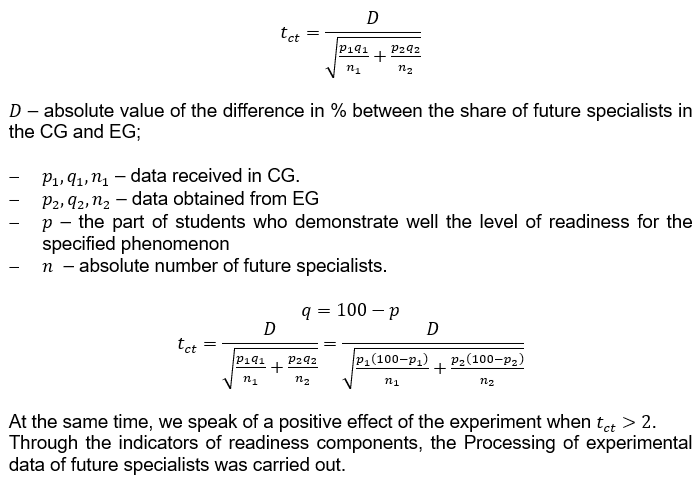
Independent-samples t-tests additionally confirmed statistically significant differences between the experimental and control groups after the intervention (p < .05). These results provide further evidence that the implemented pedagogical system produced measurable improvements in students' professional readiness.
In order to analyze the general level of readiness of future specialists in the experimental and control groups, as well as to integrate the indicators of the motivational, cognitive, and activity components, the following quantitative indicators were determined by the formula "averaged relative":

We calculated the "average relative" for the experimental and control groups based on the indicators of the components of students' readiness.
The indicators of the formation of all components of students' readiness based on the results of the formative experiment are shown in Table 2 and Figure 2.
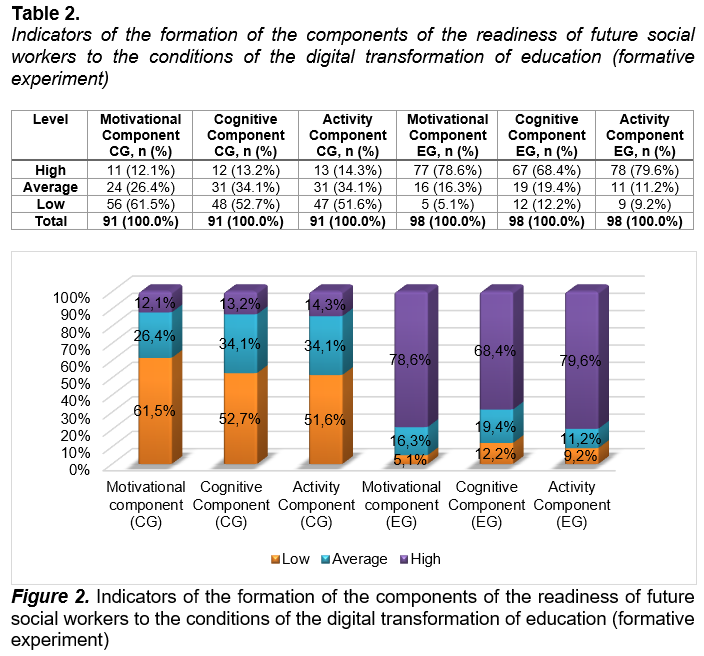
Pearson's chi-square analysis confirmed statistically significant differences between the experimental and control groups after the intervention across all three readiness components. For the motivational component, the association between group membership and readiness level was statistically significant, χ²(2) = 82.41, p < .001, Cramer's V = .66, indicating a strong effect. Similar results were obtained for the cognitive component, χ²(2) = 57.84, p < .001, Cramer's V = .55, and for the activity component, χ²(2) = 84.93, p < .001, Cramer's V = .67, demonstrating substantial improvements in the experimental group compared with the control group.
These findings indicate that the observed improvements are unlikely to be attributable to chance. The large effect sizes suggest that the implemented pedagogical system exerted a substantial influence on students' professional readiness for digital transformation across motivational, cognitive, and activity dimensions.
The results of the formative stage show that students' readiness for the outlined phenomenon across all components in the control group is at a low-to-average level.
In contrast, the experimental group is at a high level.
Methods of mathematical statistics were used to process empirical data: Pearson's criterion, Student's t-criterion, and Fisher's F-criterion.
The results of the study prove that before the ascertaining cut, students in the control and experimental groups were at approximately the same level of outlined readiness; after conducting experimental work in the experimental group, we see higher results, and we conclude that the level of students significantly increases when implementing an experimental system for forming the professional readiness of future social workers for the conditions of digital transformation of education, by developing pedagogical conditions and creating a digital educational environment of the university.
The findings of this study demonstrate that the implementation of a comprehensive pedagogical system integrating targeted pedagogical conditions with a university digital educational environment significantly improved the professional readiness of future social workers for the digital transformation of education. The most substantial improvements were observed in the motivational, cognitive, and activity components of readiness within the experimental group, whereas only minimal changes occurred in the control group. These findings indicate that systematic pedagogical support, rather than exposure to digital technologies alone, is essential for preparing future professionals to work effectively in digitally transformed educational environments.
The present results are consistent with previous studies emphasizing that digital competence cannot be developed solely through students' everyday use of technology. López Peláez et al. (2020) reported that a considerable gap exists between the digital competencies required in professional social work and those possessed by university students and practicing specialists. Similarly, Gómez-Poyato et al. (2022) concluded that being a "digital native" does not automatically ensure readiness to apply digital technologies in professional contexts. The significant improvements observed in the experimental group support these conclusions and demonstrate that structured pedagogical interventions can effectively reduce this competence gap.
The positive changes identified in the cognitive component also correspond with the findings of Kamrujjaman et al. (2023), who argued that professional readiness develops through the integration of theoretical knowledge, practical experience, and evidence-based educational practices. In the present study, combining digital educational resources with collaborative learning, research-oriented activities, and authentic professional tasks enabled students to apply theoretical knowledge in realistic educational situations, thereby strengthening both conceptual understanding and practical competence.
The results additionally support the conclusions of Winardy and Septiana (2023), who demonstrated the educational value of interactive and practice-oriented learning methods. However, unlike previous studies that primarily examined isolated instructional approaches such as role-playing or educational games, the current research evaluated a comprehensive pedagogical system that integrated multiple digital learning strategies within a unified educational environment. This integrated approach may explain the larger improvements observed across all components of professional readiness.
At the same time, the present findings extend previous research by demonstrating that the effectiveness of digital transformation depends not only on technological resources but also on organizational and pedagogical conditions. While Joiner (2019) highlighted the importance of digital ethics and responsible technology use, and Lichtenberger-Majzikné and Fischer (2017) emphasized reflective practice and feedback, the current study suggests that these elements become substantially more effective when embedded within a coherent institutional digital learning environment supported by active pedagogical guidance. Consequently, the findings broaden existing theoretical perspectives by conceptualizing professional readiness as a multidimensional construct influenced simultaneously by technological, pedagogical, motivational, and organizational factors.
Some differences between the present findings and previous studies should also be acknowledged. Many earlier investigations relied primarily on descriptive or cross-sectional survey designs that identified deficiencies in students' digital competencies but did not experimentally evaluate interventions aimed at overcoming these deficiencies. In contrast, the quasi-experimental design employed in the present study enabled direct evaluation of the effectiveness of a structured pedagogical intervention, providing stronger empirical evidence regarding causal relationships between educational practices and improvements in professional readiness.
From a theoretical perspective, this study contributes to the growing body of literature on digital transformation in higher education by providing empirical support for an integrated model of professional readiness that combines motivational, cognitive, and activity dimensions. The findings reinforce competency-based approaches to professional education while extending current theoretical understanding of how institutional digital environments interact with pedagogical conditions to facilitate competence development.
The practical implications of the study are equally significant. The proposed pedagogical system may serve as a methodological framework for higher education institutions seeking to modernize social work programmes in response to ongoing digital transformation. The integration of digital educational environments, collaborative learning, research-oriented instruction, and innovative digital technologies may enhance students' professional readiness while supporting curriculum modernization, faculty development, and institutional digitalization strategies. These findings may also inform educational policy and curriculum design aimed at strengthening the digital competencies of future social workers.
Despite the positive findings, several limitations should be acknowledged. The study was conducted within higher education institutions in one national context, which may limit the generalizability of the results to other educational systems. In addition, the intervention evaluated short-term educational outcomes, whereas future longitudinal studies are needed to examine the sustainability of professional readiness over time and its impact on graduates' professional performance. Future research may also compare different digital pedagogical models, investigate the contribution of artificial intelligence and immersive technologies, and validate the proposed framework across broader educational contexts.
Conclusions
This study contributes to the growing body of research on the digital transformation of higher education by providing empirical evidence that a comprehensive pedagogical system integrating targeted pedagogical conditions with a university digital educational environment can significantly enhance the professional readiness of future social workers. Unlike previous studies that primarily described the importance of digital competence, the present research experimentally validated an integrated educational model that simultaneously developed the motivational, cognitive, and activity components of professional readiness.
The findings extend existing theoretical understanding by conceptualizing professional readiness as a multidimensional construct shaped by the interaction of pedagogical, technological, and organizational factors. The study demonstrates that digital technologies become educationally effective when implemented within a coherent pedagogical framework that promotes active learning, collaboration, professional reflection, and continuous competence development.
From a practical perspective, the proposed pedagogical system provides a methodological framework that may be adopted by higher education institutions seeking to modernize social work education in response to digital transformation. The integration of digital educational environments, collaborative learning strategies, research-oriented instruction, and innovative educational technologies may support curriculum development, improve students' digital competencies, and strengthen graduates' preparedness for professional practice in increasingly technology-mediated educational and social contexts.
Despite these contributions, several limitations should be acknowledged. First, the study was conducted within higher education institutions in Ukraine, which may limit the generalizability of the findings to other educational systems and socio-cultural contexts. Second, the quasi-experimental design evaluated the short-term effectiveness of the pedagogical intervention and did not examine the long-term sustainability of the acquired competencies after graduation. Third, the study focused primarily on overall professional readiness and did not separately investigate the contribution of individual digital technologies or instructional strategies to specific learning outcomes.
Future research should therefore investigate the long-term impact of digital pedagogical interventions through longitudinal research designs, compare alternative models of digital professional training across different higher education institutions and countries, and explore the educational potential of emerging technologies such as artificial intelligence, immersive virtual environments, and learning analytics in preparing future social workers. Further validation of the proposed pedagogical framework in broader educational contexts would strengthen its applicability and contribute to the development of evidence-based strategies for digital transformation in higher education.