
Artículo de investigación
Utilización de las tecnologías de la información para mejorar la alfabetización mediática del profesorado de las instituciones de educación superior de Ucrania
Using information technologies to improve media literacy of teachers of higher educational institutions of Ukraine
Recibido: · Aceptado: · Publicado:
Cómo citar: Trishchuk, O., Trishchuk, R., Dankevych, J., Suprun, L., & Romanenko, O. (2026). Using information technologies to improve media literacy of teachers of higher educational institutions of Ukraine. Revista Eduweb, 20(3), 81–95. https://doi.org/10.46502/issn.1856-7576/2026.20.03.5
Resumen
El objetivo del estudio fue fundamentar empíricamente el impacto de las herramientas digitales en el nivel de alfabetización mediática y determinar el papel de la competencia digital en la formación de la capacidad de análisis crítico de contenidos mediáticos. El estudio se llevó a cabo mediante un diseño cuasiexperimental con grupos de control y experimental (n = 120). La intervención consistió en el uso sistemático de tecnologías de la información en las actividades profesionales de los docentes durante un semestre. Los resultados del análisis de varianza indicaron un impacto significativo del uso de las TIC en el nivel de alfabetización mediática (p < 0,001), con un efecto gradual en función de la intensidad de su uso. El análisis de correlación demostró una relación positiva entre la competencia digital y los indicadores de alfabetización mediática (r = 0,64–0,73). Las conclusiones destacan la eficacia de la integración de las tecnologías de la información como herramienta para el desarrollo de la alfabetización mediática del profesorado y subrayan la necesidad de la implementación sistemática de prácticas digitales en la educación superior.
Palabras clave: alfabetización mediática; competencia digital; digitalización de la educación; profesorado de educación superior; tecnologías de la información.
Abstract
The aim of the study was to empirically substantiate the impact of digital tools on the level of media literacy and determine the role of digital competence in the formation of the ability to critically analyze media content. The study was conducted using a quasi-experimental design with control and experimental groups (n = 120). The intervention provided for the systematic use of information technologies in the professional activities of teachers for one semester. The results of the analysis of variance indicated a significant impact of the use of IT on the level of media literacy (p < 0.001), the presence of a graduated effect depending on the intensity of their use. Correlation analysis demonstrated a positive relationship between digital competence and media literacy indicators (r = 0.64–0.73). The conclusions emphasize the effectiveness of the integration of information technologies as a tool for the development of teachers' media literacy, and emphasize the need for the systematic implementation of digital practices in higher education.
Keywords: digital competence; digitalization of education; higher education teachers; information technologies; media literacy.
Introduction
In the context of the rapid digital transformation of society and the expansion of the global information space, the problem of media literacy has become particularly relevant for the modern education system. The active development of information and communication technologies, the spread of social networks, digital platforms and artificial intelligence tools have significantly changed the ways of creating, distributing and perceiving information (Mazur et al., 2025; Stender et al., 2024). Under such conditions, the ability to critically evaluate information flows, identify manipulative content, counteract disinformation and effectively navigate the digital environment has become a key professional competence. It is relevant primarily for teachers of higher education institutions. Higher education institutions have played a decisive role in the formation of media literacy (Jamil et al., 2022). It is important to note that they have provided the training of future specialists and at the same time formed the professional competencies of the teaching staff. Modern studies emphasize that media literacy has become a necessary condition for the development of critical thinking and ensuring information security in the context of the growth of digital content and disinformation practices (Alcolea-Díaz et al., 2020; Feng & Sumettikoon, 2024). At the same time, researchers also emphasized that the digitalization of education has necessitated the revision of traditional pedagogical approaches and the active introduction of innovative technologies into the educational process (Grygorenko et al., 2021).
In Ukrainian realities, this problem has gained additional importance in the context of information warfare, integration into the European educational space, and the active development of distance and blended learning. The use of digital platforms, multimedia resources, and online tools has created new opportunities for the development of media literacy (Lukianova, 2022; Natriello, 2021). At the same time, it was about increasing the requirements for the level of digital and information competence of teachers (Malieiev et al., 2024; Potapchuk et al., 2026). Despite the significant number of studies devoted to digital competence and media education, the issue of targeted development of media literacy of teachers of higher education institutions using information technologies required additional attention.
Modern scientific discourse has emphasized the significant potential of information technologies in increasing the effectiveness of teaching, developing critical thinking, and forming an interactive educational environment (Scolari, 2019; Verhalle & Loos, 2025). The use of multimedia tools, digital educational platforms, interactive services and virtual interaction technologies actively contributed to the creation of adaptive and flexible learning models focused on the needs of the modern information user. At the same time, there was a need to systematize approaches to the use of information technologies precisely as a tool for the development of media literacy of teachers, taking into account pedagogical, psychological and technological aspects (Vošnjak & Vogrinc, 2026). Therefore, the existing contradiction between the growing requirements for the level of media literacy of teachers of higher education institutions and the insufficient development of methodological support for its formation by means of information technologies determined the relevance of this study.
In the modern academic environment, media literacy was increasingly considered both as an individual competence and as a component of the institutional culture of a higher education institution. Teachers in this context acted as mediators between information flows, digital technologies and students. It was on the level of their training and competence that the educational process contributed to the formation of critical thinking, information resilience and the ability to counteract manipulative practices. For this reason, the issue of developing media literacy among teachers required a comprehensive analysis that combined technological, pedagogical and socio-cultural aspects.
The purpose of the article is to analyze the possibilities of using information technologies to increase the media literacy of teachers of higher education institutions of Ukraine and to determine effective approaches to their integration into the educational process.
H1. The use of information technology in the professional activities of higher education teachers statistically significantly increased their level of media literacy compared to traditional approaches to teaching.
H2. There was a statistically significant positive relationship between the level of digital competence of teachers and their ability to critically analyze media content.
To achieve the research goal and test the proposed hypotheses, a quasi-experimental design was used with the participation of experimental and control groups. The study examined the impact of systematic use of information technologies on teachers' media literacy during one academic semester and assessed the relationship between digital competence and the ability to critically analyze media content. The methodological framework consists of comparative and statistical approaches. The article is organized as follows. The following section examines the theoretical foundations of media literacy, digital competence, and the use of information technologies in higher education. The methodology section describes the research design, participants, intervention procedures, tools, and data analysis methods. The results section presents empirical data on the effectiveness of information technologies in increasing media literacy and the relationship between digital competence and critical media analysis skills. The discussion and conclusions sections compare the results and outline their practical significance for higher education institutions in Ukraine.
Literature Review
In modern scientific discourse, media literacy is considered as a complex human ability to search, select, critically evaluate, interpret and ethically use information in the digital environment. Studies have treated media and information literacy as one of the basic competencies of a modern person (Turpo-Gebera et al., 2021). This competence has ensured critical engagement in the information space, safe navigation in the online environment and responsible interaction with digital technologies (Voitovych et al., 2025). In this context, media literacy is increasingly associated simultaneously with the ability to analyze media texts and with the development of digital competencies, information security, resistance to disinformation and the ability to reflectively consume content.
A significant place in the research has been occupied by the problem of digital competence of teachers as a prerequisite for the effective use of information technologies in the educational process. The European framework for digital competence of teachers DigCompEdu has defined the digital competence of a teacher as a multidimensional construct. It covered professional interaction, selection and creation of digital resources, management of learning with the help of technology, digital assessment and support of autonomy of education seekers (Dzogovic et al., 2025). In later studies, this logic was developed in the direction of considering digital competence as a technical skill (Mateus et al., 2026). Modern scholars have interpreted it as a pedagogically integrated ability, which undoubtedly influenced the quality of teaching, adaptability of the educational environment and readiness for innovations in higher education (Miguélez et al., 2020). A separate block of works is devoted to the use of information technologies for the development of critical thinking, digital culture and new forms of academic interaction. Scientific articles have repeatedly emphasized that the integration of digital tools, web resources, interactive platforms, multimedia solutions and online services has increased the involvement of participants in the educational process, increased the flexibility of learning and created conditions for the formation of new types of competencies (Nikou & Aavakare, 2021; Rojas-Estrada et al., 2023). At the same time, the emphasis is mainly on education seekers, future teachers, or the general impact of technology on educational quality. At the same time, the issue of targeted improvement of media literacy of higher education teachers has received less systematic evaluation.
The Ukrainian context has given this issue special importance. Researchers who have analyzed the development of media education in Ukraine have emphasized that in the context of information warfare, digital transformation of education, and the growth of manipulative content, media literacy has ceased to be an optional skill and is becoming an element of a teacher’s professional stability (Svyrydenko & Terepyshchyi, 2020). Ukrainian research in recent years has traced the integration of media education into the training of future teachers, the formation of information literacy, the development of digital culture, and the adaptation of the European framework of competencies to national conditions (Zhukova et al., 2023). At the same time, there are still few empirical studies that would directly assess the impact of specific information technologies on the growth of media literacy among higher education teachers in Ukraine.
At the same time, in modern research, there was a clear tendency towards a predominantly theoretical understanding of media literacy or its study at the level of education seekers. At the same time, empirical studies aimed at analyzing changes in teachers' professional practices remained limited. This was especially true of scientific works that used experimental or quasi-experimental designs with a quantitative assessment of the effectiveness of the introduction of information technologies. This situation led to the need for further scientific research that would allow moving from describing the potential of digital tools to empirically confirmed conclusions about their real impact on the formation of media literacy.
Therefore, the analysis of scientific sources has demonstrated that, despite significant attention to digital competence, media education, and the technologization of the educational process, a research gap remains in the modern literature regarding the comprehensive study of the use of information technologies. This is especially relevant in terms of improving the media literacy of teachers in higher education institutions in Ukraine. The issues of pedagogical conditions for the effective use of such technologies, criteria for assessing changes in the level of media literacy of teachers, the relationship between digital competence, critical analysis of media content and professional activities in the university environment are also insufficiently addressed. It is these gaps that determined the feasibility of the proposed study.
Methodology
Research Design
The study was conducted using a quasi-experimental design with control and experimental groups. This approach made it possible to assess the impact of the use of information technologies on the level of media literacy of teachers of higher education institutions of Ukraine. The chosen methodology also made it possible to establish relationships between key research variables.
The experiment lasted for one academic semester and involved the introduction of a set of digital tools into the teaching activities of teachers in the experimental group. At the same time, in the control group, the educational process was carried out using traditional approaches.
Participants
The study involved 120 teachers from four higher education institutions in Ukraine (designated as University 1, 2, 3, 4 to ensure anonymity).
Participants were divided into:
control group (CG) – 60 people
experimental group (EG) – 60 people
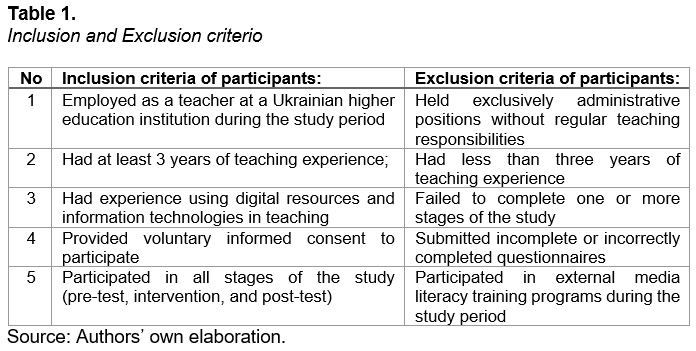
The average age of the participants was 38.6 years (SD = 7.4), teaching experience ranged from 3 to 25 years. All participants provided voluntary informed consent to participate in the study.
The research involved scientific and pedagogical staff of higher education institutions of Ukraine who met the specified inclusion criteria. The sample was formed according to the principle of purposeful selection, taking into account the professional relevance of the participants to the subject of the study (See Table 1).
Within the framework of the experiment, the experimental group was involved in the systematic use of information technologies aimed at developing media literacy, in particular:
interactive online platforms (LMS, Google Classroom);
tools for analyzing media content (fact-checking resources, digital archives);
multimedia tools (video analysis, data visualization);
digital services for creating content (presentations, interactive whiteboards);
elements of blended and distance learning.
The intensity of technology use was variable (low, medium, high levels), which made it possible to additionally test the impact of the frequency of their use.
Intervention
To collect empirical data, a set of psychodiagnostic and author's methods was used:
Media Literacy of Teachers Scale (MLTS), which included 4 subscales:
critical analysis of media content;
assessment of information reliability;
digital ethics and security;
media content creation.
Digital competence scale (adapted from DigCompEdu).
Questionnaire on the frequency of IT use in professional activities (low / medium / high).
All scales provided for assessment on a 5-point Likert scale. The reliability of the instruments was confirmed using the Cronbach's coefficient (α = 0.82–0.91).
Procedure and tools
The study took place in several stages. The first of them was pre-testing - measuring the basic level of media literacy and digital competence (See table 2).
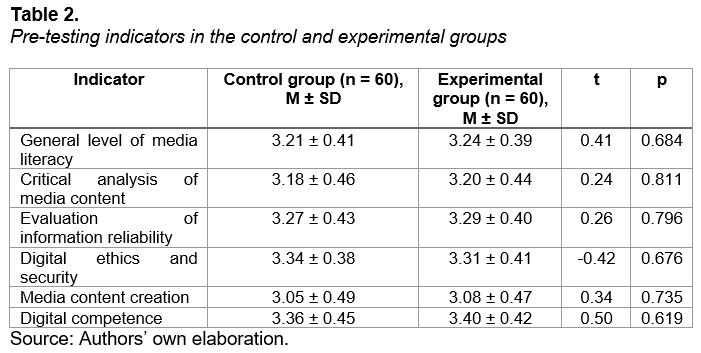
As can be seen from the pre-test results, no statistically significant differences were found between the control and experimental groups at the initial stage (p > 0.05 for all indicators). This indicated sufficient homogeneity of the sample and allowed us to interpret further differences at the post-test stage because of the experimental effect.
Then an intervention was carried out - the introduction of information technologies into the educational process (16 weeks). At the end, post-testing took place - a repeated measurement of indicators after the experiment was completed.
Statistical analysis methods were used to process the obtained data. Data processing was carried out using SPSS / R software.
To test the hypotheses, the following methods were used: ANOVA (analysis of variance) - to assess the differences between the control and experimental groups (H1); post hoc tests (Tukey HSD) - to determine paired differences between the levels of intensity of IT use; correlation analysis (Pearson r) - to establish the relationship between digital competence and media literacy (H2); multiple regression analysis - to determine the contribution of individual factors to the formation of media literacy.
The content validity of the instruments was ensured as a result of expert evaluation. 5 specialists in the fields of media education, digital pedagogy, educational psychology and teaching methods in higher education were invited to the expert group. The experts assessed: the correspondence of the statements to the theoretical constructs of the study; the clarity and unambiguousness of the formulations; the relevance of the items to the declared subscales; the general logic of the structure of the instrument.
According to the results of the expert analysis, some formulations were clarified, and some content redundancies were removed. The consistency of the expert assessments indicated a sufficient level of content validity of the instrument.
To ensure the validity and reliability of the instrument, a multi-level psychometric test was conducted. The content validity of the media literacy scale was ensured by expert evaluation by five specialists in the field of media education, digital pedagogy and educational psychology. After pilot testing on a sample of 30 teachers, individual formulations were refined. Construct validity was tested using exploratory factor analysis: the KMO value was 0.86, the Bartlett criterion was statistically significant (χ² = 1248.37; p < 0.001), which confirmed the adequacy of the sample and the correlation matrix for factorization. The reliability of the scales, estimated by the Cronbach’s alpha coefficient, ranged from 0.82 to 0.91, which indicated a high level of internal consistency.
The frequency of use of information technologies was assessed using an author’s questionnaire, which contained 8 items regarding the regularity of use of digital platforms, multimedia tools, content creation services, information verification tools and online communication in professional activities. Responses were recorded on a five-point Likert scale from 1 (“almost never”) to 5 (“very often”). For further analysis, an integral indicator was calculated in the form of an average score, which was considered as a continuous variable (Appendix 1).
Ethical aspects of the study
The study was conducted in accordance with ethical standards of academic integrity. All participants were informed about the purpose of the study and provided voluntary informed consent to participate. Anonymity and confidentiality of personal data were guaranteed at all stages of the study.
Results and Discussion
Results
In order to empirically test the hypotheses put forward, a comprehensive statistical analysis was conducted, which consisted of comparing indicators between groups, assessing the impact of the intensity of information technology use, and studying the relationships between key variables. The analysis was carried out based on the results of post-testing, which made it possible to assess the changes that occurred after the introduction of the experimental effect.
First of all, the differences between the control and experimental groups in terms of the general level of media literacy were analyzed. Additionally, the impact of the frequency of information technology use on the studied indicator was studied, which made it possible to clarify the nature of the detected effect. Special attention was paid to the analysis of the relationships between digital competence and the components of media literacy, which made it possible to test the second hypothesis of the study.
Comparison of post-test results between the control and experimental groups demonstrated significant differences in media literacy levels.
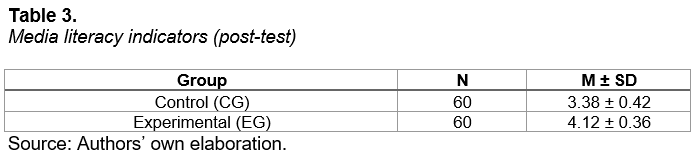
The results of the analysis of variance indicated the existence of statistically significant differences between the groups:
F(1, 118) = 86.47, p < 0.001, η² = 0.42
The obtained value of η² indicated a large effect size, which indicated a significant impact of the use of information technologies on the level of media literacy of teachers. Thus, the proposed results confirmed the hypothesis H1.
For a more detailed analysis, the impact of the frequency of use of information technologies (low, medium, high levels) was investigated. To clarify the nature of the detected effect, a correlation and regression analysis of the frequency of use of information technologies as a continuous indicator was conducted. This approach avoided artificial categorization of data and provided a more accurate assessment of the relationship between the intensity of IT use and the level of media literacy of teachers (See Table 4).
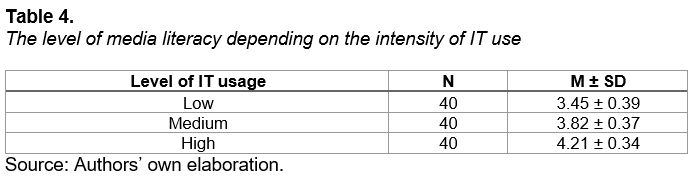
The results of the one-way analysis of variance showed the following:
F(2, 117) = 54.63, p < 0.001, η² = 0.48
This indicated that there were statistically significant differences between the levels of information technology use. To clarify the nature of these differences, a post hoc analysis was conducted using the Tukey HSD criterion.
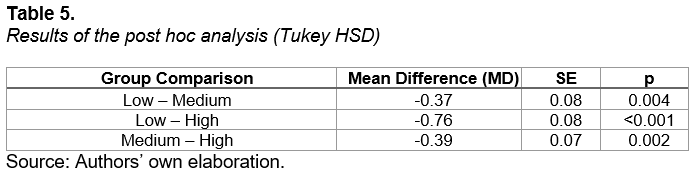
The results of the post hoc analysis demonstrated that all pairwise comparisons were statistically significant. The largest difference was observed between the groups with low and high levels of IT use. This confirmed the presence of a gradual (graded) effect: with increasing intensity of use of information technologies, the level of media literacy statistically increased.
To test the hypothesis of the relationship between digital competence and media literacy, a correlation analysis was conducted using the Pearson coefficient.
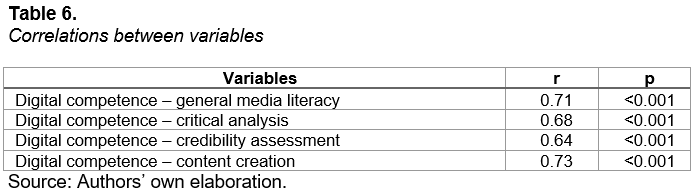
The results showed strong positive correlations between digital competence and all components of media literacy. This indicated an increase in the level of digital competence, which was accompanied by an increase in the ability to critically analyze information and effectively work with media content.
In order to determine the relative contribution of individual factors to the formation of media literacy, multiple regression analysis was used.
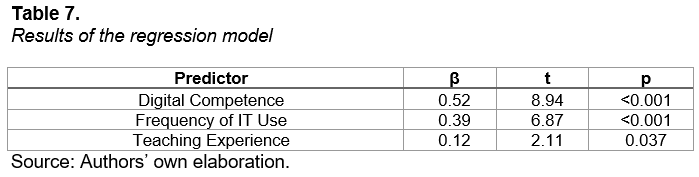
The model was statistically significant:
R² = 0.58, F(3, 116) = 53.21, p < 0.001
This meant that the included variables explained 58% of the variation in the level of media literacy. The most significant predictor was digital competence, which is consistent with the results of the correlation analysis.
Therefore, the results obtained showed a statistically significant effect of the use of information technologies on the level of media literacy of teachers. The proposed results confirmed the existence of a close relationship between digital competence and the ability to critically analyze media content. The identified graded effect of the intensity of IT use further strengthened the obtained conclusions.
Thus, both hypotheses of the study (H1 and H2) were confirmed.
Discussion
The proposed research results confirmed the key role of information technologies in the formation of media literacy of teachers of higher education institutions. A statistically significant impact of the use of digital tools on the level of media literacy was revealed. It was consistent with modern scientific approaches that considered the digital educational environment as an important factor in the development of critical thinking (Reyna et al., 2018), information culture and the ability to analytically process media content (Albardía et al., 2025; Da Porta & Morabes, 2024).
In this sense, the analysis of the participants' responses demonstrated a growing awareness of the need for a critical approach to information and a gradual increase in the level of integration of digital tools into everyday pedagogical practice. These findings make it possible to consider the recorded quantitative changes not merely as isolated data, but as a manifestation of more complex transformations in the professional behavior of teachers, which aligns with the perspectives on institutional digital adaptation highlighted by Colón Zayas (2024).
It is important to note that the results obtained reflected not only a formal increase in the indicators on the scales. It was also about significantly deeper changes in the professional activities of teachers, which were associated with a rethinking of the role of information technologies in the educational process.
Hence, the results of testing the hypothesis H1 demonstrated that the integration of information technologies into the professional activities of teachers contributed to a significant increase in the level of media literacy. This correlated with the main conclusions of several scientific works that the effective use of digital resources in teaching optimized the educational process, formed new cognitive and metacognitive skills of teachers (Fernández-Otoya et al., 2024; Reeves-Huapaya et al., 2025). The large effect size found (η² = 0.42) indicated that the impact of information technologies was not random, but systemic.
Of particular importance was the establishment of a graduated effect of the intensity of use of information technologies. That is, with the increase in the frequency of their use, the level of media literacy statistically increased. This made it possible to argue that it was important not only to use digital tools. It was also important to regularly integrate them into the educational process, where they would act as critically important factors. Similar conclusions were consistent with the results of studies that were devoted to the digital transformation of education (Özcan, 2022; Rodríguez Cruz et al., 2025). There, the importance of systematic implementation of technologies was emphasized.
The results of the hypothesis test H2 also confirmed the existence of a close relationship between digital competence and media literacy. The strong positive correlations revealed indicated that digital competence served as a basic condition for the development of the ability to critically analyze media content. This is consistent with the results of other scientists who have repeatedly emphasized the integrative nature of digital and media competences (Asfaha & Nag, 2023; Kabakus et al., 2025). In this context, digital competence was both a technical skill and a significant cognitive resource that ensured effective interaction with the information environment (Mokhtari, 2023; Pakhomova et al., 2023). The results of the proposed regression analysis additionally confirmed the leading role of digital competence as a key predictor of media literacy. At the same time, the significant contribution of the frequency of use of information technologies indicated that the formation of media literacy was the result not only of the individual characteristics of the teacher. The features of the organization of the educational process also had a significant impact. This provision expanded traditional ideas about media education, focused on the need to create an appropriate digital educational environment (Gómez-Trigueros et al., 2019; Lukianova & Ovcharuk, 2023).
The results obtained had important practical implications. First of all, the feasibility of integrating information technologies into the system of advanced training of teachers was confirmed. The latter has been repeatedly proposed in the scientific literature. The proposed results also demonstrated the need to develop specialized programs for the development of media literacy, which would combine the formation of digital skills with the development of critical thinking. Thirdly, the effectiveness of the graduated approach to the use of IT made it possible to recommend the implementation of differentiated learning models depending on the level of digital training of teachers.
Special attention was paid to the interpretation of the obtained results in the broader context of the transformation of the role of the teacher in the conditions of digitalization of education. The modern teacher increasingly acted as a facilitator of learning, a moderator of information flows and a mentor in the digital environment. In this regard, the development of media literacy has acquired the meaning of individual competence and at the same time an important professional standard that determined the quality of the educational process. Therefore, the introduction of information technologies should be considered in the future as a tool for a deeper pedagogical transformation.
At the same time, the results of the study should be interpreted taking into account certain limitations. In particular, the study was conducted within a limited sample of Ukrainian higher education institutions, which could affect the possibility of generalizing the results. Secondly, the use of self-assessment tools always contained an element of subjectivity. Also, the duration of the experiment is limited to one semester, which did not allow assessing the long-term effects of the influence of information technologies.
Conclusions
In conclusion, this research confirms that the systematic integration of information technologies acts as a systemic catalyst for advancing media literacy among higher education faculty. The robust effect sizes identified demonstrate that casual digital exposure is insufficient; rather, sustained, multi-level digital interaction is required to significantly elevate capabilities in critical text analysis, data verification, and content creation. Consequently, higher education institutions must shift from generic ICT training toward comprehensive frameworks that blend digital operational efficiency with media cognitive resilience.
The scientific novelty of the study consisted in the comprehensive empirical substantiation of the relationship between the use of information technologies, digital competence and the level of media literacy of teachers.
The practical significance of the results obtained was the possibility of their use in the development of teacher training programs and the creation of media literacy courses.
Prospects for further research will consist in expanding the sample, using mixed methods (in particular, combining quantitative analysis with qualitative interviews), as well as studying the long-term impact of digital educational practices on the formation of media literacy.
Bibliographic references
Appendix 1.
ICT Use Frequency Questionnaire for Teachers
Instructions for the respondent:
Please rate how often you use the following information technologies in your professional (teaching) activities.
Use a scale from 1 to 5:
1. Almost never
2. Rarely
3. Sometimes
4. Often
5. Very often
Questionnaire items
How often do you use learning management systems (LMS) (e.g. Moodle, Google Classroom, Canvas)?
How often do you use online platforms for communication with students (Zoom, Microsoft Teams, Google Meet, etc.)?
How often do you use multimedia materials (videos, podcasts, interactive presentations) in the educational process?
How often do you use digital tools for creating educational content (Canva, PowerPoint, Prezi, Genially, etc.)?
How often do you use tools to verify the accuracy of information (fact-checking resources, academic databases)?
How often do you use online resources and digital libraries to prepare educational materials?
How often do you use interactive digital services (Kahoot, Mentimeter, Quizizz, etc.) in the learning process?
How often do you use digital tools for assessment and feedback (online tests, Google Forms, LMS assessments)?