
Artículo de investigación
Un estudio cuasiexperimental sobre la preparación para el aprendizaje autodirigido en entornos digitales mejorados con STEAM (Ciencia, tecnología, ingeniería, arte y matemáticas)
A quasi-experimental study on self-directed learning readiness in STEAM-enhanced digital environments
Recibido: · Aceptado: · Publicado:
Cómo citar: Chovriy, S., Tambovska, K., Barulina, Y., Shevchuk, I., & Tyulpa, T. (2026). A quasi-experimental study on self-directed learning readiness in STEAM-enhanced digital environments. Revista Eduweb, 20(3), 59–80. https://doi.org/10.46502/issn.1856-7576/2026.20.03.4
Resumen
El artículo investiga el desarrollo de la preparación de los futuros docentes para el aprendizaje profesional autodirigido en un entorno digital innovador de educación superior. El estudio se centra en la implementación de condiciones pedagógicas que apoyan el aprendizaje autónomo mediante tecnologías de Internet integradas, la digitalización del proceso educativo y la creación de un entorno de aprendizaje orientado a STEAM. Se aplicó un diseño de investigación cuasiexperimental con mediciones pre-test y post-test para evaluar la efectividad de la intervención pedagógica propuesta. El estudio involucró a 162 futuros docentes de universidades pedagógicas de Ucrania, incluyendo 82 estudiantes en el grupo experimental y 80 en el grupo de control. La preparación para el aprendizaje profesional autodirigido se evaluó a través de tres componentes: motivacional-valorativo, cognitivo-operacional y reflexivo-activo. El análisis estadístico se realizó utilizando estadística descriptiva y la prueba de chi-cuadrado de Pearson (χ²) para determinar la significancia de las diferencias entre los grupos. Los resultados del post-test demostraron una mejora sustancial en el grupo experimental después de la implementación del modelo pedagógico. La proporción de estudiantes con un alto nivel de preparación aumentó del 7,1 % al 38,2 % (una mejora de 31,1 puntos porcentuales), mientras que la proporción con un nivel bajo disminuyó del 48,2 % al 8,9 %. En contraste, el grupo de control mostró cambios mínimos. Los resultados confirman la eficacia de las condiciones pedagógicas propuestas para mejorar la preparación de los estudiantes para el aprendizaje profesional autodirigido en entornos digitales de educación superior.
Palabras clave: aprendizaje profesional autodirigido; futuros docentes; entornos innovadores en la educación superior; tecnologías de Internet integradas; digitalización.
Abstract
The article investigates the development of pre-service teachers’ readiness for self-directed professional learning in an innovative digital higher education environment. The study focuses on the implementation of pedagogical conditions that support autonomous learning through integrated Internet technologies, digitalization of the educational process, and the creation of a STEAM-oriented learning environment. A quasi-experimental research design with pre-test and post-test measurements was applied to evaluate the effectiveness of the proposed pedagogical intervention. The study involved 162 pre-service teachers from pedagogical universities in Ukraine, including 82 students in the experimental group and 80 in the control group. Readiness for self-directed professional learning was assessed across three components: motivational-value, cognitive-operational, and activity-reflective. Statistical analysis was conducted using descriptive statistics and the Pearson chi-square (χ²) test to determine the significance of differences between groups. The post-test results demonstrated a substantial improvement in the experimental group after the implementation of the pedagogical model. The proportion of students with a high level of readiness increased from 7.1% to 38.2% (an improvement of 31.1 percentage points), while the proportion with a low level decreased from 48.2% to 8.9%. In contrast, the control group showed only minor changes. The findings confirm the effectiveness of the proposed pedagogical conditions in enhancing students’ readiness for self-directed professional learning in digital higher education environments.
Keywords: self-directed professional learning; future teachers; innovative environments in higher education; integrated Internet technologies; digitalization.
Introduction
Modern educational systems increasingly expect teachers not only to possess professional knowledge and pedagogical competencies but also to demonstrate the ability for continuous professional development and autonomous learning. In this context, self-directed professional learning has become one of the key competencies of future teachers, enabling them to adapt to technological innovations, respond to educational reforms, and continuously improve their professional practice.
The concept of self-directed learning has been widely discussed in contemporary educational research. Scholars emphasize that the ability to independently plan, regulate, and evaluate learning activities plays a crucial role in developing professional competence and lifelong learning skills. Recent studies demonstrate that self-directed learning contributes to professional effectiveness, motivation, and adaptability in complex educational environments. At the same time, the rapid integration of digital technologies into higher education has expanded the possibilities for supporting autonomous learning through digital platforms, online resources, and interactive educational tools (Çamur & Gogus, 2025).
Despite the growing number of studies on self-directed learning, the existing literature reveals several important limitations. First, many studies focus primarily on general student populations or in-service teachers, while empirical research addressing the development of self-directed professional learning readiness among pre-service teachers remains limited. Second, although digital technologies are widely recognized as an important factor in promoting autonomous learning, most studies examine individual digital tools rather than integrated pedagogical systems that combine digital environments, innovative teaching approaches, and structured training models within teacher education programs. Third, there is still insufficient experimental evidence demonstrating how specific pedagogical conditions and digital learning environments influence the development of self-directed professional learning readiness in higher education contexts.
Another limitation concerns the methodological approaches used in previous research. Many studies rely primarily on theoretical analysis or correlational designs, which limits the ability to establish causal relationships between educational interventions and the development of students’ readiness for self-directed learning. Consequently, there is a need for experimental or quasi-experimental studies that provide empirical evidence regarding the effectiveness of pedagogical innovations aimed at fostering self-directed professional learning among future teachers (Blanco-García, 2021).
Addressing these gaps is particularly important in the context of digitally transformed higher education, where teacher training programs must integrate innovative learning environments, digital technologies, and student-centered pedagogical strategies. The development of such environments requires a systematic approach that combines motivational, cognitive, and behavioral components of learning readiness while simultaneously creating opportunities for autonomy, reflection, and professional self-development.
The purpose of this study is to examine the effectiveness of a pedagogical model aimed at developing pre-service teachers’ readiness for self-directed professional learning within an innovative digital higher education environment.
The research specifically focuses on the implementation of a set of pedagogical conditions, including the integration of digital learning technologies, the development of a STEAM-oriented learning environment, and the introduction of a specialized training course designed to enhance students’ autonomy and professional self-development. The study also seeks to provide empirical evidence of the effectiveness of these pedagogical interventions through a quasi-experimental research design comparing experimental and control groups.
Literature Review
Self-directed learning (SDL) has become a central concept in contemporary educational research, particularly in the context of digital transformation and the growing demand for lifelong learning competencies. In teacher education, SDL is considered an essential mechanism for fostering professional autonomy, adaptability, and continuous professional development. Scholars emphasize that SDL enables learners to independently set learning goals, regulate their learning processes, and evaluate outcomes, thereby supporting the development of reflective and responsible professionals (García-Martínez & Fallas-Vargas, 2022).
Recent empirical studies confirm the positive relationship between self-directed learning readiness and professional effectiveness. For instance, Çamur and Gogus (2025) found that a higher level of self-directed learning readiness among school leaders correlates with improved professional performance and more effective decision-making in educational management. Similarly, research by Temiaková and Pavlov (2026) shows that self-directed learning is widely practiced among teachers as a strategy for professional development, although the frequency and effectiveness of such learning vary depending on professional experience, available resources, and institutional support.
The integration of digital technologies has significantly expanded opportunities for SDL in higher education. Digital platforms, online resources, and interactive tools provide learners with flexible access to educational content and allow them to construct individualized learning trajectories. Morris and Rohs (2023) highlight the considerable potential of digital technologies to support SDL by facilitating access to information, collaboration, and reflective learning processes. Additionally, empirical evidence indicates a strong connection between SDL and digital competence. For example, Rini et al. (2022) demonstrate that self-directed learning significantly contributes to the development of students’ digital literacy in online learning environments. Similarly, Alanoglu et al. (2026) emphasize that digital literacy and online learning readiness play an important mediating role in the development of self-directed online learning skills.
Despite the widely recognized advantages of SDL, recent studies also emphasize several important limitations and challenges associated with its implementation. One of the key issues concerns the assumption that learners possess a sufficient level of autonomy, motivation, and self-regulation. In practice, many students—particularly at the early stages of higher education—experience difficulties in organizing their independent learning processes, setting clear learning goals, and maintaining consistent motivation (Morris & Rohs, 2023). Without appropriate pedagogical guidance, the shift toward self-directed learning may lead to fragmented knowledge acquisition or reduced learning effectiveness.
Another limitation concerns the role of instructional support in SDL environments. While autonomous learning emphasizes student independence, research suggests that effective SDL requires a balance between learner autonomy and structured pedagogical guidance. Morris and Rohs (2023) note that digital technologies alone do not automatically enhance self-directed learning; learners often lack the necessary competencies to effectively plan, monitor, and evaluate their learning activities. Therefore, structured learning environments and supportive instructional strategies remain essential for ensuring meaningful learning outcomes.
A further critical issue discussed in recent literature relates to the risk of the digital divide in technology-supported self-directed learning. Although digital environments provide new opportunities for autonomous learning, access to digital resources and technological infrastructure remains uneven across student populations. Studies indicate that disparities in access to devices, stable internet connections, and digital competencies may create barriers for some learners when engaging in autonomous digital learning environments (Cardona-Acevedo et al., 2025). As a result, digital learning models that rely heavily on independent use of online resources may unintentionally reinforce educational inequalities.
In addition, the abundance of information in digital environments may create challenges related to information overload and critical evaluation of sources. Students engaged in self-directed learning must independently navigate complex information spaces, assess the credibility of digital resources, and synthesize information from multiple sources. Without well-developed information literacy and reflective skills, learners may encounter difficulties in effectively processing and applying knowledge (Cerda et al., 2022).
Despite the growing body of research on SDL, several gaps remain in the literature. Many existing studies focus either on practicing teachers or general student populations, while empirical research addressing the development of self-directed professional learning readiness among pre-service teachers remains limited. Furthermore, although digital technologies are widely recognized as tools supporting SDL, relatively few studies examine integrated pedagogical models that combine digital environments, innovative teaching approaches, and structured teacher training systems within higher education. Addressing these gaps requires empirical investigation of comprehensive pedagogical interventions capable of fostering SDL while mitigating the limitations associated with autonomous learning in digital environments.
Methodology
Research Design
The study employed a quasi-experimental research design with a pre-test – post-test control group structure. This design was selected to examine the effectiveness of pedagogical conditions aimed at developing pre-service teachers’ readiness for self-directed professional learning in a digital higher education environment. The experimental approach enabled comparison between control and experimental groups and provided empirical evidence of the intervention’s impact.
Participants
The study involved pre-service teachers enrolled in a higher education institution in Ukraine. Participants were selected using a purposive sampling method to ensure relevance to the research objectives.
The sample was divided into:
- Experimental group (EG): received the intervention based on the developed pedagogical model and digital learning environment.
- Control group (CG): followed the traditional instructional approach without targeted intervention.
Both groups were comparable in terms of initial readiness levels, academic background, and educational program characteristics.
Intervention
The experimental intervention was based on a structured system of pedagogical conditions aimed at fostering readiness for self-directed professional learning. The intervention included:- Integration of digital learning tools and platforms.
- Implementation of student-centered and activity-based learning strategies.
- Use of STEAM-oriented and problem-based tasks.
- Application of heutagogical principles (learner autonomy and reflection).
- Development of a special training course focused on self-directed learning competencies.
The intervention was implemented over a defined academic period within regular educational activities.
Description of the Special Course
To enhance the methodological transparency of the study and ensure the reproducibility of the research design, the structure and content of the developed special course are presented in detail. The special course was designed according to a modular approach and aimed at integrating theoretical knowledge with practice-oriented activities focused on the use of innovative and digital technologies in professional learning.
The course was developed as part of the pedagogical intervention implemented in the experimental group and was intended to foster students’ readiness for autonomous and professionally oriented learning in a digital educational environment. The curriculum was grounded in contemporary approaches to student-centered learning, digital pedagogy, and competence-based education.
The structure of the course comprised four interconnected modules that progressively developed theoretical understanding, practical skills, and reflective competencies. The first module focused on the theoretical foundations of innovative educational technologies and the digital transformation of higher education. Within this module, students explored key conceptual approaches to innovation in education, analyzed contemporary trends in digital learning environments, and examined the role of technological tools in professional development.
The second module emphasized the development of practical competencies related to the use of digital platforms, interactive educational tools, and collaborative online environments. Particular attention was paid to the integration of project-based and problem-based learning methods supported by digital technologies.
The third module had a practice-oriented focus and involved the application of innovative technologies to simulated professional tasks. Students designed and implemented mini-projects aimed at solving professional problems using digital resources and collaborative strategies.
The fourth module was devoted to reflective practice and the evaluation of learning outcomes. Students analyzed the effectiveness of applied technologies, reflected on their learning experiences, and discussed the potential of innovative tools for future professional practice.
The total workload of the course was 60 hours, including lectures, practical sessions, and independent study, which ensured a balanced integration of theoretical instruction and active learning.
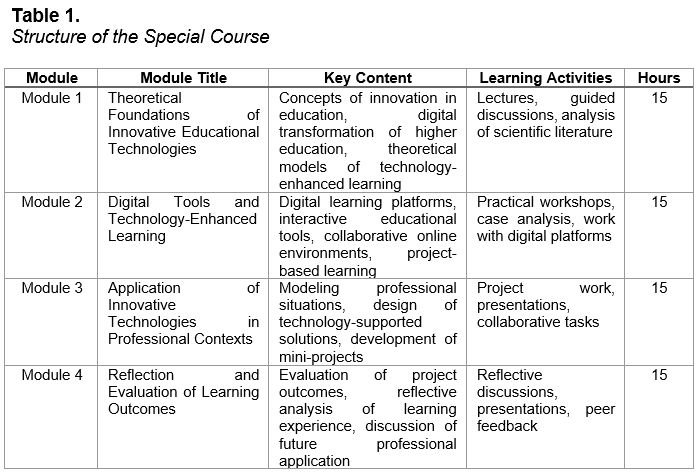
Total course workload: 60 hours (20 hours of lectures, 20 hours of practical sessions, and 20 hours of independent study).
Instrument and Measures
Data collection was conducted using a standardized diagnostic tool developed by the researchers, designed to assess pre-service teachers’ readiness for self-directed professional learning.
The instrument measured three components:
-Motivational-value component (learning motivation, professional orientation).
-Cognitive-operational component (knowledge and strategies for independent learning).
-Behavioral-reflective component (self-regulation, reflection, and learning autonomy).
Responses were evaluated using a structured rating scale. The instrument demonstrated acceptable reliability and validity indicators based on pilot testing.
Procedure
The research procedure consisted of three stages:
-Baseline (pre-test) stage: assessment of initial readiness levels in both groups.
-Intervention stage: implementation of pedagogical conditions and digital learning activities in the experimental group.
-Post-test stage: repeated measurement of readiness levels in both groups after the intervention.
The same diagnostic instrument was used in both pre-test and post-test phases to ensure comparability of results.
Data Analysis
Quantitative data were processed using statistical analysis methods in SPSS software.
The following techniques were applied:-Descriptive statistics (mean, standard deviation)-Comparative analysis between groupsChi-square test (χ²) to determine statistically significant differences between control and experimental groups.
Significance level was set at p < 0.05The analysis aimed to determine the effectiveness of the implemented pedagogical conditions in improving students’ readiness for self-directed professional learning.
Ethical Considerations
The study complied with general ethical standards of educational research. Participation was voluntary, and all respondents were informed about the purpose of the study. Confidentiality and anonymity of participants were ensured throughout the research process.
Results and Discussion
Content and features of self-directed professional learning of future teachers in an innovative educational environment of higher education.
Self-directed learning refers to an individual’s ability to set goals, regulate their learning process, and evaluate outcomes in accordance with personal and professional values. If we talk about the features of future self-directed learning teachers, it is necessary to characterize them as a process of developing both professional and personal qualities. This allows us to say that self-directed learning reflects the relationship between personal and professional development, which encourages each individual to creative self-realization. Such an approach to understanding a person's self-directed learning involves understanding the value of a person's life, professional and personal; forming professional self-esteem; developing the ability to set goals; thinking through the meaning of their own life; and experiencing and empathizing. Therefore, one cannot help but discuss a person's personal development when discussing their self-directed professional learning (García-Martínez & Fallas-Vargas, 2022).
We consider the personal and professional development of the future teacher as the integration of professional training, personal development, and their internal movement. It is professional training in the innovative educational environment of higher education that determines the content, schemes of professional reflection, forms, and internal movement, thereby providing personal meaning, realization, and energy for self-directed professional learning. Professional learning of pre-service teachers contributes to the formation of an individual style in the process of professional activity. It is comprehensive, grounded in best practices, and an understanding of one's own practice for future professional activity (Fernández Nistal et al., 2019).
Much depends on the teacher's ability to program the self-directed learning of a future teacher: implementing professional plans, defining vectors of change, and developing basic personal skills. Therefore, self-directed professional learning is considered a highly organized, creative, systematic, and planned activity that will continue throughout a specialist's professional life (Jiang et al., 2024).
New approaches, technologies, requirements for classes, new emphasis on learning outcomes, and methodologies force students and teachers to constantly develop competencies, update knowledge, and master new roles to become the creators of an innovative digital environment for the development of each student, and the continuous self-improvement of a teacher and their self-directed professional learning are an integral part of quality education. That is why students and teachers are increasingly planning individual educational trajectories, choosing innovative development routes according to their level of experience, interests, and professional needs to obtain high-quality results in their work, determine ways to achieve them; successfully combine the fulfillment of the norms of real professional and personal self-directed learning; test their strengths, experience, ideas, and achievements; identify weaknesses and quickly make adjustments (Cardona-Acevedo et al., 2025).
Implementation of several tasks and leading approaches in education that contribute to the professional self-directed learning of future teachers through the use of integrated Internet technologies, digitalization of the educational process, and the formation of a STEAM space.
Professional self-directed learning of future teachers is carried out in higher education through the systematization, accumulation, assimilation, updating, and organization of diverse experiences to meet cognitive needs across various activities.
The formation of a STEAM space in the professional self-directed learning of future teachers during their professional training is of great importance. One promising technology is STEAM education, which, in the formation of a new generation of teachers, contributes to the activation of pedagogically innovative approaches to the search for pedagogically oriented self-directed learning and personal development. The formation of professional self-directed learning among future teachers who will be competitive in the market requires the widespread use of non-standard forms and interactive methods. It is necessary to introduce the latest STEAM technologies into higher education, since traditional methods do not enable modern, high-quality training for future teachers with a project-based thinking style.
The STEAM educational space of a higher education institution for a new generation of teachers is a developing and creative environment that should acquire the following properties:
-Flexibility, which means the ability to rebuild educational structures in accordance with the environment quickly, the needs of the individual, and society.
-Didactic transformation of professional disciplines (Zambrano et al., 2022).
Under the STEAM environment in the practice and theory of the educational process, we understand the improvement of the implementation and content of the creative learning process, the set of conditions for the emergence and availability of feedback in such an innovative environment, as a result of which a teacher with critical, clearly expressed thinking, cognitive flexibility is formed; a new generation teacher is ready to cooperate in a team, capable of solving complex tasks of varying complexity, to implement innovative activities in their work in the specialty (Sriwisathiyakun, 2023).
As a result of the study, we have identified the features of the pedagogy of a new approach – heutagogy – as a leading approach in education, which includes the modern doctrine of continuous education and self-education as a lifestyle throughout life, which was caused by the information explosion and the need to find a new approach to organizing learning. In the 21st century, in the conditions of the information flow, the term "heutagogy" is the pedagogy of self-study, the emergence of a new innovative scientific direction on self-education, which is now the leading form of the educational process and is presented as a "net-oriented" theory that fully uses the capabilities of the World Wide Web, including Web 4.0 technologies. Heutagogy provides an opportunity for the conscious involvement of each individual in the educational process, thereby drawing attention to the search for new, effective educational methods for the entire pedagogical society (Navas Bonilla et al., 2025).
Heutagogy solves tasks aimed at the self-directed professional learning of the individual to support additional and basic training:
- Preparation of a person for modern conditions and their adaptation to professional activity.
-Updating of a person's knowledge to constantly changing conditions for appropriate adaptation.
-Individual self-directed learning, diverse creative development, the formation of a worldview, in accordance with modern requirements − aesthetic and moral qualities.
The digital transformation of education for the self-directed professional learning of future teachers is the main trend in modern education. The need to adapt higher education to the requirements of the 21st century and society's active digitalization has become a powerful catalyst for accelerating digital change. The digital transformation of the educational space has become critically necessary, and not just desirable. The development and implementation of digital tools in education for pre-service teachers’professional learning has become one of the main directions in higher education, particularly in the sector's renewal (Díaz Porras, 2025).
The use of interactive educational resources, digital platforms, mobile applications, video lessons, and online communication services for students' self-directed professional learning has become a familiar tool for most people today. Digital tools increase students' motivation to learn and expand teaching capabilities through visualization, game mechanics, and adaptive content. Therefore, self-directed professional learning should be directed towards the development trends of educational systems, towards improving skills in working with modern digital tools, towards the use of open electronic educational resources, a cloud-based educational environment, electronic social networks, and towards the development of international approaches to the digitalization of education, which will allow the teacher to make learning flexible, more personalized, effective, and accessible. Such modern learning will open access to high-quality content and contribute to the formation of a modern generation capable of interacting in a digital environment, thinking critically, and competing in a globalized world (Cerda et al., 2022).
So, the digital transformation of education for the self-directed professional learning of future teachers is a profound change in the educational paradigm, and not just the introduction of the latest technologies. The digital transformation of education requires a rethinking of teaching methods, the teacher's role, and forms of student interaction.
Organization and methodology of experimental work.
In conducting the study, we took into account the subject's general specificity, determining the sample of subjects. The study was carried out during 2023–2025 at the basis of pedagogical universities in three stages:
At the first stage, the state of development of the problem in the psychological, philosophical, pedagogical scientific literature was studied; the documentation of educational institutions (educational and programmatic) was analyzed, in particular, the content of academic disciplines, syllabi, programs, curricula; the purpose of the study was substantiated, theoretical and methodological principles were formulated, and the research tasks were determined. In the experimental study, an appropriate diagnostic tool was developed and selected for research in the educational innovation environment of higher education, at the levels of formation of readiness for professional learning of pre-service teachers.
At the second stage, the choice of the number of respondents was justified, an initial diagnosis was carried out to determine the level of formation of readiness for self-directed professional learning of future teachers; the author's pedagogical conditions of readiness for this process were justified; a teacher training system and an innovative environment were developed, a special course was prepared to introduce technologies for self-directed professional learning of students; which allowed us in the EG to form practical self-directed learning skills, and not only to obtain theoretical knowledge in conditions that simulate the future professional activity of students; the structural components of readiness were identified and justified; the initial stage of the experiment was carried out.
At the third stage, a formative experiment was conducted, the final level of formation of the indicated readiness of students for self-directed professional learning was determined, a statistical and comparative analysis of the experimental data was carried out, conclusions were formulated, and prospects for further scientific research were determined.
Identifying individual and personal indicators of readiness for self-directed professional learning among future teachers was the next task in our study.
Using the modified method of D. Keirsey, the personality structure of future teachers was determined.
It has been proven that future teachers belong to the rational type in terms of their individual typological characteristics. The conclusions of this statement are made from the fact that students strive to make a certain decision as early as possible and then act consistently within a specific plan, working through the intermediate stages of their search on the way to achieving the set long-term goal.
The next stage of the study aimed to examine indicators of future teachers' readiness for self-directed professional learning.
The study of indicators of readiness for self-directed learning among future teachers made it possible to assess students' self-esteem and the characteristic features of their professional and pedagogical self-improvement on their way to professional formation as teachers.
The study made it possible to apply the methodology for diagnosing the personal creative abilities of the participating students and to find out how creative and innovative future teachers consider themselves to be.
The use of statistical analysis and mathematical methods ensured the reliability of the experiment.
Control of side variables at different levels (external expert assessments of qualitative and quantitative nature) ensures the External validity of the research conducted.
Using the Student parametric criterion for independent samples, a comparison of measurement indicators used in the distribution of the feature was made to identify differences. In groups of students, to assess statistically significant differences in the level of development of readiness components, the criterion applied in this study was one of the parametric methods used for samples from normally distributed general populations.
The formula calculated the value of the Student criterion:

Independent samples were used to test the hypothesis. Independent samples were obtained because the EG and CG students were ready to set adequate goals and measure their readiness.
To compare the levels of readiness of members of two independent samples, measurements were carried out on an ordinal scale and analyzed using the Pearson criterion (χ2). The formula calculated it:

For a confidence coefficient of 95% or probability σ = 0.05 for the number of levels and the number of degrees of freedom 5 = С – 1 = 5 – 1 = 4, then, if T2 > Tj, then the critical value of the criterion T2 = 9.49. This means that the distribution of candidates in CG and EG at the beginning of the experiment does not differ significantly in terms of readiness levels. This indicates that the revealed readiness levels of future teachers will meet the criteria of realism and validity when comparing the results of both groups (CG and EG) at the subsequent stages of the experiment.
Based on the current control, the obtained results were analyzed. The teacher organized the control in interaction with the candidates in the form of seminar classes, written surveys, consultations, and active learning methods.
The diagnostic program and methods used during the experimental verification made it possible to trace the dynamics of the dependent variables.
In accordance with the selected methods, the interpretation of the survey results (qualitative) was carried out according to the selected components and criteria.
The structure of the readiness of future teachers for self-directed professional learning (components, criteria, indicators) was revealed:
-Motivational component (criteria: value, personal, motivational).
-Cognitive-operational component (criteria: cognitive, operational, informational).
-Activity component (criteria: functional, evaluative, reflective).
The indicators of the motivational component include: awareness of the goal and objectives of self-directed professional learning, stability of interest in the profession, orientation towards this process, awareness of the significance of professional learning; the need to master professional knowledge, methods of organization, techniques of educational activity, the degree of formation of leading motives, and formation of professional and personal qualities for self-directed professional learning.
The indicators of the cognitive-operational criterion are: interests of the individual, his psychological-pedagogical and organizational knowledge, systematicity, innovative development, thinking, practice-oriented knowledge of the main areas of self-directed professional learning of the future teacher in the process of school education; formation of ideas about this process; awareness of the presence of elements of self-directed professional learning of the future teacher.
Indicators of the activity component include: the ability to develop, support, and organize educational activities; self-directed learning; adequate application of knowledge of self-directed professional learning in practical activities; originality and independence in solving professional situations; and the manifestation of the individual's reflective activity, taking into account the specifics of professional learning.
The levels of readiness of future teachers for self-directed professional learning are conventionally divided into three levels: high, average, and low.
Let us present the results of the study’s initial stage (Table 2 and Figure 1).
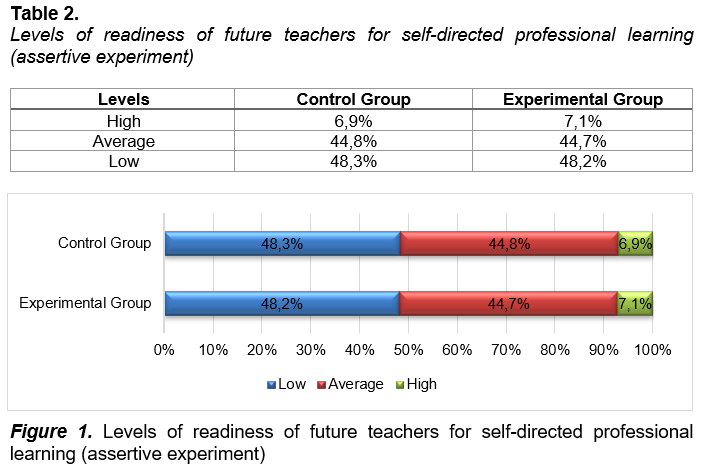
The data obtained at the initial stage of the experiment thus confirmed the low level of formation of future teachers' readiness for self-directed professional learning, which does not allow them to carry out professional activities effectively.
The results of the initial section showed that the groups of students who participated in the experiment had a similar distribution of levels of readiness for self-directed professional learning.
According to the observation results, a high level was observed in only 6.9% of students for the CG and 7.1% for the EG. Students demonstrated the ability and readiness to consciously perform key functions of self-directed professional learning regardless of the proposed situations and their external factors. The average level was determined in 44.8% of students for the CG 44.7% for the EG. The low level was observed in 48.3% of students for the CG and 48.2% for the EG.
Based on the data analysis, we can conclude that future teachers' readiness for self-directed professional learning is generally low.
When identifying the level of readiness of students for self-directed professional learning, based on the data of the analysis of the questionnaire at the initial stage of the experiment, expert assessment, we come to the conclusions: students do not have a clear understanding of the essence of the learning process; deficiencies in the formation of skills necessary for self-directed professional learning have a significant impact on the level of readiness for the specified process.
The program for the formative stage of the experimental study and for the interpretation of the experimental results.
The results of the initial stage of the study indicated that increasing future teachers' readiness for self-directed professional learning is necessary in higher education. For this purpose, we developed an experimental program that was implemented in the EG. The CG studied according to the standard teaching methodology.
The program of the formative stage of the experimental study included a set of experimental factors (independent variables) introduced into the pedagogical process, which significantly affect the dependent variables, which, in turn, change under the influence of the first: the goal of forming the readiness of future teachers for self-directed professional learning; selective components, updated content of subject programs, active learning methods, innovative forms and digital applications.
The preparation of EG students for self-directed professional learning in higher education shares components with general professional training and is carried out throughout the educational process. At the same time, such training has its own specific features, determined by its nature and the nature of pedagogical activity. In view of this, during the study, we identified the following stages that will contribute to the development of future teachers' readiness for self-directed professional learning in the educational environment of higher education, and proposed for EG respondents:
-The first stage is the teacher's adaptation to the profession (the student goes through a period of initial mastery of the necessary innovative digital tools, techniques, mindset, norms, and professional practices, sets goals, and forms value orientations for further self-improvement and self-directed learning).
-The second stage is individualization (awareness of carrying out professional activity and its individual capabilities; the beginning of self-directed learning through the profession; awareness of the possibilities for fulfilling professional norms; smoothing out negative qualities and strengthening positive qualities, building an individual modern style of activity).
- The third stage – free mastering of the profession by future teachers (mastering the system of scientific skills, knowledge, abilities, the ability to evaluate one’s results critically, one’s own achievements, the ability to conduct self-reflection, which provides the future teacher with versatile development, familiarizing the individual with educational standards, reproducing previously mastered methodological recommendations, digital tools of developments at the proper - level, the ability to correctly and quickly find information in social networks, the Internet space, as well as the use of modern information technologies in this process).
- The fourth stage – self-realization in the profession of a future teacher (the ability to critically evaluate one’s own skills, results, achievements; maximum self-realization in professional activity; conducting self-reflection in the self-directed learning process; transition to a creative state and mastering the professional culture of personality, which affects oneself, the surrounding socio-pedagogical environment; implementation of the process of forming social and professional qualities; improvement of professional activity).
The use of integrated Internet technologies, which was proposed in the EG, made it possible to implement important tasks for the self-directed professional learning of students: to optimally integrate forms of using Internet technologies in education and professional activities, taking into account the main aspects of the educational process; by taking into account the skills of working on the Internet and the level of students' computer skills, to minimize the technical complexity of the tasks; by giving students great freedom in the information space and time for actions, to take into account the individual characteristics of students; since students must be able to organize their own time, it is necessary to teach them to be more responsible for their own knowledge, to decide what information can be used to complete the task, in what form the student should present their point of view.
The study considered it necessary to create a new, innovative educational environment for EG students, including the widespread use of multimedia teaching aids, STEM, and IT technologies. It updated laboratory facilities for studying professionally oriented subjects. In such an innovative and creative environment as the one in which EG students were, the requirements for organizing the educational process in such an environment for the professional, modern training of future teachers increased. In the STEAM methodology, the focus was on a practical task or a professional problem. EG respondents learned to find ways to solve the problem not only in theory but also in real time, using digital tools through mistakes and trials. In the STEAM space, EG students received much more autonomy than in classical education; they determined the appropriate pedagogical technologies necessary for developing creative, cognitive, and mental qualities, the level of which in the modern market of educational services determines students' competitive ability.
The theoretical and methodological basis of the developed innovative environment for the formation of future teachers' readiness for self-directed professional learning, in which EG students studied, was the following approaches:
- The synergistic approach treats self-directed professional learning as a nonlinear dynamic process of self-organization that occurs with the help of internal factors and under the influence of interactions with external factors. Within the framework of teacher training, this means the ability to self-direct professional learning, adapt to change, and make non-standard pedagogical decisions.
- The acmeological approach provides training for future teachers, as individuals, for continuous self-directed professional learning, focused on the highest professional achievements.
- The anthropocentric approach allows organizing, based on self-education, the process of forming students' readiness for their self-directed professional learning and strengthening students' internal activity in professional activities.
The activity approach contributes to paradigmatic changes in education, provides an opportunity for the individual to self-directed professional learning, - to specially organized activities aimed at self-realization and achievement of their certain ideal; provides students with a general style of thinking, which is a new turn of the spiral in the development of science.
- The competency-based approach is considered in the plane of the formation of certain competencies in a future teacher, which contribute to their continuous self-directed professional learning and successful solution of professional tasks.
- The axiological is oriented to a person as the highest value, and during the selection of methods, forms, and content of training future teachers, it encourages professional continuous self-directed learning, allowing for the consideration of their value orientations, and is considered in the context of students' awareness of the values of self-directed professional learning.
- The systemic approach involves research into the professional continuous self-directed learning of future specialists and the process of high-quality training for future teachers to support this learning, which constitutes a pedagogical system.
- The personal approach ensures continuous self-directed professional learning in the training of specialists; orientation on the personality of each student.
- The synergistic approach allows us to consider students' continuous, self-directed professional learning as a process of constant development in accordance with the evolution of society, nature, and man, and the universal laws governing society.
- The culturological approach, as a basis, involves using the phenomenon of culture to explain and understand pedagogical processes and phenomena, particularly those that underpin preparing future teachers for continuous, self-directed professional learning.
- The creative approach orients future teachers to the search for non-standard solutions and new approaches in pedagogical, professional, and organizational activities. In this context, self-directed professional learning in personality involves the development of innovative initiative, the generation of original methods, creative thinking, and the ability to experiment among students.
- The reflective approach emphasizes the importance of analyzing each student's own activities, identifying errors, evaluating achievements, and deriving new development goals.
- The contextual approach ensures the creation of conditions as close as possible to professional real-world activity.
- The heutagogic approach consists of collecting the best, organizing self-education, and innovative practices, seeking effective ways for personal and professional growth by searching for a new paradigm of education, conscious inclusion of students in education, where the individual begins to play the role of a manager of their knowledge.
Such a system of teacher training in a developed, innovative environment allowed us at the EG to develop practical, self-directed learning skills and not only to obtain theoretical knowledge under conditions that simulate students' future professional activity.
Pedagogical conditions, a teacher training system has been developed for the educational process of EG students, an innovative environment and a special course have been created with the aim of introducing digital innovative technologies for the self-directed professional learning of teachers and forming students' readiness for the outlined phenomenon, which is what the formative experiment was aimed at.
The study outlines the following pedagogical conditions that ensure the self-directed professional learning of students:
- Creation of a creative digital environment, the effectiveness of which is ensured by innovative learning approaches, productive methods, and features of the educational process that create a motivational field for professional self-realization.
-Self-determination and professional orientation in a modern, innovative society.
-Support of positive motivation for self-directed professional learning.
-Creation of a socio-communicative digital-rich space in the process of interactive interaction of students to demonstrate positive professional experience and create "situations of success" in higher education.
Dependent variables: level of readiness for self-directed professional learning of future teachers in general, components, criteria, and indicators.
In our study, we identified the following additional variables:
Individual qualities of students (interests, abilities, attitudes toward self-directed professional learning, and professional duties) are factors that depend on the pedagogical process. In various ways in the experiment, these additional variables were eliminated as much as possible.
When conducting diagnostics, the methods used at the initial stage were used. This made it possible to compare the results of the research stages more correctly. Experimental data were obtained for the motivational, cognitive-operational, and activity components and were distributed across three levels (low, average, high).
According to the study on determining the readiness of future teachers for self-directed professional learning, the data were summarized across the three identified components.
The results are presented in Table 3 and Figure 2.
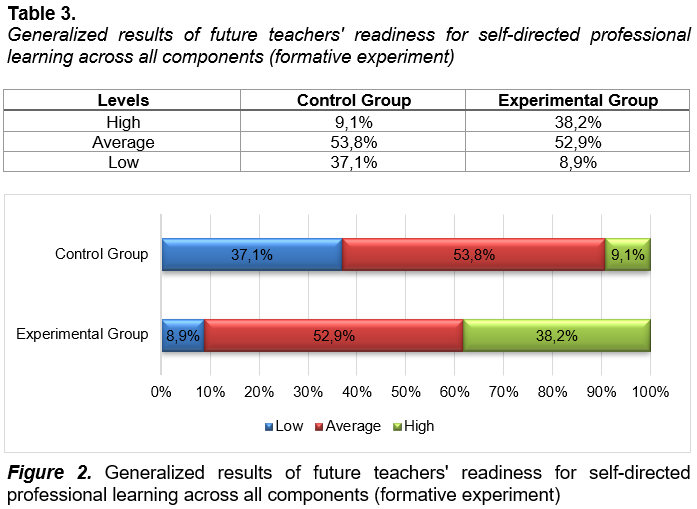
At the formative stage of the experiment, we applied mathematical and statistical methods to substantiate the conclusions drawn from the experimental work.
To assess the statistical significance of differences in readiness for self-directed professional learning at the end of the experiment between CG and EG students, the Pearson criterion (χ2) was used.
According to the results of calculating the Pearson criterion (χ2), the alternative hypothesis H1 is accepted about the significant influence of the experimental factor on the studied process, which was manifested in the influence on the educational process of EG students: pedagogical conditions, innovative teacher training system, innovative environment, and special course.
The results of the study indicate significant differences between CG and EG at the 0.05 level of significance. This means that our null hypothesis, adopted at the initial stage, is consistent with the observed results: these differences are determined by innovations (pedagogical conditions, the teacher training system, the creation of an innovative environment, and a special course), and the distribution of students in groups by readiness levels differs.
The formative experiment allowed us to form the following conclusions that will confirm the effectiveness of the experimental work:
-In the experimental groups, the number of students who have reached a high level of readiness is higher with the use of pedagogical conditions, an innovative teacher training system, an innovative environment, and a special course; in the control groups, the number of students with an average level prevails, where classes were held according to the traditional organization of the educational process.
-The results of the mathematical and statistical analysis conducted between the CG and the EG before the experiment indicate no statistically significant differences in the level of readiness of future teachers for self-directed professional learning across all components. After the experiment, statistically significant differences were observed between the CG and the EG.
Analysis of digital data on the dynamics of changes in future teachers' readiness for self-directed professional learning indicates that the initial indicators in the CG and the EG for conducting the initial diagnosis were approximately the same. The method of mathematical and statistical analysis reinforces this statement: no statistically significant differences were found “at the entrance” between the level of readiness of respondents in the CG and the EG for self-directed professional learning.
For a reliability of 95%, or a probability coefficient of σ = 0.05, generally accepted in pedagogical research, for the number of degrees of freedom and the number of levels С = 4 − 5 = С – 1 = 4, then: T2 = 9.49 − critical value of the criterion. This means that the distribution of future teachers' levels of readiness for self-directed professional learning in CG and EG at the end of the experiment differs significantly, confirming the statistical significance of the results. The difference in EG between the components is insignificant.
The results obtained in this study demonstrate a significant increase in the proportion of students with a high level of readiness for self-directed professional learning in the experimental group (from 7.1% to 38.2%), which confirms the effectiveness of the implemented pedagogical conditions. These findings are consistent with previous research emphasizing the positive impact of structured digital learning environments on self-directed learning development.
In particular, the results align with the study by García-Martínez and Fallas-Vargas (2022), who reported that students engaged in personalized and technology-supported learning environments demonstrate higher levels of autonomy and self-regulation. However, unlike their correlational findings, the present study provides experimental evidence, confirming a causal relationship between pedagogical intervention and increased readiness levels.
Similarly, the findings support the conclusions of Rini et al. (2022), who identified a strong relationship between self-directed learning and digital literacy development. The substantial increase in high-level readiness in the experimental group in this study may be explained by the integration of digital tools and platforms, which, as noted by Rini et al. (2022), facilitate independent learning and cognitive engagement.
The results are also in line with the research of Alanoglu et al. (2026), who highlighted the mediating role of digital competence in the development of self-directed online learning. In the present study, the implementation of a STEAM-oriented digital environment and a structured special course contributed to the development of both digital competence and self-directed learning readiness, reinforcing the interdependence identified in previous studies.
At the same time, the findings extend the conclusions of Morris and Rohs (2023), who argued that digital technologies alone do not guarantee the development of self-directed learning skills. The significant differences between the experimental and control groups in this study confirm that the effectiveness of digital learning depends on structured pedagogical support, including guided activities, reflection, and targeted training.
Furthermore, compared to the findings of Temiaková and Pavlov (2026), who reported variability in self-directed learning depending on experience and context, the results of this study demonstrate that purposeful pedagogical conditions can significantly reduce such variability and ensure more consistent development of readiness among students.
In contrast to studies highlighting challenges such as low initial autonomy and motivation (Morris & Rohs, 2023), the present research shows that these limitations can be effectively addressed through a combination of motivational, cognitive, and activity-based components within a structured pedagogical model.
Thus, the obtained results not only confirm existing theoretical assumptions about the importance of digital and student-centered learning environments but also provide new empirical evidence regarding the effectiveness of an integrated pedagogical model in developing readiness for self-directed professional learning among pre-service teachers.
Conclusions
The study examined the development of pre-service teachers’ readiness for self-directed professional learning in the context of digital higher education. The results confirm that self-directed professional learning represents a complex integrative construct that combines motivational-value, cognitive-operational, and behavioral-reflective components. The analysis of the initial stage of the experiment demonstrated that the majority of students showed insufficient levels of readiness for self-directed professional learning, which indicates the need for purposeful pedagogical support and the transformation of teacher training practices in higher education.
The implementation of the proposed pedagogical conditions, including the integration of digital learning technologies, the development of a STEAM-oriented learning environment, the use of student-centered and activity-based learning strategies, and the introduction of a specialized training course, contributed to a significant improvement in students’ readiness for self-directed professional learning. Statistical analysis confirmed the effectiveness of the experimental intervention: students in the experimental group demonstrated a higher proportion of high-level readiness indicators compared to the control group, where traditional teaching approaches were applied.
The study provides empirical evidence that the formation of readiness for self-directed professional learning requires a systematic pedagogical approach that combines technological, methodological, and motivational components. The results emphasize the importance of creating innovative digital learning environments that encourage autonomy, reflection, and continuous professional development among future teachers.
From a theoretical perspective, the research contributes to the advancement of teacher education theory by clarifying the structure and pedagogical conditions for developing readiness for self-directed professional learning in digitally transformed higher education. The findings expand existing research by experimentally validating a model that integrates digital technologies, heutagogical principles, and STEAM-oriented learning practices within teacher training programs.
The practical implications of the study lie in the possibility of applying the proposed pedagogical conditions and training model in teacher education programs at higher education institutions. The integration of digital learning tools, flexible learning environments, and reflective learning strategies can significantly enhance students’ autonomy, professional motivation, and ability to engage in lifelong learning.
Despite its contributions, the study has several limitations. The research was conducted within a limited sample of pedagogical universities, which may affect the generalizability of the results. In addition, the study focused primarily on quantitative indicators of readiness, while qualitative aspects of students’ professional development and long-term effects of the intervention require further investigation.
Future research should focus on extending the empirical scope and methodological rigor of the present study: it is necessary to conduct longitudinal studies to examine the sustainability and long-term effects of self-directed professional learning readiness, particularly tracking how these competencies evolve during the transition from pre-service to in-service teaching; further studies should investigate the differential impact of specific components of the pedagogical model (motivational-value, cognitive-operational, and activity-reflective) using multivariate statistical techniques (e.g., structural equation modeling) to determine their relative contribution to overall readiness development; it is important to explore the effectiveness of the proposed model across diverse educational contexts, including different academic disciplines, institutional types, and cultural settings, in order to assess its generalizability and contextual sensitivity; future research should incorporate mixed-methods designs, combining quantitative measurement with qualitative approaches (e.g., interviews, reflective journals, learning analytics data) to gain deeper insight into students’ individual learning trajectories and mechanisms of self-directed learning development; a promising direction involves the integration of adaptive digital learning systems, where personalized learning pathways are generated based on students’ readiness profiles. In this context, research should examine how specific features of digital environments (e.g., feedback mechanisms, scaffolding strategies, and task complexity) influence the development of self-directed learning competencies; future studies should address equity-related factors, including differences in digital access, prior learning experience, and self-regulation skills, in order to identify potential barriers to the effective implementation of self-directed learning in digitally enriched environments.