
Original Article
Eduweb, 2026, abril-junio, v.20, n.2. ISSN: 1856-7576
Doi: https://doi.org/10.46502/issn.1856-7576/2026.20.02.25
Digital Educational Training of Future Legal Professionals in Foreign Trade of Agricultural Products: EU and Ukraine
Serhii Kravchenko
Ph.D., Associate Professor, Director of the Center for Extramural and Distance Learning of National University "Odesa Law Academy", Odesa, Ukraine.
https://orcid.org/0000-0001-6252-3243
Oleksandr Pachchenko
Ph.D., Associate Professor of the Department of Civil Law Disciplines, Institute of Law and Security, Odessa State University of Internal Affairs, Odesa. Ukraine.
https://orcid.org/0000-0002-1679-7689
Olha Tsybulska
Ph.D., Associate Professor of the Department of International and European Law of National University «Odesa Law Academy», Odesa, Ukraine.
https://orcid.org/0000-0001-5534-4917
Olena Khrapenko
Candidate of Juridical Sciences, Associate Professor, Assistant Professor of the Department of Judiciary,Law Enforcement Authorities and Advocacy National University «Odessa Law Academy», Odesa, Ukraine.
https://orcid.org/0000-0001-5864-0367
Hanna Samilo
Ph.D., Head of the Department of “Constitutional, Administrative and Labor Law”, National University "Zaporizhzhia Polytechnic", Zaporizhzhia, Ukraine.
https://orcid.org/0000-0001-9493-8013
Cómo citar:
Kravchenko, S., Pachchenko, O., Tsybulska, O., Khrapenko, O., & Samilo, H. (2026). Digital Educational Training of Future Legal Professionals in Foreign Trade of Agricultural Products: EU and Ukraine. Revista Eduweb, 20(2), 434-447. https://doi.org/10.46502/issn.1856-7576/2026.20.02.25
Recibido: 10/04/26 Aceptado: 15/06/26
Resumen
Existe una creciente demanda de profesionales jurídicos altamente cualificados con conocimientos de derecho internacional y europeo, herramientas digitales para el comercio exterior y las particularidades de la regulación de la exportación e importación de productos agrícolas. La digitalización de los procesos comerciales, la expansión del comercio electrónico y la introducción de sistemas de certificación digital plantean nuevos retos para el sistema de formación jurídica. En particular, el análisis y la aplicación de las mejores prácticas educativas de la UE contribuirán a fortalecer la capacidad institucional de Ucrania y a garantizar su participación efectiva en el mercado internacional de productos agrícolas. El objetivo del estudio es un análisis comparativo de la formación digital de futuros abogados en el ámbito del comercio exterior. La metodología de la investigación consta de los siguientes métodos: método estructural-funcional, método empírico, método de análisis y síntesis, y método sistémico. Como resultado del estudio, se realizó un análisis exhaustivo de la formación digital de futuros abogados especializados en la regulación jurídica del comercio exterior de productos agrícolas en el contexto del programa de integración europea de Ucrania. A partir de un análisis jurídico comparativo, se identificaron las tendencias en la formación de competencias digitales de los abogados en la UE y se evaluó la preparación del sistema de formación jurídica ucraniano para implementar las herramientas digitales modernas necesarias para la actividad profesional en el mercado agrícola internacional. Se prestó especial atención al impacto de la guerra en la transformación de la educación superior en Ucrania. Se propusieron líneas estratégicas para adaptar las mejores prácticas europeas en la digitalización de la educación.
Palabras clave: educación moderna, educación jurídica digital, competencias digitales, integración europea, prácticas educativas, preparación de estudiantes.
Abstract
There is a growing demand for highly qualified legal professionals who have knowledge of international and European law, digital tools of foreign trade activity and the specifics of regulating the export and import of agricultural products. The digitalization of trade processes, the expansion of e-commerce, the introduction of digital certification systems create new challenges for the legal education system. In particular, the analysis and implementation of the best educational practices of the EU will contribute to strengthening the institutional capacity of Ukraine and ensuring effective participation in the international market of agricultural products. The purpose of the study is a comparative analysis of the digital educational training of future lawyers in the field of foreign trade. The research methodology consists of the following methods: structural-functional method, empirical method, method of analysis and synthesis, system method. As a result of the study, a comprehensive analysis of the digital educational training of future lawyers specializing in the legal regulation of foreign trade in agricultural products was conducted in the context of Ukraine's European integration course. Based on comparative legal analysis, trends in the formation of digital competencies of lawyers in the EU were identified and the readiness of the Ukrainian legal education system to implement modern digital tools necessary for professional activity in the international agricultural market was assessed. Particular attention was paid to the impact of the war on the transformation of higher education in Ukraine. Strategic directions for adapting best European practices in the digitalization of education were proposed.
Keywords: modern education, digital legal education, digital competencies, European integration, educational practices, student preparation.
Introduction
The development of digital technologies significantly transforms the educational environment and requires the integration of digital competencies into the professional training of students. In the context of European integration and Ukraine's approximation to EU standards, there is a need to combine international experience in digital education with national educational practices.
The European Declaration on Digital Rights and Principles (European Union, 2023) defines basic standards of digital literacy, access to technology and data security, which are important guidelines for the formation of competencies of future specialists in the field of foreign trade. The conclusion of the Association Agreement between Ukraine and the EU (European Commission, 2017) is aimed at harmonizing the legal field and economic relations, including trade in agricultural products, which requires appropriate training of specialists. EU Regulation No. 1308/2013 establishes a single organization of agri-food markets, and the WTO provisions on agricultural trade regulate international standards that affect the activities of specialists in the field of foreign economic activity (World Trade Organization, n.d.).
The digitalization of the educational process plays an important role in the transformation of education. The European Commission, in its reports “Digital Education Action Plan (2021–2027)” identifies priorities for integrating digital tools, improving the digital competence of teachers and students, and creating conditions for innovative learning. The digital competence frameworks (DigComp, DigCompEdu) serve as a reference point for assessing the level of digital training and planning educational programs. An analysis of the current state of digital education in Europe shows the active implementation of e-learning and interactive methods, which contributes to the formation of professional competencies (European Association for Viewers Interests [EAVI], 2018).
At the same time, the development of Ukraine's foreign trade demonstrates dynamic growth despite the difficult conditions of the economic and security crisis. This creates a need for training specialists who possess both practical knowledge in the field of foreign economic activity and digital competencies for effective operation in the conditions of the modern market. European experience combined with national specifics opens up opportunities for the development of digital training of future specialists and the formation of highly qualified personnel for the agricultural sector and foreign trade activities.
The lack of comprehensive research on the features of digital training for lawyers in the specific field of foreign trade in agricultural products, as well as the lack of a systematic comparative analysis of the experience of the EU and Ukraine, create obstacles to the effective harmonization of educational standards and the implementation of best European practices in the domestic legal education system.
Thus, the relevance of the study is due to the need to integrate digital educational technologies and European standards into the training of specialists in foreign trade in agricultural products in Ukraine, which will contribute to increasing the competitiveness of the national agricultural sector and adaptation to international market requirements.
The purpose of the study is to conduct a comparative analysis of digital training systems for future lawyers in the field of foreign trade in agricultural products in the EU and Ukraine, identify key differences, identify best practices, and formulate recommendations for improving the Ukrainian system of specialist training, taking into account European integration processes.
The object of the study is the system of professional training of future lawyers specializing in the legal regulation of foreign trade in agricultural products in the European Union and Ukraine.
The subject of the study is digital technologies, methods, tools and learning platforms used in the process of training future international lawyers in the field of foreign trade in agricultural products, as well as a comparative characteristic of educational standards, programs and practices of digitalization of legal education in the EU and Ukraine.
To achieve the goal, it is necessary to solve the following tasks:
To ensure terminological clarity of the study, it is necessary to identify key concepts used in the context of digital training of future specialists in the field of foreign trade in agricultural products:
Theoretical Framework and Literature Review
The analysis of scientific sources indicates the growing attention of researchers to the digital transformation of education, especially in the context of professional training of those applicants who will work in the field of international trade in agricultural products.
Radkevych et al. (2018) provide a thorough comparison of vocational education models in the EU, where one of the central features is the close integration of digital solutions into the interaction between universities and employers. The researchers emphasize that digital technologies provide rapid updating of knowledge, flexibility of educational trajectories and data-based decision-making. The authors actually indicate: the development of qualifications in the EU is impossible without modern digital tools, and the relevant experience should become a reference point for Ukraine. We share the opinion that digital competencies are mandatory for lawyers who will work with the regulatory mechanisms of agricultural trade, since most trade and legal procedures are electronic.
Methodological recommendations by Turchyn et al. (2022) emphasize the dominance of practice-oriented digital forms of learning in European universities. Researchers emphasize that the use of simulations, interactive platforms and digital simulators not only increases the efficiency of learning, but also “models professional scenarios that are as close as possible to real practice”. We fully agree with this position, since the training of specialists in the field of international agricultural trade should involve working with real digital platforms used in the European market.
European scholars Gisbert-Cervera & Caena (2022) draw attention to the fact that the digital competence of the teacher is a catalyst for the digital development of the student. The authors actually note: a teacher who does not own modern digital tools is not able to effectively form these skills in others. They justify the need for systematic support and advanced training of teachers within the framework of DigCompEdu.
Starkey (2020) conducts a systematic review of international practices in teacher training for the digital era, where the author emphasizes the need to integrate digital competencies into teaching activities, which directly affects the effectiveness of student learning. It is highlighted that the level of digital literacy of the teacher determines the quality of the formation of relevant skills in students, and insufficient training of teachers creates significant barriers to the implementation of innovative teaching methods. These findings are directly consistent with the need to train Ukrainian lawyers to work with electronic platforms and digital systems for regulating foreign trade in agricultural products.
Mannila et al. (2018) examined the relationship between teachers’ digital competences, their self-esteem and learning needs. The authors emphasize that a high level of digital mastery of teachers increases their confidence in applying innovative methods and, as a result, contributes to the effective formation of digital skills in students. This confirms the need for a systematic approach to improving the skills of teachers, in particular in the training of future specialists in foreign trade of agricultural products, where modern digital skills are mandatory for working with electronic certificates, customs systems and trading platforms.
Bakhmat's (2022) study focuses on the formation of students' professional competencies in a digital educational environment. The author demonstrates that the use of electronic platforms and interactive tools increases the level of practical training of education seekers and provides the opportunity to apply theoretical knowledge in real situations. Similar conclusions are confirmed in the work of Bakhmat et al. (2022), which emphasizes that the digital transformation of education in conditions of war and informatization of society ensures the stability of the education system, promotes the accessibility of training and forms competencies relevant to the modern labor market. These observations confirm the importance of a practice-oriented approach in the training of lawyers to work with international trade processes in the agricultural sector.
In summary, the sources cited indicate a close relationship between the development of foreign trade and the need for highly qualified personnel with digital competencies. In Ukraine, despite the crisis conditions and martial law, there is an increase in trade, which emphasizes the need to modernize vocational education. Thus, the research data confirm that digital tools and competencies are becoming a key element in the training of specialists capable of operating effectively in the field of international agricultural trade, ensuring the competitiveness of Ukraine in world markets.
Methodology
This study employs a qualitative documentary research design with a structured comparative approach. The empirical basis of the study consists of EU legal acts, Ukrainian regulatory documents, methodological recommendations, institutional reports, and peer-reviewed scientific publications published between 2018 and 2025. The selection of sources was based on relevance to digital legal education, foreign trade regulation, and European integration processes.
The structural-functional method is used to analyze the organizational and functional aspects of vocational education systems, including teacher training and curriculum structure. It is based on the study of educational models of the EU and Ukraine, in particular their organization, use of digital technologies and integration of practical components. The method helped to identify elements of the system that contribute to the formation of digital competencies of students.
Documentary analysis of statistical and analytical sources was employed to examine trends in foreign trade development and the evolving demand for professional and digital competencies in the agricultural sector. Statistical reports, institutional analyses, and analytical publications issued by the National Institute for Strategic Studies, UNIAN, and the World Bank were included in the documentary corpus. The examination of these sources enabled the identification of key trends, challenges, and competency requirements relevant to the training of future legal professionals involved in foreign trade activities.
The method of analysis and synthesis involves the systematization and integration of data from various sources: scientific publications, regulatory acts, and statistical materials. The use of this method allowed us to identify patterns and trends in digital education and training of specialists in foreign agricultural production.
The systems method provides a comprehensive approach to studying the process of training future specialists as a single system, including legal, educational, technological and economic components. The application of this method allows to assess the relationships between regulatory requirements, digital competencies of students and teachers, program structure and labor market needs.
The comparative analysis was conducted using the following analytical categories:
Inclusion criteria covered official EU and Ukrainian policy documents, peer-reviewed publications, and institutional analytical reports addressing digital legal education, vocational training, digital competencies, and foreign trade regulation in the agricultural sector. Sources not directly related to legal education or lacking analytical relevance to the research objectives were excluded.
The combination of these research methods ensures scientific validity, systematicity, and practical relevance of the results. Each method contributed to the achievement of the research objectives: the structural-functional method facilitated the identification of organizational elements of educational systems; the documentary analysis of statistical and analytical sources enabled the identification of trends, challenges, and competency requirements; the method of analysis and synthesis supported the integration and interpretation of information from diverse sources; and the systems method provided a comprehensive understanding of the relationships among educational, legal, technological, and economic components involved in the training of future legal professionals.
The documentary analysis was conducted through structured comparative interpretation of EU and Ukrainian regulatory, scientific, and institutional sources according to predefined analytical categories.
Results and Discussion
Comparative Analysis of the Regulatory Framework for Digital Legal Education in the EU and Ukraine
The comparative documentary analysis demonstrated that the European Union has developed a systematic and institutionally coordinated approach to the digital transformation of education through strategic policy documents, digital competence frameworks, and unified educational standards. In particular, the European Declaration on Digital Rights and Principles (European Union, 2023), the Digital Education Action Plan 2021–2027, DigComp, and DigCompEdu establish a comprehensive framework for the formation of digital competencies, integration of innovative technologies into the educational process, and continuous professional development of teachers (European Union, 2023; European Union, 2021; European Commission, 2023; Digital Skills and Jobs Platform, 2024).
The analysis of EU regulatory and methodological documents revealed that digital competencies are considered a mandatory component of professional education, including legal education related to foreign trade and agricultural market regulation. EU educational policy emphasizes practical digital training, interdisciplinary learning, and the integration of Legal Tech tools into educational programs (European Commission, 2025; European Commission, 2018).
In contrast, the Ukrainian system of legal education is currently undergoing accelerated digital transformation in response to European integration processes and wartime challenges. The documentary analysis indicates that Ukraine has adopted strategic directions toward educational digitalization and harmonization with European standards; however, the implementation of these initiatives remains uneven due to infrastructural disparities, insufficient institutional support, and limited digital preparedness of some educational institutions (Ivanenko et al., 2023; European Training Foundation, 2024).
At the same time, methodological recommendations developed within Ukrainian higher education institutions, particularly the course “Ukraine–EU: Digital Transformation” implemented at the National University “Lviv Polytechnic,” demonstrate a gradual approximation of domestic legal education to European educational practices (Turchyn et al., 2022). The findings suggest that Ukraine is transitioning from emergency digital adaptation toward a more systematic integration of digital educational models.
Comparative Analysis of Digital Tools and Educational Platforms
The structured comparative analysis revealed significant differences between the EU and Ukraine regarding the integration of digital technologies into the training of future legal professionals specializing in foreign trade in agricultural products.
The analysis of European educational practices demonstrates that vocational and legal education institutions in the EU actively integrate digital learning platforms, electronic certification systems, online simulations, and blended learning technologies directly into curricula. In Finland, digital educational ecosystems combine electronic textbooks, online learning environments, and progress monitoring systems. In the Netherlands, educational institutions actively use electronic portfolios and digital simulations of export procedures and customs processes. Germany applies blended learning models focused on business process modeling and digital trade management, while Scandinavian countries prioritize lifelong digital learning and continuous competence development (Radkevych et al., 2018).
The documentary analysis further indicates that the integration of digital tools into European educational programs is closely connected with labor market needs and practical professional training. Educational institutions cooperate with governmental bodies, business representatives, and international organizations to ensure that students acquire practical digital skills required for work with customs platforms, electronic certification systems, trade databases, and Legal Tech solutions (EAVI, 2018; European Commission, 2025).
In Ukraine, digital educational practices expanded significantly due to the challenges caused by the military conflict and the need to ensure continuity of the educational process. The findings demonstrate that Ukrainian higher education institutions actively introduced distance learning technologies, electronic educational platforms, and blended learning formats. However, unlike the EU model, Ukrainian digitalization often remains reactive rather than strategically institutionalized (Bakhmat et al., 2022; Yatsukh, 2025).
The comparative analysis revealed that the Ukrainian legal education system still faces limitations related to uneven access to digital infrastructure, insufficient financing of technological modernization, and the incomplete integration of practical digital tools related to international agricultural trade regulation (Leu-Severynenko, 2022; European Training Foundation, 2024).
Teacher Digital Competence and Professional Preparedness
The documentary analysis identified teacher digital competence as one of the key analytical categories influencing the effectiveness of digital legal education.
European educational policy documents and scientific studies consistently emphasize that teachers’ digital preparedness directly affects students’ professional competence formation. The DigCompEdu framework provides a structured model for the development of teachers’ digital competencies, including digital communication, online assessment, content creation, and integration of digital technologies into professional training (European Commission, 2023).
The analysis of scientific literature demonstrates that EU educational systems implement systematic teacher training programs focused on digital skills development and practical application of innovative teaching methods. European universities provide continuous professional development opportunities for academic staff, including specialized training in online teaching methodologies, Legal Tech applications, and interactive educational technologies (Gisbert-Cervera & Caena, 2022; Starkey, 2020).
The comparative analysis further revealed that teacher self-efficacy significantly influences the successful implementation of digital learning models. As shown by Mannila et al. (2018), teachers with a higher level of digital confidence are more likely to apply innovative teaching approaches and facilitate students’ acquisition of practical professional skills.
In Ukraine, the process of developing teachers’ digital competencies intensified considerably during wartime conditions. The documentary analysis demonstrates that the transition to distance and blended learning accelerated the acquisition of digital skills among academic staff. Nevertheless, the findings indicate substantial disparities in the level of digital preparedness between educational institutions and regions (Bakhmat et al., 2022).
The results also demonstrate that many Ukrainian educators still require additional professional training in the application of digital educational technologies, interactive teaching methods, and Legal Tech tools relevant to foreign trade and agricultural law (Ivanenko et al., 2023; Yatsukh, 2025).
Challenges and Barriers to the Digital Transformation of Legal Education in Ukraine
The comparative documentary analysis identified several major barriers affecting the digital transformation of legal education in Ukraine.
First, infrastructural inequality remains a significant challenge. The analysis revealed uneven access to stable internet connection, digital platforms, and technological equipment across educational institutions, particularly under wartime conditions (Bakhmat et al., 2022).
Second, the findings indicate insufficient institutionalization of digital educational policies compared to the EU model. While the European Union has established unified competence frameworks and coordinated implementation mechanisms, Ukraine is still developing a comprehensive and fully integrated digital education strategy for legal training (European Union, 2021; Ivanenko et al., 2023).
Third, the study identified limited integration of Legal Tech technologies and practical trade-oriented simulations into legal education programs. Unlike European educational institutions, Ukrainian universities only partially incorporate digital tools related to customs procedures, electronic certification, online dispute resolution, and international trade documentation (Radkevych et al., 2018; Turchyn et al., 2022).
Fourth, the analysis revealed the need for systematic professional development of teachers in the field of digital pedagogy and technological innovation. The lack of consistent institutional support mechanisms complicates the sustainable implementation of digital learning approaches (Starkey, 2020).
At the same time, the findings demonstrate that wartime challenges have accelerated educational innovation and stimulated the active implementation of online learning technologies, electronic educational resources, and international academic cooperation (Bakhmat et al., 2022; Yatsukh, 2025).
Comparative Findings and Implications for Legal Education Modernization
The comparative analysis demonstrated that the EU model of digital legal education is characterized by systematic institutional coordination, practical integration of digital technologies, and strong alignment between education and labor market demands (Radkevych et al., 2018; European Commission, 2025).
Ukraine, in contrast, remains in the stage of accelerated digital adaptation driven by European integration processes and wartime conditions. Nevertheless, the documentary analysis indicates a gradual convergence of Ukrainian educational practices with European standards (Ivanenko et al., 2023; European Training Foundation, 2024).
The structured comparative documentary analysis allowed the identification of key analytical categories reflecting the differences and similarities between the EU and Ukrainian approaches to the digital training of future legal professionals in the field of foreign trade in agricultural products. The comparison demonstrates the level of institutionalization of digital education practices, the integration of digital competencies into professional training, and the major challenges affecting the modernization of legal education in Ukraine. The analytical categories presented below summarize the principal findings derived from the reviewed regulatory documents, scientific literature, and institutional reports.
Table 1.
Comparative analytical framework of digital legal education development in the EU and Ukraine
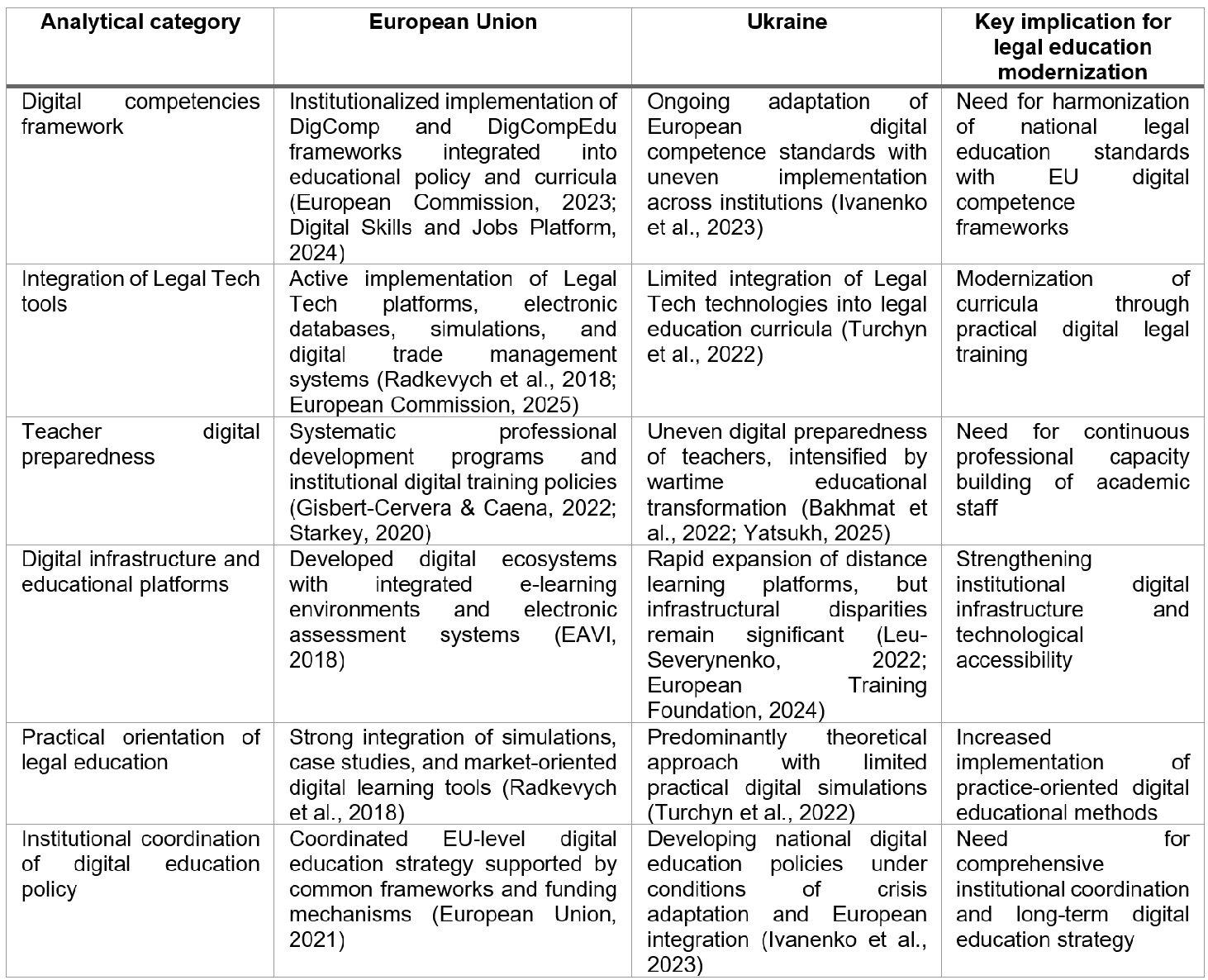
The comparative findings presented in Table 1 demonstrate that the EU model of digital legal education is characterized by systematic institutional coordination, advanced integration of digital technologies, and strong alignment between educational programs and labor market demands. In contrast, the Ukrainian system of legal education is currently characterized by accelerated digital adaptation under wartime conditions and European integration processes. At the same time, the analysis revealed substantial potential for the modernization of Ukrainian legal education through the implementation of European digital competence frameworks, expansion of Legal Tech integration, strengthening of teacher digital preparedness, and development of practice-oriented educational models.
The findings suggest that further modernization of legal education in Ukraine should focus on:
Therefore, the structured documentary comparison revealed that the successful digital transformation of legal education in Ukraine requires not only technological modernization, but also institutional, methodological, and pedagogical adaptation to European educational standards.
Conclusions
The comparative documentary analysis demonstrated that the European Union has developed a systematic and institutionally coordinated model of digital legal education based on unified competence frameworks, strategic policy documents, and the practical integration of digital technologies into professional training. The findings indicate that EU educational systems actively combine digital learning tools, Legal Tech solutions, interactive educational methods, and continuous teacher professional development to ensure the effective preparation of specialists capable of working in the field of international trade and agricultural market regulation.
The structured comparison revealed that Ukraine is currently undergoing accelerated digital transformation of legal education under the influence of European integration processes and wartime challenges. The analysis demonstrated that Ukrainian higher education institutions have significantly expanded the use of distance learning technologies, online educational platforms, and blended learning models. At the same time, the findings indicate that the implementation of digital educational practices in Ukraine remains uneven due to infrastructural limitations, insufficient institutional coordination, limited financing, and disparities in teachers’ digital preparedness.
The comparative documentary analysis further demonstrated that the development of digital competencies among teachers and students is a critical prerequisite for the modernization of legal education related to foreign trade in agricultural products. The findings confirmed that the effective integration of Legal Tech tools, electronic certification systems, customs documentation platforms, and interactive simulations into educational programs contributes to the formation of practical professional competencies required in the modern digital economy.
The study also revealed that the European experience of integrating digital technologies into vocational and legal education may serve as an important methodological and institutional reference point for Ukraine. In particular, the findings indicate the necessity of strengthening the institutional implementation of European digital competence frameworks, expanding teacher training in digital pedagogy, modernizing educational infrastructure, and increasing international academic cooperation.
The results of the structured comparative analysis allow the formulation of several practical recommendations for improving the Ukrainian system of legal education. These include the systematic integration of European digital education standards into curricula, the development of specialized digital learning platforms for agricultural trade law, the expansion of practical training using simulations and electronic trade systems, and the institutional support of continuous professional development for teachers.
Therefore, the findings suggest that the successful modernization of legal education in Ukraine requires a comprehensive approach combining technological innovation, methodological adaptation, institutional support, and alignment with European educational standards. Further scientific research should focus on the development of cross-border educational cooperation models, joint EU–Ukraine digital educational programs, and mechanisms for integrating advanced Legal Tech solutions into the professional training of future lawyers specializing in foreign trade and agricultural market regulation.
Limitation of the study
The study is limited by its documentary nature and does not include empirical surveys or interviews with educators and students. Future studies may complement the present findings through empirical assessment of digital legal education practices in EU and Ukrainian institutions.
Bibliographic references
Bakhmat, N. V. (2022). Formation of professional competence of future primary school teachers in the digital educational environment. Science and Technology Today (Pedagogy Series), 6(6), 89–100. Retrieved from http://perspectives.pp.ua/index.php/nts/article/view/1830
Bakhmat, N., Kyryliuk, O., Siasiev, A., Yurchuk, V., & Kozlovskyi, A. (2022). Digital transformation of education in the context of informatization of education and society against the background of Russian armed aggression: Current problems and vectors of development. WISDOM, 4(3), 14–21. Doi: 10.24234/wisdom.v4i3.813
Digital Skills and Jobs Platform. (2024). The Digital Competence Framework (DigComp). Retrieved from https://digital-skills-jobs.europa.eu/en/actions/european-initiatives/digital-competence-framework-digcomp
European Association for Viewers Interests. (2018). How European education keeps up nowadays: E-learning and e-education. Retrieved from https://eavi.eu/how-european-education-keeps-up-nowadays-e-learning-and-e-education/
European Commission. (2017). Association Agreement between the European Union and its Member States, of the one part, and Ukraine, of the other part. Retrieved from https://eur-lex.europa.eu/EN/legal-content/summary/association-agreement-with-ukraine.html
European Commission. (2018). Communication from the Commission to the European Parliament, the Council, the European Economic and Social Committee and the Committee of the Regions on the Digital Education Action Plan (COM(2018) 22 final). Brussels, Belgium: Author. Retrieved from https://eur-lex.europa.eu/legal-content/EN/TXT/?uri=celex:52018DC0022
European Commission. (2023). DigCompEdu: Digital competence framework for educators. Retrieved from https://ec.europa.eu/jrc/en/digcompedu
European Commission. (2025). A New Skills Agenda for Europe. Retrieved from https://employment-social-affairs.ec.europa.eu/policies-and-activities/skills-and-qualifications/european-skills-agenda_en
European Training Foundation. (2024). Key policy developments in education, training and employment: Ukraine. Turin, Italy: Author. Retrieved from https://www.etf.europa.eu/sites/default/files/2024-12/Country%20Fiche_Ukraine_2024_EN_web_0.pdf
European Union. (2021). Digital Education Action Plan 2021–2027. Retrieved from https://education.ec.europa.eu/focus-topics/digital-education/plan
European Union. (2023). European Declaration on Digital Rights and Principles for the Digital Decade. Official Journal of the European Union, C 23, 1–7. Retrieved from https://eur-lex.europa.eu/legal-content/EN/TXT/?uri=OJ:JOC_2023_023_R_0001
Gisbert-Cervera, M., & Caena, F. (2022). Teachers’ digital competence for global teacher education. European Journal of Teacher Education. Advance online publication. doi: https://doi.org/10.1080/02619768.2022.2135855
Ivanenko, N., Boiko, A., Fedorchuk, L., Panchenko, I., & Marieiev, D. (2023). Development of educational policy in Ukraine in the context of European integration and digital transformation. Revista Eduweb, 17(2), 296–305. https://doi.org/10.46502/issn.1856-7576/2023.17.02.25
Leu-Severynenko, S. (2022). A short overview on vocational education and training in Ukraine. Bonn, Germany: Federal Institute for Vocational Education and Training. Retrieved from https://datapool-bibb.bibb.de/pdfs/Snizhana_Overview_VET_in_Ukraine.pdf
Mannila, L., Norden, L., & Pears, A. (2018). Digital competence, teacher self-efficacy, and training needs. In Proceedings of the 2018 ACM Conference on International Computing Education Research (pp. 78–85). New York, NY: Association for Computing Machinery. Retrieved from https://doi.org/10.1145/3230977.323099
Radkevych, V. O., Pukhovska, L. P., Borodiienko, O. V., Radkevych, O. P., Bazeliuk, N. V., Korchynska, N. M., Leu, S. O., & Artemchuk, V. V. (2018). Modern models of vocational education and training in the European Union: Comparative experience. Kyiv, Ukraine: Institute of Vocational Education and Training of the National Academy of Educational Sciences of Ukraine.
Starkey, L. (2020). A review of research exploring teacher preparation for the digital age. Cambridge Journal of Education, 50(1), 37–56. doi: https://doi.org/10.1080/0305764X.2019.1625867
Turchyn, Y. B., Ivasechko, O. Y., Tsebenko, O. O., Sukhorolska, I. Y., Vovk, N. S., Markovets, O. V., Kasha, L. V., & Zabavska, K. Y. (2022). Ukraine–EU: Digital transformation (Methodological guidelines). Lviv, Ukraine: Lviv Polytechnic Publishing House. Retrieved from https://lpnu.ua/sites/default/files/2022/pages/18734/metodichni-rekomendacii-do-vikladannya-navchalnogo-kursu-ukraina-es-cifrova-transformaciya_0.pdf
Yatsukh, O. (2025). Educational innovations and digital technologies as an opportunity to improve the educational environment in Ukraine during martial law. European Humanities Studies: State and Society, 1(1), 68–81. https://doi.org/10.38014/ehs-ss.2025.1.06
World Trade Organization. (n.d.). Agreement on Agriculture. Geneva, Switzerland: World Trade Organization. Retrieved from https://www.wto.org/english/docs_e/legal_e/14-ag.pdf

Este artículo no presenta ningún conflicto de intereses. Este artículo está bajo la licencia Creative Commons Atribución 4.0 Internacional (CC BY 4.0). Se permite la reproducción, distribución y comunicación pública de la obra, así como la creación de obras derivadas, siempre que se cite la fuente original.