
Original Article
Eduweb, 2026, abril-junio, v.20, n.2. ISSN: 1856-7576
Doi: https://doi.org/10.46502/issn.1856-7576/2026.20.02.18
Gamification as a tool for increasing student motivation in a digital educational environment
Halyna Kozub
Candidate of Engineering Sciences, Associate Professor, Department of Information technology and systems, Luhansk Taras Shevchenko National University, Lubny, Ukraine.
https://orcid.org/0000-0001-5387-050X
Nataliia Stepanova
Candidate of Philosophical Sciences, Associate Professor, Department of Preschool and Special Education, Educational and Scientific Institute of Pedagogical Education, Social Work and Art, Bohdan Khmelnytskyi Cherkasy National University, Cherkasy, Ukraine.
https://orcid.org/0000-0002-6842-629X
Ihor Zelenyi
PhD, Deputy Director for Academic and Research Affairs, Odesa military academy, Odesa, Ukraine.
https://orcid.org/0000-0003-2115-5696
Igor Shumkov
PhD, Head of the Educational and Scientific Institute of Military Intelligence and Special Operations, Odesa military academy, Odesa, Ukraine.
https://orcid.org/0000-0002-2715-3854
Vitalii Rudynskyi
PhD, Head of Department of Management of Military Intelligence Units and Special Operations Forces, Odesa military academy, Odesa, Ukraine.
https://orcid.org/0000-0003-2066-865X
Cómo citar:
Kozub, H., Stepanova, N., Zelenyi, I., Shumkov, I., & Rudynskyi, V. (2026). Gamification as a tool for increasing student motivation in a digital educational environment. Revista Eduweb, 20(2), 308-321. https://doi.org/10.46502/issn.1856-7576/2026.20.02.18
Recibido: 05/05/26 Aceptado: 28/06/26
Resumen
El objetivo del estudio fue determinar la efectividad de la gamificación para incrementar la motivación estudiantil. La relevancia del estudio radicaba en la necesidad de aumentar la participación y la actividad de aprendizaje de los estudiantes en el contexto de la digitalización de la educación. El estudio se implementó en un formato cuasiexperimental utilizando un diseño pre-test/post-test con grupos no equivalentes (124 participantes). En el grupo experimental, se realizó una capacitación durante 8 semanas utilizando elementos de gamificación en un entorno digital. El análisis estadístico consistió en pruebas t, análisis de correlación y ANCOVA, que se utilizó para controlar las diferencias iniciales entre los grupos experimental y de control y para proporcionar una estimación más precisa del efecto de la intervención. Los resultados del estudio demostraron un incremento estadísticamente significativo en el nivel de motivación en el grupo experimental (p < 0,001) con un tamaño del efecto grande. También se estableció una relación positiva entre la intensidad del uso de la gamificación y el nivel de motivación (r = 0,64, p < 0,001). Las conclusiones destacan que la eficacia de la gamificación como herramienta para aumentar la motivación de los estudiantes se ha confirmado en general.
Palabras clave: educación superior, entorno educativo digital, gamificación, motivación estudiantil, tecnologías educativas.
Abstract
The purpose of the study was to determine the effectiveness of gamification to increase student motivation. The relevance of the study was due to the need to increase student engagement and learning activity in the context of the digitalization of education. The study was implemented in a quasi-experimental format using a pre-test/post-test design with non-equivalent groups (124 participants). In the experimental group, training took place for 8 weeks using gamification elements in a digital environment. Statistical analysis consisted of t-tests, correlation analysis, and ANCOVA, which was used to control for baseline differences between the experimental and control groups and to provide a more accurate estimate of the intervention effect. The results of the study demonstrated a statistically significant increase in the level of motivation in the experimental group (p < 0.001) with a large effect size. A positive relationship was also established between the intensity of gamification use and the level of motivation (r = 0.64, p < 0.001). The conclusions emphasize that the effectiveness of gamification as a tool for increasing student motivation has generally been confirmed.
Keywords: digital educational environment, educational technologies, gamification, higher education, student motivation.
Introduction
In the modern conditions of digitalization of university education, the issue of increasing student motivation has become particularly relevant. The active use of digital educational platforms in the educational process, distance and blended formats of classes has transformed traditional approaches to organizing education in higher education institutions, changed the features of interaction between teachers and students. At the same time, the digital environment did not always allow, as a result of the use of automation, to achieve a high level of student engagement. This feature indicated the importance of finding effective pedagogical tools to support educational motivation. One of such tools is gamification. This tool provided for the integration of game design elements into the educational process. The use of points, ratings, badges, levels, competitions and receiving instant feedback made it possible to increase interest in educational activities, stimulate active participation of students and form a positive experience of interaction of students with educational content. In the context of a digital educational environment, gamification has become a logical technological solution, but (together with appropriate pedagogical strategies) has been aimed at strengthening both intrinsic and extrinsic motivation.
Modern studies in the field of educational technology have confirmed that gamification has contributed to increasing the level of student engagement, improving learning outcomes and forming a more active position in learning (Aldalur & Perez, 2023; Camacho-Sánchez et al., 2023). At the same time, the results of such studies have indicated the existence of certain ambiguities and gaps. First of all, along with positive effects, scientists have noted the existence of certain contradictions and limitations. Special emphasis in this context is placed on the risk of dominance of external stimuli and a decrease in motivation in the long term (Papadakis & Karakose, 2025). In addition, the issues of the impact of gamification in the conditions of a complex digital educational environment, where different technological and pedagogical approaches are combined, have not been sufficiently studied.
Therefore, it has become relevant to conduct empirical research aimed at determining the role of gamification as a tool for increasing student motivation in a modern digital educational environment. Such a scientific vector is poorly represented in existing sources.
The purpose of the proposed study is to determine the impact of gamification on the level of student motivation in a digital educational environment. To confirm (or refute) the following research hypotheses were proposed:
H1. The use of gamification in a digital educational environment was statistically significant, increased the level of student learning motivation, if compared to traditional (non-gamified) approaches to learning.
H2. The level of student motivation was positively correlated with the intensity of use of gamification elements (points, badges, ratings, levels), which was manifested in increased involvement and activity in the educational process.
The paper is structured as follows. The first section presents the theoretical framework and an overview of previous research on gamification and student motivation in digital learning environments. The methodology section outlines the study design, participants, instruments, procedures, and statistical methods used for data analysis. The results section presents the empirical findings of the quasi-experimental study, including pre-/post-test comparisons, correlation analysis, and ANCOVA results. The discussion section interprets the results in relation to previous research and highlights their pedagogical implications. The conclusions summarize the main findings and suggest directions for future research.
Literature Review
In modern studies of digital education, the problem of student motivation is considered as one of the key conditions for the effectiveness of the educational process. In particular, within the framework of the Self-Determination Theory, motivation was interpreted as a multidimensional phenomenon that was formed through the satisfaction of basic psychological needs (autonomy, competence, and social interaction) (Reiter, 2025; Ukgoda, 2025). In the context of digital learning, ensuring such needs was a difficult task that necessitated the search for new pedagogical approaches (Czerkawski, 2024).
One of such approaches was gamification, which spread in higher education as a tool for increasing student engagement. Conceptually, gamification was defined as the application of game design elements in non-game contexts, in particular in the educational process. A significant contribution to the development of this approach was made by scientists who emphasized that the effectiveness of gamification depended on its integration into the content of learning (Tolentino, 2025; Saritepeci & Yildiz Durak, 2024). That is, the use of individual game mechanics was one of the elements, and not an end in itself, of gamification.
Empirical studies have shown that gamification can have a positive impact on student motivation, engagement, and learning outcomes. In particular, Pozo-Sánchez et al. (2022) found that the use of game elements (scores, badges, ratings) increased student engagement and participation in the learning process. Similar findings have been confirmed in other studies that have considered gamification as an effective tool for stimulating learning behavior (Ertan & Arkün Kocadere,2022).
However, there was no consensus among scholars on the effectiveness of gamification. Some studies have indicated that its impact was limited or context-dependent. In particular, Das et al. (2025) have emphasized that an excessive focus on external rewards could lead to a decrease in intrinsic motivation (especially when game mechanics are not related to the content of the learning). This was consistent with a broader discussion about the balance between intrinsic and extrinsic motivation in digital learning.
A separate area of research has focused on the impact of gamification on different components of motivation. Researchers noted that gamification was able to increase cognitive engagement, emotional interest and learning activity. However, the strength of such an impact could vary depending on the design of the educational environment. In this context, the importance of a comprehensive approach that combined gamification with other digital tools, primarily adaptive learning and personalization, was emphasized (Lampropoulos & Kinshuk, 2024).
At the same time, several important unresolved issues remain in the scientific literature. First, the impact of the intensity of gamification use on student motivation has not been sufficiently studied. Second, the number of empirical studies that analyzed gamification in the context of a complex digital educational environment (i.e., not from the perspective of an isolated tool) was limited. Third, the relationship between the individual components of motivation in gamified learning will need to be clarified.
Therefore, existing studies have confirmed the potential of gamification as a tool for increasing student motivation. However, the need for further empirical research aimed at clarifying the conditions for its effective application is also indicated.
Methodology
Research design
The study was conducted in a quasi-experimental format using a pre-test/post-test design with non-equivalent groups. This approach made it possible to compare the levels of students' learning motivation before and after the pedagogical intervention under the conditions of the real educational process without random assignment of participants to groups. The quasi-experimental design was chosen due to the impossibility of fully ensuring randomization of academic groups within a higher education institution. Another important aspect was the need to preserve the natural organization of learning.
Two groups were organized within the study. Within the experimental group, the learning process took place with the systematic use of gamification elements in a digital educational environment. Within the control group, learning was carried out using traditional digital models, that is, without the targeted introduction of gamification tools. Comparing the results of both groups made it possible to determine the impact of gamification on the level of student motivation.
Study participants
The study involved students of a higher education institution studying in bachelor's level programs. The total sample consisted of 124 students, of whom 62 were included in the experimental group and 62 in the control group. The selection of participants was carried out according to the principle of accessible sampling based on available academic groups. These academic groups were comparable in terms of course of study, specialty, teaching format and general conditions of the educational process.
Students aged 18 to 22 years were included in the study. The following inclusion criteria were applied: regular participation in classes, access to a digital educational platform, consent to participate in the study and completion of both stages of measurement. Students who did not complete the full cycle of the study or missed the final survey were not to be included in the final analysis (such cases were not recorded).
To minimize initial differences between the groups, a preliminary test of the level of motivation was carried out at the start of the study. Such a test made it possible to check their relative comparability before the intervention began.
Educational intervention
The pedagogical intervention took place over 8 weeks and was implemented within the framework of an academic discipline in a digital educational environment. In the experimental group, a set of gamification elements was identified that were integrated into the structure of the educational process.
This set included:
scoring points for completing educational tasks;
digital badges for achieving individual stages;
rating tables;
level promotion system;
short-term educational challenges;
instant digital feedback;
visualization of student progress.
Therefore, the proposed tools were aimed at increasing interest among students, increasing involvement in completing tasks, and forming more active participation in the digital educational environment.
Within the control group, the educational process was also carried out using digital platforms, although special gamification mechanisms were not used. Students received standard educational materials, tasks, instructions, and regular feedback from the teacher.
Research tools
A structured questionnaire on learning motivation of students was used to collect empirical data. This instrument was formed from 20 statements that were combined into four content subscales:
The answers were recorded on a five-point Likert scale:
Higher scores indicated a higher level of learning motivation.
In addition to the main questionnaire, data from the digital platform were used to analyze behavioral indicators. Information on the frequency of logins to the system, the number of completed tasks, activity in completing modules, and the timeliness of completing learning tasks was used.
Such additional indicators were important for indirectly verifying motivational dynamics and confirming self-assessment results.
In addition to the analysis of behavioral indicators, the integral value of the intensity of gamification use was determined to test hypothesis H2. This indicator was calculated based on four behavioral metrics obtained from the digital platform: frequency of logins to the system; number of completed tasks; activity in completing educational modules; timeliness of completing educational tasks.
Each of the indicated indicators was normalized to a single scale (from 0 to 1), after which the integral index of gamification intensity was calculated as the arithmetic mean of standardized values. Higher index values indicated a higher level of student interaction with gamified elements of the educational environment.
This integral indicator was used in Pearson correlation analysis to determine the relationship between the intensity of gamification and the level of students' learning motivation.
Reliability and validity of the instruments
To check the internal consistency of the questionnaire, Cronbach's α coefficient was used. The overall reliability value of the scale was α = 0.88. Therefore, this indicator indicated a high level of internal consistency of the instrument. For individual subscales, the Cronbach's α value was within the range of 0.79 to 0.85, which also indicated acceptable or high reliability (See Table 1).
Table 1.
Internal consistency indicators of the learning motivation scale

The content validity of the instruments was ensured through expert evaluation. Three experts in the field of pedagogy, digital education and educational measurements were involved in this procedure, who assessed the compliance of the statements with the research purpose, their clarity and relevance for measuring learning motivation in a digital educational environment.
Construct validity was primarily assessed by analyzing the structure of the instrument and the consistency between its subscales. Correlation analysis between subscales indicated logically expected positive relationships, which confirmed the conceptual integrity of the measurement model.
Before conducting the main stage of the study, the instrument was tested on a small pilot group of education seekers (n = 20). This made it possible to refine the wording of individual statements and increase the clarity of the questionnaire.
Procedure
The study was conducted in three consecutive stages.
During the first stage, pre-testing of participants in both groups was carried out to determine the initial level of motivation. All students completed a questionnaire before the start of the pedagogical intervention.
In the second stage, training using gamification elements in a digital environment was implemented in the experimental group for eight weeks. For the control group, training continued in the usual format (i.e., targeted gamification was not applied).
In the third stage, after the intervention, the level of motivation was re-measured in both groups (the same questionnaire was used again for this). The obtained pre-test and post-test results were compared to determine changes within each group and intergroup differences.
Statistical analysis methods
Empirical data processing was performed using descriptive and inferential statistics. At the first stage, mean values (M), standard deviations (SD), minimum and maximum values for the main motivation indicators were calculated.
Cronbach's α coefficient was used to check the internal consistency of the scale. The normality of data distribution was assessed using the Shapiro-Wilk test. If the conditions of parametric analysis were met, the following were used:
Student's paired t-test - to compare pre-test and post-test indicators within the same group;
Student's independent t-test - to compare the results of the experimental and control groups;
ANCOVA - to assess the impact of the intervention on the final motivation indicators with the control of the initial level of motivation;
Pearson correlation analysis - to identify the relationship between the intensity of use of gamification elements and the level of motivation of students.
To assess the practical significance of the results, the effect size (Cohen’s d) was additionally calculated. A value of 0.20 was interpreted as a small effect, 0.50 as a medium effect, and 0.80 and above as a large effect.
Testing the normality of the data distribution using the Shapiro–Wilk test demonstrated that most of the indicators of academic motivation did not have statistically significant deviations from normal distribution (p > 0.05). In some cases, minor deviations from normality were recorded, which is typical for educational research using Likert scales. At the same time, given the sample size (n = 62 in each group), the use of parametric methods (Student's t-test and ANCOVA) was justified, since according to the central limit theorem, such methods are resistant to moderate violations of the normality of the distribution.
Ethical aspects
Student participation in the study was voluntary. Before data collection began, all participants were informed about the purpose of the study, its educational and scientific nature, the confidentiality of the results, and the right to refuse participation at any stage without negative consequences. The participants' personal data were not disclosed, and the results were analyzed in a generalized form.
Results and Discussion
Results
At the first stage of the analysis, descriptive statistics of the indicators of students' learning motivation in the control and experimental groups before (pre-test) and after (post-test) pedagogical intervention were obtained (See Table 2).
Table 2.
Dynamics of students' motivation level (M ± SD)

Analysis of the obtained data established that at the beginning of the study, both groups were characterized by practically the same levels of motivation (M = 3.52 in the experimental group and M = 3.49 in the control group). This confirmed the absence of statistically significant differences at the start of the experiment and ensured the correctness of further comparison.
After the completion of the pedagogical intervention, a significant increase in the average value of motivation was determined within the experimental group (ΔM = +0.66). In contrast, the increase in the control group was significantly smaller (ΔM = +0.13). This indicated the existence of pronounced positive dynamics under the conditions of gamification.
In addition, the decrease in the standard deviation in the experimental group (from 0.48 to 0.46) indicated a certain leveling of the level of motivation among students. Therefore, the gamified environment had a stabilizing effect.
To test hypothesis H1, a paired Student's t-test was used. This approach allowed us to assess the statistical significance of changes within each group (See Table 3).
Table 3.
Paired t-test results (pre-test vs post-test)

The results of the analysis showed that in the experimental group there was a statistically significant increase in the level of motivation (t = 8.74, p < 0.001). The value of the Cohen’s d coefficient = 1.12 indicated a significant effect size, which confirmed both the statistical and practical significance of the results obtained.
In the control group, the changes did not reach statistical significance (p = 0.052). Therefore, this gave grounds for the statement that standard digital learning without gamification elements had no significant impact on student motivation.
Thus, the results of the pairwise analysis confirmed that it was gamification that became the key factor in increasing motivation (i.e., not only the fact of using the digital educational environment). Additionally, a between-group comparison of post-test results was conducted (See Table 4).
Table 4.
Comparison of experimental and control groups (post-test)

The average motivation value in the experimental group was 4.18 ± 0.46, and in the control group, 3.62 ± 0.52. The results of the independent t-test showed that this difference was statistically significant (t = 5.87; p < 0.001). This gave grounds for the statement that the use of gamification in the digital educational environment contributed to a more pronounced increase in student motivation (when compared to the traditional digital learning format).
To more accurately assess the impact of the pedagogical intervention, considering the initial level of motivation, an ANCOVA test was used, where the post-test motivation indicators acted as the dependent variable, the group (experimental/control) as the independent variable, and the pre-test results as the covariate. The ANCOVA results showed a statistically significant effect of group affiliation on the final level of motivation after controlling for initial values (F(1, 121) = 34.52, p < 0.001, η² = 0.22). This indicated a significant impact of the use of gamification on increasing students' learning motivation.
To test hypothesis H2, a Pearson correlation analysis was conducted. This allowed us to determine the relationship between the intensity of gamification and student motivation indicators (Table 5). The analysis indicated moderate to strong positive correlations between the intensity of gamification and all motivation dimensions. The strongest relationships were observed with learning activity (r = 0.64, p < 0.01) and general motivation (r = 0.64, p < 0.01).
Table 5.
Correlation between gamification and motivation
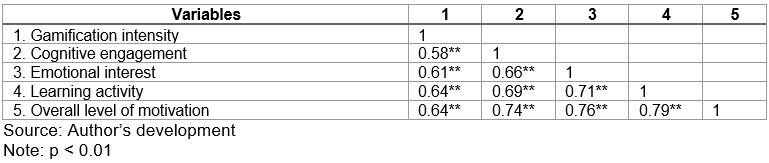
The proposed results showed that the increase in the intensity of the use of gamification mechanics was accompanied by an increase in individual components of motivation and its overall level. This made it possible to assert that gamification had a systemic impact on the motivational sphere of students. Therefore, hypothesis H2 was also confirmed.
Discussion
The obtained results of the study demonstrated that gamification was an effective tool for increasing students' motivation in a digital educational environment. A significant increase in the level of motivation in the experimental group was recorded, and the significant effect size indicated that the impact of gamification went beyond statistical significance and had a pronounced pedagogical meaning.
The interpretation of the obtained results could be carried out through the prism of modern motivational theories, particularly the Self-Determination Theory (de la Cruz-Campos et al., 2022; Saleem et al., 2021). According to this approach, motivation usually increased under the conditions of satisfying basic psychological needs, to which the researchers noted autonomy, competence and social interaction (Ramírez-Donoso et al., 2021). The gamification elements introduced in the study (levels, badges, feedback, visualization of progress) were directly related to increasing the sense of competence and control over one's own learning (Shatila et al., 2024; Rincon-Flores et al., 2021). Presumably, this led to a positive dynamic of motivation.
The proposed results are consistent with modern empirical studies and meta-analyses, which have recorded a consistently positive (moderate) effect of the influence of gamification on student motivation and engagement. However, most researchers have emphasized the significant variability of the results, depending on the context, intervention design and sample characteristics (Camacho-Sánchez et al., 2022; Kardoyo et al., 2020). Against this background, the large effect obtained in our study may indicate that the key factor was not the fact of using gamification itself. More importantly, its systematic and integrated use in the pedagogical process.
Of particular note were the results of the correlation analysis, which indicated that the intensity of the use of gamification elements was associated with both the general level of motivation and its individual components - cognitive involvement, emotional interest and learning activity (Campillo-Ferrer et al., 2020; García-López et al., 2023; Serna Gómez et al., 2021). This made it possible to interpret gamification as a tool for a comprehensive impact on the motivational structure of the student's personality (along with its definition as a local stimulating mechanism).
At the same time, the results obtained required critical reflection in the light of discussions that were presented in the scientific literature. In particular, a significant part of the researchers indicated that gamification often activated external motivation to a greater extent than internal (Li et al., 2023; Ratinho & Martins, 2023; Turchyn et al., 2023). In this context, an increase in the level of motivation was recorded, which in the proposed results could be partially due to the effect of rewards, competition and achievements, a profound change in students' attitude towards learning.
Another important aspect is the problem of the durability of the effect. Several studies have shown that the positive effects of gamification wane over time due to habituation or loss of novelty (Ivarson et al., 2024; Sadovets et al., 2022). In our case, the intervention was of limited duration, which could have amplified the observed effect. This meant that the results obtained reflected rather the short-term effectiveness of gamification. It is probably premature to speak about its stable long-term effect (Jaramillo-Mediavilla et al., 2024; Navarro-Espinosa et al., 2022; Boichenko et al., 2023).
In addition, it is worth considering that the effectiveness of gamification largely depended on the quality of its pedagogical design (Ansar & George, 2022). Studies have shown that the mechanical addition of game elements did not guarantee a positive result and could even reduce motivation in the event of overload or formalization of the learning process (Alrashedi et al., 2024; Alt, 2023). In the proposed results, the positive effect was probably associated with the consistency of gamification elements with learning objectives and their integration into the course structure.
Therefore, the results of the study confirmed that gamification was an effective tool for increasing student motivation. However, its impact was not universal and depended on a number of factors: intensity of use, quality of design, duration of implementation, and educational context.
Study Limitations
Despite the results obtained, the study had a number of limitations. First, the use of a quasi-experimental design without randomization reduced the possibility of unambiguously establishing cause-and-effect relationships. There was a significant possibility of the influence of uncontrolled variables, in particular, the peculiarities of group dynamics or individual characteristics of students.
Second, the study was conducted within a single higher education institution, which limited the possibility of generalizing the results. Third, the duration of the intervention was limited to 8 weeks, which did not allow assessing the long-term stability of the gamification effect.
Conclusions
The article determined the impact of gamification as a pedagogical tool on the level of motivation of students in a digital educational environment. Based on the conducted quasi-experimental study, it was found that the introduction of gamification elements into the educational process provided a statistically significant increase in student motivation compared to traditional digital learning.
The results obtained confirmed the hypothesis of a positive impact of gamification on motivation. This was manifested in particular in a significant increase in indicators in the experimental group and a large effect size. Additionally, a positive relationship was found between the intensity of use of gamification mechanics and the level of motivation. This process demonstrated the systemic nature of the impact of gamification on the motivational sphere of students.
The scientific novelty of the study consisted in a comprehensive empirical substantiation of the effectiveness of gamification in a digital educational environment, taking into account the general level of motivation and its individual structural components. The results obtained expanded modern ideas about the role of gamification - a kind of tool of pedagogical influence. The conditions for its effective application were also specified.
The practical significance of the conducted research was the possibility of using gamification as a tool for increasing student motivation in higher education institutions. The results showed that the most effective was the systematic implementation of gamification elements integrated into the course structure. Their fragmented use was a destructive phenomenon. This can be useful for the modernization of digital educational platforms, the development of training courses and the implementation of innovative pedagogical approaches.
The prospects for further research are primarily related to the study of the long-term impact of gamification on the motivation of education seekers. Also promising were the analysis of individual gamification mechanics, research into the interaction of gamification with other digital educational technologies, personalization of learning and the use of artificial intelligence.
Bibliographic references
Alrashedi, N. T., Najmi, A. H., & Alhalafawy, W. S. (2024). Utilising Gamification to Enhance Ambition on Digital Platforms: An Examination of Faculty Members’ Perspectives in Times of Crisis. Journal of Ecohumanism, 3(8). https://doi.org/10.62754/joe.v3i8.5003
Alt, D. (2023). Assessing the benefits of gamification in mathematics for student gameful experience and gaming motivation. Computers & Education, 104806. https://doi.org/10.1016/j.compedu.2023.104806
Ansar, M., & George, G. (2022). Gamification in Education and Its Impact on Student Motivation – A Critical Review. In Lecture Notes in Networks and Systems (pp. 161–170). Springer Nature Singapore. https://doi.org/10.1007/978-981-19-2940-3_11
Boichenko, M., Churychkanych, I., Kulichenko, A., Shramko, R., & Rakhno, M. (2023). Mind maps to boost the learning of English as L2 at higher education institutions in Ukraine. Amazonia Investiga, 12(70), 229–240. https://doi.org/10.34069/AI/2023.70.10.21
Czerkawski, B. (2024). AI and the Learning Experience Design: From Divergent Creativity to Convergent Precision. TechTrends, 69, 260–270. https://doi.org/10.1007/s11528-024-01032-2
Camacho-Sánchez, R., Rillo-Albert, A., & Lavega-Burgués, P. (2022). Gamified Digital Game-Based Learning as a Pedagogical Strategy: Student Academic Performance and Motivation. Applied Sciences, 12(21), 11214. https://doi.org/10.3390/app122111214
Camacho-Sánchez, R., Serna Bardavío, J., Rillo-Albert, A., & Lavega-Burgués, P. (2023). Enhancing motivation and academic performance through gamified digital game-based learning methodology using the ARCS model. Interactive Learning Environments, 32(10), 6868–6885. https://doi.org/10.1080/10494820.2023.2294762
Campillo-Ferrer, J.-M., Miralles-Martínez, P., & Sánchez-Ibáñez, R. (2020). Gamification in Higher Education: Impact on Student Motivation and the Acquisition of Social and Civic Key Competencies. Sustainability, 12(12), 4822. https://doi.org/10.3390/su12124822
Das, S., Vaishnavi Nakshatram, S., Söbke, H., Baalsrud Hauge, J., & Springer, C. (2025). Towards gamification for spatial digital learning environments. Entertainment Computing, 52, 100893. https://doi.org/10.1016/j.entcom.2024.100893
de la Cruz-Campos, J.-C., Pozo-Sánchez, S., Berral-Ortiz, B., & Alonso-García, S. (2022). Gamification. In Advances in Game-Based Learning (pp. 119–141). IGI Global. https://doi.org/10.4018/978-1-6684-5240-0.ch008
Ertan, K., & Arkün Kocadere, S. (2022). Gamification design to increase motivation in online learning environments: A systematic review. Journal of Learning and Teaching in Digital Age., 7(2), 151-159. https://doi.org/10.53850/joltida.1020044
García-López, I. M., Acosta-Gonzaga, E., & Ruiz-Ledesma, E. F. (2023). Investigating the Impact of Gamification on Student Motivation, Engagement, and Performance. Education Sciences, 13(8), 813. https://doi.org/10.3390/educsci13080813
Ivarson, E., Erlandsson, V., Faraon, M., & Khatib, S. (2024). Augmented reality and gamification in higher education: Designing mobile interaction to enhance students’ motivation and learning. E-Learning and Digital Media, 22(6), 571-590. https://doi.org/10.1177/20427530241239981
Jaramillo-Mediavilla, L., Basantes-Andrade, A., Cabezas-González, M., & Casillas-Martín, S. (2024). Impact of Gamification on Motivation and Academic Performance: A Systematic Review. Education Sciences, 14(6), 639. https://doi.org/10.3390/educsci14060639
Kardoyo, Nurkhin, A., Muhsin, & Pramusinto, H. (2020). Problem-based learning strategy: its impact on students’ critical and creative thinking skills. European Journal of Educational Research, 9(3), 1141-1150. https://doi.org/10.12973/eu-jer.9.3.1141
Lampropoulos, G., & Kinshuk. (2024). Virtual reality and gamification in education: a systematic review. Educational technology research and development, 72, 1691–1785. https://doi.org/10.1007/s11423-024-10351-3
Li, M., Ma, S., & Shi, Y. (2023). Examining the effectiveness of gamification as a tool promoting teaching and learning in educational settings: a meta-analysis. Frontiers in Psychology, 14. https://doi.org/10.3389/fpsyg.2023.1253549
Navarro-Espinosa, J. A., Vaquero-Abellán, M., Perea-Moreno, A.-J., Pedrós-Pérez, G., Martínez-Jiménez, M. d. P., & Aparicio-Martínez, P. (2022). Gamification as a Promoting Tool of Motivation for Creating Sustainable Higher Education Institutions. International Journal of Environmental Research and Public Health, 19(5), 2599. https://doi.org/10.3390/ijerph19052599
Papadakis, S., & Karakose, T. (2025). Gamification and Student Achievement: Potential Benefits, Limitations, and Effective Use in Educational Environments. Educational Process International Journal, 19(1). https://doi.org/10.22521/edupij.2025.19.529
Pozo-Sánchez, S., Lampropoulos, G., & López-Belmonte, J. (2022). Comparing Gamification Models in Higher Education Using Face-to-Face and Virtual Escape Rooms. Journal of New Approaches in Educational Research, 11(2), 307. https://doi.org/10.7821/naer.2022.7.1025
Ramírez-Donoso, L., Pérez-Sanagustín, M., Neyem, A., Alario-Hoyos, C., Hilliger, I., & Rojos, F. (2021). Fostering the use of online learning resources: results of using a mobile collaboration tool based on gamification in a blended course. Interactive Learning Environments, 31(3), 1564–1578. https://doi.org/10.1080/10494820.2020.1855202
Ratinho, E., & Martins, C. (2023). The role of gamified learning strategies in student's motivation in high school and higher education: A systematic review. Heliyon, 9(8), 19033. https://doi.org/10.1016/j.heliyon.2023.e19033
Reiter, M. (2025). Gamification in Education: Effectiveness and Impact on Student Motivation. Acta Educationis Generalis, 15(s1), 38–51. https://doi.org/10.2478/atd-2025-0013
Rincon-Flores, E. G., & Santos-Guevara, B. N. (2021). Gamification during Covid-19: Promoting active learning and motivation in higher education. Australasian Journal of Educational Technology, 37(5), 43–60. https://doi.org/10.14742/ajet.7157
Sadovets, O., Martynyuk, O., Orlovska, O., Lysak, H., Korol, S., & Zembytska, M. (2022). Gamification in the Informal Learning Space of Higher Education (in the Context of the Digital Transformation of Education). Postmodern Openings, 13(1), 330–350. https://doi.org/10.18662/po/13.1/399
Saleem, A. N., Noori, N. M., & Ozdamli, F. (2021). Gamification Applications in E-learning: A Literature Review. Technology, Knowledge and Learning, 27, 139–159. https://doi.org/10.1007/s10758-020-09487-x
Saritepeci, M., & Yildiz Durak, H. (2024). Effectiveness of artificial intelligence integration in design-based learning on design thinking mindset, creative and reflective thinking skills: An experimental study. Education and Information Technologies, 29, 25175–25209. https://doi.org/10.1007/s10639-024-12829-2
Serna Gómez, J. H., Díaz-Piraquive, F. N., Muriel-Perea, Y. d. J., & Díaz Peláez, A. (2021). Advances, Opportunities, and Challenges in the Digital Transformation of HEIs in Latin America. In Radical Solutions for Digital Transformation in Latin American Universities (pp. 55–75). Springer Singapore. https://doi.org/10.1007/978-981-16-3941-8_4
Shatila, K., Martínez-Climent, C., Enri-Peiró, S., & Perez-Ruiz, P. (2024). The impact of gamification on academic performance: the case of digital marketing in Lebanon. European Journal of Innovation Management, 28(8), 4061–4082. https://doi.org/10.1108/ejim-04-2024-0411
Tolentino, A. P. (2025). Digital Gamification: Benefits and Challenges in Education. International Journal of Information and Education Technology, 15(5), 902–911. https://doi.org/10.18178/ijiet.2025.15.5.2296
Turchyn, I., Zaitseva, S., Rudenko, N., Saienko, V., Kuzemko, N., & Denefil, O. (2023). Using distance learning models as opportunities for blended learning for foreigners. Revista Romaneasca Pentru Educatie Multidimensionala, 15(4), 178–191. https://doi.org/10.18662/rrem/15.4/787
Ukgoda, H. (2025). Gamification in Education: Its Impact on Engagement, Motivation, and Learning Outcomes. Journal of Educational Technology Development and Exchange, 18(3), 41–66. https://doi.org/10.18785/jetde.1803.03

Este artículo no presenta ningún conflicto de intereses. Este artículo está bajo la licencia Creative Commons Atribución 4.0 Internacional (CC BY 4.0). Se permite la reproducción, distribución y comunicación pública de la obra, así como la creación de obras derivadas, siempre que se cite la fuente original.