
Original Article
Eduweb, 2026, enero-marzo, v.20, n.1. ISSN: 1856-7576
Doi: https://doi.org/10.46502/issn.1856-7576/2026.20.01.23
Chatbots y asistentes virtuales en la educación superior: apoyo a la escritura y la investigación académica
Liubov Terletska
PhD (Pedagogy), Senior Lecturer, Foreign Languages and Methodology Department, Faculty of Pedagogical Education, Borys Grinchenko Kyiv Metropolitan University, Kyiv, Ukraine.
https://orcid.org/0000-0002-3690-5691
Svitlana Sobolieva
Candidate of Pedagogical Sciences (PhD), Associate Professor, Associate Professor of the Department of Psychology and Pedagogy, Ivan Kozhedub Kharkiv National Air Force University, Kharkiv, Ukraine.
https://orcid.org/0000-0003-0655-615X
Mariia Hryshchuk
Candidate of biological sciences, Vice-rector for scientific and pedagogical work (international relations), associate professor of the department Human Anatomy, Ivano-Frankivsk National Medical University, Ivano-Frankivsk, Ukraine.
https://orcid.org/0000-0001-9202-295X
Yuliia Haidenko
PhD (Philology), Associate Professor, Department of English for Humanities, Faculty of Linguistics, National Technical University of Ukraine “Igor Sikorsky Kyiv Polytechnic Institute”, Kyiv, Ukraine.
https://orcid.org/0000-0002-4063-525X
Yuliia Dankevych
Candidate of Philological Sciences, Associate Professor, Associate Professor of the Department of Computer and Information Technologies, Educational and Scientific Institute of Municipal Administration and Urban Economy, V. I. Vernadsky Taurida National University, Kyiv, Ukraine.
https://orcid.org/0000-0002-6518-7078
Cómo citar:
Terletska, L., Sobolieva, S., Hryshchuk, M., Haidenko, Y., & Dankevych, Y. (2026). Chatbots and virtual assistants in higher education: supporting academic writing and research. Revista Eduweb, 20(1), 382-395. https://doi.org/10.46502/issn.1856-7576/2026.20.01.23
Recibido: 11/12/25 Aceptado: 10/03/26
Abstract
The article aimed to analyze the impact of chatbot-assisted support on the development of academic writing and research competencies of higher education students. The proposed study was implemented using a quasi-experimental mixed design with control and experimental groups (n = 180) and measurements before and after the intervention. The assessment was carried out using the analytical rubric of academic writing, the research competencies index, as well as through AI literacy questionnaires and qualitative analysis of student reflections. The results showed a significant and moderate positive impact of the intervention. In particular, the quality of academic writing, its organization, sentence construction, and logic of argumentation improved. An increase in research competencies was also found in the experimental group of students. Besides, correlation and regression analyses showed that the level of AI literacy is a more important predictor of academic outcomes than the frequency of use of the digital assistant. The conclusion states that chatbots and virtual assistants effectively performed the function of cognitive and methodological support for academic writing and research under conditions of clear pedagogical integration and adherence to the principles of academic integrity.
Keywords: academic writing, chatbots, higher education, research competencies, virtual assistants.
Resumen
El objetivo del artículo fue analizar el impacto del apoyo asistido por chatbots en el desarrollo de la escritura académica y las competencias de investigación de estudiantes de educación superior. El estudio propuesto se implementó mediante un diseño mixto cuasiexperimental con grupos control y experimental (n = 180) y mediciones antes y después de la intervención. La evaluación se realizó mediante la rúbrica analítica de escritura académica, el índice de competencias de investigación, así como mediante cuestionarios de alfabetización en IA y análisis cualitativo de las reflexiones de los estudiantes. Los resultados destacaron un impacto positivo estadísticamente significativo y moderado de la intervención en la calidad de la escritura académica, su organización estructural y la lógica de la argumentación. También se observó un aumento en las competencias de investigación en el grupo experimental de estudiantes. Los análisis de correlación y regresión mostraron que el nivel de alfabetización en IA es un predictor más importante de los resultados académicos. La conclusión afirma que los chatbots y los asistentes virtuales desempeñaron eficazmente la función de apoyo cognitivo y metodológico para la escritura académica y la investigación en condiciones de clara integración pedagógica y adhesión a los principios de integridad académica.
Palabras clave: asistentes virtuales, chatbots, escritura académica, competencias de investigación, educación superior.
Introduction
The digital transformation of higher education in recent years has turned into a new dimension of the educational sector, characterized by the active introduction of artificial intelligence (AI) into educational and scientific practices. A special place among such technologies has been occupied by chatbots and virtual assistants, which have been increasingly used as information support tools and in the field of application of cognitive, methodological and research support for the academic activities of teachers and students. In the context of the permanent increase in requirements for the quality of academic writing, scientific integrity and research productivity, the issue of the role of such digital tools in higher education has gained additional relevance.
Academic writing and research activities have traditionally been considered one of the most complex components of university training (Ebrahim et al., 2025). They required already formed thorough subject knowledge, which had to be combined with the formation of skills in argumentation, text structuring, critical analysis of sources, adherence to stylistic and ethical standards of scientific communication. For the majority of students – especially in the context of a multilingual academic environment and the internationalization of education – such requirements have become a rather serious barrier that has affected the further success of their studies and the involvement of students in research work.
In this context, chatbots and virtual assistants have emerged as potential tools for further support for students, capable of performing the functions of individualized mentoring, promptly responding to feedback calls, and working as navigators in the academic environment (Cabeza-Rodríguez, 2025; Imran & Almusharraf, 2023). They could contribute to research planning, clarifying scientific issues, improving the structure of academic texts, language editing, and identifying methodological aspects. At the same time, their use has given rise to a number of theoretical and practical issues that researchers have addressed. First of all, these problems were related to the limits of automated assistance, the transformation of authorship, the risks of superficial knowledge acquisition, and further challenges to maintaining academic integrity.
Despite the increase in the number of scientific publications devoted to the use of AI in education, there have been few studies that systematically analyze the role of chatbots and virtual assistants specifically in the field of academic writing and scientific research in higher education (Jardón Gallegos et al., 2024; María Jimenez et al., 2024). Many available scientific works have focused on the technical characteristics of the tools and the general pedagogical effects of their use (Rivadeneira et al., 2024; Usher & Amzalag, 2025). At the same time, the analysis of their impact on cognitive processes, the importance of academic culture, and the research autonomy of students is insufficiently conducted in the modern scientific space.
The purpose of the proposed article will be to consider chatbots and virtual assistants as tools for supporting academic writing and scientific research in higher education. The study aimed to identify the main areas of their application, potential benefits, and limitations. Another important issue was to clarify the educational and ethical challenges that accompany the integration of these technologies into the academic environment. Therefore, the article aimed to contribute to the current discussion on the role of artificial intelligence in the transformation of university education and research.
Literature Review
Since 2021, the scientific literature has seen a significant increase in interest in the use of chatbots and virtual assistants in higher education. This state of affairs is due to the development of generative AI and its comprehensive integration into educational platforms. Studies devoted to this issue have covered a wide range of challenges (Böhmer, 2023; Campbell & Cox, 2024) – from pedagogical effectiveness and user acceptance of technologies to ethical, methodological and cultural challenges that have been associated with the transformation of academic writing and research.
Main research vectors
The first body of research focused on the perception and acceptance of chatbots and virtual assistants by students and teachers. In the works carried out in Spain and Latin American countries, the authors applied quantitative methods (surveys, structural models based on UTAUT or TAM), which allowed them to identify key factors of use: expected benefits, ease of use, institutional support and regulatory certainty (Cabero-Almenara et al., 2025; Villegas-Ch et al., 2021). The results showed that higher education students primarily perceived chatbots as an auxiliary tool for organizing learning and writing assignments, while teachers had a more cautious attitude, which was associated with the risks of academic dishonesty and reduced autonomy of learning.
The second direction covered the study of the impact of chatbots on academic writing (Abbas et al., 2022; Bond et al., 2025). A significant part of the Spanish-language works from the regions of Spain, Mexico, Peru and Ecuador analyzed the use of chatbots for language correction, text structuring, idea generation and feedback (Anjulo Lambebo & Chen, 2024). Methodologically, these studies were based on student surveys, analysis of academic texts before and after the use of AI tools, as well as qualitative interviews. Such results indicated a positive effect in the short term (reduction of anxiety, increased confidence in writing, improved formal quality of texts) (Guillén-Yparrea & Hernández-Rodríguez, 2024), while also recording a limited impact on the development of deeper argumentation and critical thinking skills.
The third block of studies is devoted to supporting research activities in higher education (García Sánchez, 2023). In these works, chatbots and virtual assistants are considered as tools to help formulate research questions, explain methodological approaches, conduct preliminary literature reviews, and organize scientific texts. Studies from Latin America and the Caribbean have shown that such tools were particularly in demand by master's degree students and early-stage researchers who faced a shortage of individual scientific support (Lucero Fredes et al., 2022; Salas-Pilco & Yang, 2022).
Key findings
The literature review showed the dominance of descriptive and correlational studies. At the same time, experimental and longitudinal studies were rare. In the regions of Spain and Latin America, interdisciplinary teams that combined pedagogy, educational technology, and applied linguistics prevailed (Ortiz-Bonnin & Blahopoulou, 2025; Peña Cáceres et al., 2025). Most authors agreed that chatbots are effective as support tools, but they cannot replace full-fledged training in academic writing or research methods (Sánchez-Ticona et al., 2023).
At the same time, a significant part of the work emphasized the contextual dependence of the results. The effectiveness of the use of chatbots varied depending on the linguistic environment, digital literacy of students, institutional policies, and cultural perceptions of authorship and learning (Tarchi et al., 2024; Tobin, 2024). This is especially noticeable in Central American and Caribbean countries, where access to digital resources and the regulatory framework were often uneven.
Thus, the current literature has a number of limitations. First, most studies have focused on the general use of chatbots. Accordingly, researchers often did not distinguish functionally between chatbots for service support and virtual assistants for cognitive and research support. Second, there is a lack of work that would indicate the long-term impact of these tools on the formation of academic competencies, in particular the ability to independently write and think scientifically.
Thus, the available scientific literature has demonstrated the potential of chatbots and virtual assistants as tools for supporting academic writing and research in higher education. However, a need was identified for an analysis of the role of virtual assistants in supporting the learning environment. It is these gaps that determined the relevance of further analysis of the role of such technologies.
Methodology
Research Design
The proposed study was conducted using a quasi-experimental mixed-methods design with control and experimental groups and pre-test/post-test measurements.
This design made it possible to effectively assess the impact of chatbots and virtual assistants on teaching academic writing and research skills in the context of the real educational process. Also, while maintaining the validity of the results, control for initial differences between groups was ensured through statistical procedures.
Participants and Sample
A total of 180 higher education applicants participated in the study. The formation of groups was based on existing academic streams (without full randomization), which corresponded to the natural conditions of university education. To minimize the impact of group unevenness in starting characteristics, all participants took an initial pre-test to determine the level of academic writing and self-assessment of research competencies. Participants also completed a short questionnaire on their previous experience with AI tools. All participants provided informed consent to participate in the study. Overall, the proposed quasi-experiment was conducted in compliance with the rules and principles of voluntariness, confidentiality, and academic integrity.
Conditions and intervention
Participants were divided into two groups.
Participants in the control group were trained in academic writing and basic elements of research work exclusively according to standard educational programs (text planning, argumentation, working with sources, formatting references, avoiding plagiarism, etc.). In contrast, participants in the experimental group had a standard program, which was supplemented by the regulated use of a chatbot/virtual assistant as a tool to support writing and research.
To prevent the appearance of the “free use” effect and ensure the reproducibility of the intervention, structured scenarios for using the tool were introduced in the experimental group, which did not provide for the generation of ready-made fragments of academic text “on a turnkey basis”. At the same time, assistance in the form of cognitive and methodological “scaffolding” was allowed. In particular, participants in the experimental group were entitled to the following types of interaction:
clarification and narrowing of the topic, formulation of the problem and research questions;
creation of a plan/logic of sections, recommendations for improving the argumentation;
explanation of methodological terms and choice of research design;
linguistic and stylistic editing of individual sentences/paragraphs without changing the authorship;
creation of self-check checklists (coherence, logical connections, citation style requirements).
The requirements of academic integrity were equally emphasized for both groups. Participants received short “allowed/forbidden” protocols, which were supposed to minimize the risks of opaque authorship and abuse.
Instruments and indicators
Before and after the intervention, participants completed a standardized writing task (essay/short research text) with the same requirements for structure and use of sources. The texts were assessed using an analytical rubric (scales with several subcomponents), which covered the logic of the structure (introduction–argumentation–conclusion), the quality of the argumentation and criticality, the work with sources (relevance, integration, correctness of references), academic style and accuracy of formulations, coherence and readability of the text.
The assessment was carried out by independent experts/reviewers who did not know to which group the author of the text belonged (blind scoring). The consistency of the assessment was checked using interrater reliability indicators.
An analysis of research competence was performed (additional outcome). In particular, the implementation of a short test/exercise on the formulation of the problem, hypotheses and variables was monitored, and self-assessment of research competence (planning, selection of methods, interpretation) was determined.
The levels of technology acceptance and digital readiness (explanatory variables) were assessed. In particular, for the experimental group, the following indicators were recorded: benefits and convenience (based on TAM/UTAUT logic), AI/digital literacy (basic understanding of limitations and risks), frequency and features of the use of individual types of tool use (short journal/self-report after tasks).
To understand how exactly the chatbot/assistant influenced writing and research thinking, open-ended responses from participants were collected regarding the usage strategy, targeted short interviews/focus groups with a subsample, examples of “before/after text” (portfolio) for content analysis of changes.
Procedure
At the beginning of the study, a Pre-test was carried out: written task + measurement of research competences + experience/readiness questionnaire. The assessment, as already noted, was carried out as a result of the involvement of external experts/reviewers.
Actually, the educational intervention lasted 3-4 months. During this time, control measures (4 written and research mini-tasks) were carried out within each course.
The experimental group used a digital assistant and AI in accordance with the regulations.
Post-test consisted of a repeated written task and repeated measurements, collecting qualitative data.
Data analysis
To check the differences between the groups after the intervention, ANCOVA was used, where the post-test was the dependent variable, the group was a factor, and the pre-test was a covariate. This made it possible to correctly control the starting differences without full randomization. Effect sizes (for example, Cohen’s d or partial η²) were calculated separately. For additional analysis, regression models were used that assessed the contribution of AI literacy, previous experience, and technology adoption indicators to the increase in results. The reliability of the scales was tested using Cronbach’s α, and the assumptions of the models were tested using standard diagnostic procedures.
A qualitative analysis method was used for open-ended responses. Such materials and interviews were analyzed using thematic analysis. In particular, the qualitative component was used as an explanatory sequential component to interpret quantitative effects: which practices of using the assistant contributed to progress, and which led to superficial changes or dependence.
Ethical and quality guarantees
The study was implemented in compliance with the principles of informed consent, data anonymization, and voluntary participation. To minimize the risks of academic dishonesty, the intervention was designed to support the process rather than replace authorship: participants received the rules of acceptable use, and the evaluation focused on the quality of argumentation, work with sources, and the logic of the study.
Results and Discussion
Results
Before the intervention began, it was necessary to determine how much the performance of the control and experimental groups differed in terms of academic writing and research skills. Initial measurements showed that both groups were at approximately the same starting level. In particular, the differences identified were not statistically significant. In particular, the mean values of academic writing scores were 63.4 (SD = 8.9) in the control group and 64.1 (SD = 9.1) in the experimental group. The level of research competence was 3.21 (SD = 0.54) in the control group and 3.24 (SD = 0.57) in the experimental group. (See Table 1). This made it possible to consider further changes as being related to the learning conditions, rather than to the previous inequality of the participants.
Table 1.
Descriptive statistics of pre-test measures

During the intervention period, both groups improved their scores. However, the nature of this increase differed. In the control group, progress was more moderate and uniform. This state of affairs was fully consistent with typical dynamic indicators of the development of academic writing skills. In contrast, in the experimental group, the increase in scores was noted as more significant. This increase was concentrated mainly in those aspects of writing that were related to the structure of the text and the logic of argumentation.
At the same time, to assess the effect of the intervention, an ANCOVA was used, in which the results of academic writing after testing were the dependent variable, the type of group was the independent variable, and the pre-test was the covariate. Hence, the data indicated a significant effect of group type (F = 18.72; p < .001; Partial η² = .096). This indicated a medium effect of the intervention. The effect of pretest as a covariate was also significant (F = 41.55; p < .001; Partial η² = .191).
Table 2.
ANCOVA results for academic writing performance

After the intervention, students in the experimental group who worked with a chatbot or a virtual assistant in a regulated format had higher scores in academic writing, even taking into account their initial level. This demonstrated the importance of using digital assistants to support the learning process and enhance its educational effectiveness.
The qualitative nature of this impact was also determined on the basis that students in the experimental group structured their texts better, formulated the main theses more clearly, and built their arguments more consistently. In their works, logical “gaps” between parts of the text were smoothed out, and introductions and conclusions demonstrated a higher level of coherence with the main content. Under such circumstances, the digital assistant performed the function of a kind of cognitive “navigator” that helped students maintain the general logic of the written assignment at a higher level.
On the other hand, the results show that linguistic and stylistic aspects (e.g. formal academic language or precision of formulations) improved less dynamically. This allowed us to demonstrate that chatbots and virtual assistants are more effective as tools for organizing thinking and structure. At the same time, their effectiveness as tools for the deep development of stylistic skills is less noticeable. Therefore, additional analysis of the subcomponents of writing demonstrated that more substantial differences between groups were observed in text structure, logic of argumentation, and coherence. At the same time, linguistic and stylistic aspects showed more moderate growth (See Table 3).
Table 3.
Post-test differences by writing components

Post-test analysis of research competencies also confirmed a statistically significant effect of the intervention. Students in the experimental group demonstrated a better ability to formulate research questions and research logic. The effect size (Cohen's d = 0.69) indicated a medium practical impact of the intervention on the development of students' research competence. (See Table 4).
Table 4.
Group differences in research competence (post-test)

To compare the post-experimental academic writing profiles in the control and experimental groups, Figure 3 presents a radar chart of key components of writing (See Figure 1).
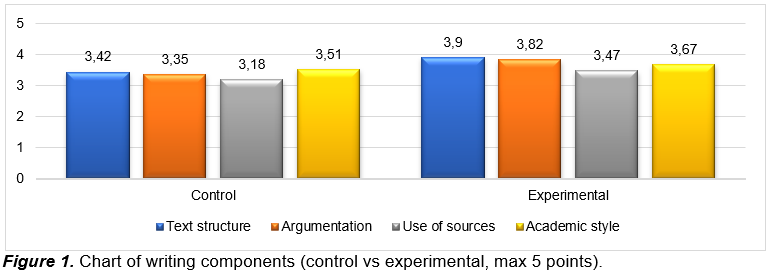
Correlation analysis provided an understanding of the mechanisms behind the observed effects. It was found that academic writing performance was moderately correlated with research competency. As a result, there was an interdependence between these competencies. In other words, students who had a better understanding of the logic of the research task tended to complete the written task in a more structured and convincing manner. The relationship between writing performance and AI literacy was particularly striking. In particular, students who had a higher level of awareness of the possibilities and limitations of AI benefited significantly more from using this digital assistant. In contrast, the frequency of chatbot use was less strongly associated with academic performance. Correlation analyses were conducted to identify the main relationships between the intensity and nature of assistant use, digital readiness, and learning outcomes (see Table 5).
Table 5.
Pearson correlations among key variables (experimental group)

The results indicated that academic writing performance was correlated with AI literacy and research competencies. The regression model further confirmed these observations. It was demonstrated that AI literacy and basic research competency were important predictors of improved writing performance (β = 0.32, t = 4.21, p < 0.001). The frequency of use of a digital assistant had a positive direction of influence (β = 0.27, t = 3.58, p = 0.001). Frequency of chatbot use showed a positive, but insignificant, effect (β = 0.14, t = 1.97, p = 0.051).This made it possible to identify the chatbot as not a universal "performance enhancer" (see Table 6).
Table 6.
Multiple regression predicting academic writing gain

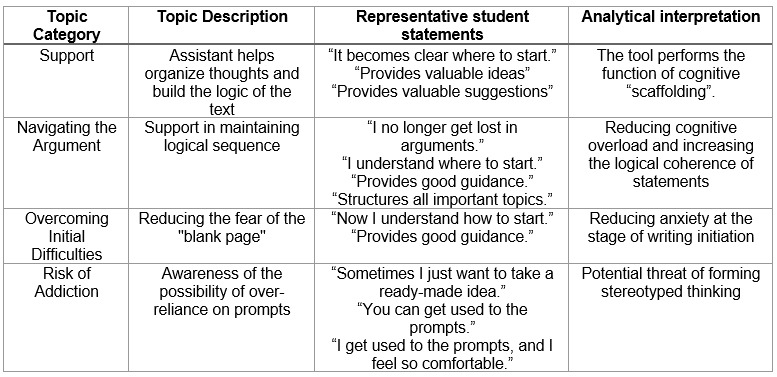
Qualitative analysis of students’ reflections and text examples provided a way to complement the quantitative results. Participants in the experimental group most often described the assistant as a tool that helps them “see the structure,” “not get lost in the arguments,” and “understand where to start.” At the same time, some students noted the risk of over-reliance on prompts, which could eventually lead to stereotyped thinking. Such reservations are consistent with the quantitative data, which demonstrated a limited impact of the intervention on the depth of argumentation (See Table 7).
Table 7.
Analysis of reflections of students in the experimental group
Discussion
The results confirmed the importance of using chatbots and virtual assistants as support tools. However, these digital mechanisms are not intended to completely replace subjects such as academic writing and research in higher education. The quasi-experimental design made it possible to record a moderate and stable positive effect of the intervention, which was primarily reflected in the improvement of the structural organization of texts, the logic of argumentation and related research competencies. This nature of the results is fully consistent with modern studies, which emphasize that the greatest potential of generative AI lies in the functions of cognitive “scaffolding” (Bohomaz et al., 2023; Krumsvik, 2024), and not in forming a direct line of academic content generation.
An important observation in the proposed results was that the most pronounced effects were recorded precisely in the higher cognitive components of writing. In contrast, linguistic and stylistic aspects showed only a moderate increase. This confirmed the findings of other researchers that chatbot-assisted support had a positive impact on the organization of thinking, text planning, and understanding the logic of argumentation. However, this did not replace the process of long-term formation of an academic style, which was also indicated by many researchers. This result was also correlated with the approaches to academic literacy (Peralta & Pila, 2025; Thottoli et al., 2024; Palacios-Núñez et al., 2025), according to which writing was considered as a language skill and at the same time as a form of participation in disciplinary knowledge and research culture.
Particular attention was focused on identifying the role of AI literacy as one of the key factors in the effectiveness of the intervention. Correlation and regression analyses demonstrated how higher education students with a higher level of awareness of the possibilities and limitations of AI benefited more from the use of digital assistants. This made it possible to interpret chatbots both as a universal means of improving outcomes and an influential tool, the effectiveness of which depended largely on the user’s reflexive and responsible interaction with technology. In this context, the results confirmed existing views on the need to integrate AI literacy elements into academic writing and research skills development programs (Sanz-Tejeda et al., 2026; Urzúa et al., 2025).
At the same time, the relatively weak relationship between the frequency of assistant use and educational outcomes highlighted the limitations of the instrumental approach to the use of AI. Simply increasing the number of calls to the chatbot did not guarantee qualitative changes in writing or research thinking. Instead, the focus on analyzing, testing, and refining one’s own ideas became decisive (Getenet & Tualaulelei, 2023). This observation is likely to have important pedagogical implications (McSharry, 2023; Ojeda Carpio, 2025), as it confirmed a shift in focus from controlling the use of technologies to forming a culture of their conscious use.
The qualitative data presented allowed us to further confirm previous scientific findings that students perceived the chatbot primarily as a means of support in the initial stages of writing and research. At the same time, a caveat was noted regarding the risk of stereotyped thinking and superficial acceptance of the proposed formulations. These observations are consistent with quantitative findings that showed limited impact of the intervention on depth of argumentation (Moreno-Guerrero et al., 2022; Khryk et al., 2021). The proposed results highlight the need for pedagogical support for the use of such tools (Labadze et al., 2023).
Overall, the study results add to the existing literature, offering an empirically informed perspective on the role of chatbots and virtual assistants in the development of academic writing and research skills. More broadly, the proposed results demonstrate a transformation of the role of digital tools in higher education, from automation tools to partners in the process of educational thinking (Essel et al., 2022; Polyezhayev et al., 2024). However, the study has methodological limitations. First, the use of a quasi-experimental design without complete randomization limited the ability to broadly generalize causal conclusions. Second, the duration of the intervention was relatively short. Thus, this duration did not allow for the assessment of the long-term impact of chatbot support.
Conclusions
The article analyzes the possibilities of using chatbots and virtual assistants as tools to support academic writing and research activities in higher education institutions. The results of a quasi-experimental study demonstrated that the regulated and pedagogically directed use of such tools had a positive impact on the quality of academic writing (primarily on the structural organization of texts, the logic of argumentation, and related research competencies).
The study also indicated that the effect of support using chatbots was different. In particular, the most pronounced changes were observed in the components that reflected higher cognitive processes. However, linguistic and stylistic characteristics had more moderate changes. This confirmed the feasibility of considering chatbots and virtual assistants as means of cognitive and methodological support. The conscious use of artificial intelligence technologies had a more important impact on learning than the frequency of their use. This indicated the importance of integrating digital and artificial intelligence elements into educational programs.
The results had practical significance for teachers and educational program developers, as they demonstrated the possibilities of combining traditional learning with artificial intelligence tools under conditions of clear pedagogical regulation and adherence to the principles of academic integrity.
Bibliographic references
Abbas, N., Whitfield, J., Atwell, E., Bowman, H., Pickard, T., & Walker, A. (2022). Online chat and chatbots to enhance mature student engagement in higher education. International Journal of Lifelong Education, 41(3), 308–326. https://doi.org/10.1080/02601370.2022.2066213
Anjulo Lambebo, E., & Chen, H.-L. (2024). Chatbots in higher education: a systematic review. Interactive Learning Environments, 33(4), 2781–2807. https://doi.org/10.1080/10494820.2024.2436931
Bohomaz, O., Koreneva, I., Lihus, V., Kambalova, Y., Shevchuk, V., & Tolchieva, H. (2023). Regarding the development of educational and scientific potential in the 21st century: technological challenges. Conhecimento & Diversidade, 15(38), 479–495. https://doi.org/10.18316/rcd.v15i38.11100
Böhmer, A. (2023). Students’ Perspectives on Digital and International Virtual Academic Cooperation. In Anselm Böhmer, Götz Schwab, Illie Isso (eds.) Digital Teaching and Learning in Higher Education (pp. 157–158). Bielefeld, Germany: Transcript Verlag. https://doi.org/10.1515/9783839462768-009
Bond, M., Oxley, E., & Lymperis, L. (2025). AI applications in initial teacher education: a systematic mapping review. In Handbook of Artificial Intelligence in Higher Education (pp. 550–575). Cheltenham, UK: Edward Elgar Publishing. https://doi.org/10.4337/9781035338764.00046
Cabero-Almenara, J., Palacios-Rodríguez, A., Rojas Guzmán, H. d. l. Á., & Fernández-Scagliusi, V. (2025). Prediction of the Use of Generative Artificial Intelligence Through ChatGPT Among Costa Rican University Students: A PLS Model Based on UTAUT2. Applied Sciences, 15(6), 3363. https://doi.org/10.3390/app15063363
Cabeza-Rodríguez, M.-Á. (2025). Asistentes ChatGPT en educación superior en línea y satisfacción del alumnado: un caso de estudio. RIED-Revista Iberoamericana de Educación a Distancia, 28(2), 9-38. https://doi.org/10.5944/ried.28.2.43552
Campbell, L. O., & Cox, T. D. (2024). Utilizing AI Chatbots in Higher Education Teaching and Learning. Journal of the Scholarship of Teaching and Learning, 24(4). https://doi.org/10.14434/josotl.v24i4.36575
Ebrahim, O. O., Mhouti, A. E., & Allaoui, M. (2025). Academic Integrity in the Era of Artificial Intelligence: A Systematic Review. In Atlantis Highlights in Social Sciences, Education and Humanities (pp. 99–113). Atlantis Press SARL. https://doi.org/10.2991/978-2-38476-408-2_9
Essel, H. B., Vlachopoulos, D., Tachie-Menson, A., Johnson, E. E., & Baah, P. K. (2022). The impact of a virtual teaching assistant (chatbot) on students' learning in Ghanaian higher education. International Journal of Educational Technology in Higher Education, 19(1). https://doi.org/10.1186/s41239-022-00362-6
García Sánchez, O. V. (2023). Uso y Percepción de ChatGPT en la Educación Superior. Revista de Investigación en Tecnologías de la Información, 11(23), 98–107. https://doi.org/10.36825/riti.11.23.009
Getenet, S., & Tualaulelei, E. (2023). Using interactive technologies to enhance student engagement in higher education online learning. Journal of Digital Learning in Teacher Education, 39(4), 220–234. https://doi.org/10.1080/21532974.2023.2244597
Guillén-Yparrea, N., & Hernández-Rodríguez, F. (2024). Unveiling Generative AI in Higher Education: Insights from Engineering Students and Professors. In 2024 IEEE Global Engineering Education Conference (EDUCON). IEEE. https://doi.org/10.1109/educon60312.2024.10578876
Imran, M., & Almusharraf, N. (2023). Analyzing the role of ChatGPT as a writing assistant at higher education level: A systematic review of the literature. Contemporary Educational Technology, 15(4), ep464. https://doi.org/10.30935/cedtech/13605
Jardón Gallegos, M. d. C., Granizo Malusin, J. H., Yaselga Auz, W. F., & Cocha Telenchana, M. G. (2024). Impacto de los asistentes virtuales de inteligencia artificial en el rendimiento académico de estudiantes universitarios. Revista Social Fronteriza, 4(4), e44338. https://doi.org/10.59814/resofro.2024.4(4)338
Khryk, V., Ponomarenko, S., Koval, L., Verhun, A., Morhulets, O., Nikonenko, T., & Koval, L. (2021). Digitization of education as a key characteristic of modernity. International Journal of Computer Science and Network Security, 21(10), 191–195. https://doi.org/10.22937/IJCSNS.2021.21.10.26
Krumsvik, R. J. (2024). Chatbots and academic writing for doctoral students. Education and Information Technologies, 30, 9427–9461. https://doi.org/10.1007/s10639-024-13177-x
Labadze, L., Grigolia, M., & Machaidze, L. (2023). Role of AI chatbots in education: systematic literature review. International Journal of Educational Technology in Higher Education, 20(1). https://doi.org/10.1186/s41239-023-00426-1
Lucero Fredes, A., Cano, S., Cubillos, C., & Díaz, M. E. (2022). Virtual Assistant as an Emotional Support for the Academic Stress for Students of Higher School: A Literature Review. In Lecture Notes in Computer Science (pp. 108–118). Switzerland: Springer Nature. https://doi.org/10.1007/978-3-031-17902-0_8
María Jimenez, A., Bilbao, G., Gonzalez, M., & Caceres, P. (2024). Development of Digital Competencies in Higher Education: Exploring the role of ChatGPT. In 6th International Conference on Human Systems Engineering and Design Future Trends and Applications (IHSED 2024). AHFE International. https://doi.org/10.54941/ahfe1005554
McSharry, P. E. (2023). Promoting AI Ethics Through Awareness and Case Studies. In AI Ethics in Higher Education: Insights from Africa and Beyond (pp. 67–84). Springer International Publishing. https://doi.org/10.1007/978-3-031-23035-6_6
Moreno-Guerrero, A.-J., Marín-Marín, J.-A., Dúo-Terrón, P., & López-Belmonte, J. (2022). Chatbots in Education. In Artificial Intelligence in Higher Education (pp. 81–94). CRC Press. https://doi.org/10.1201/9781003184157-4
Ojeda Carpio, G. E. (2025). Innovación en tutoría académica: asistentes virtuales de inteligencia artificial en proyectos de grado de ciencias empresariales. Orbis Tertius-UPAL, 9(17), 215-235. https://biblioteca.upal.edu.bo/htdocs/ojs/index.php/orbis/article/view/175
Ortiz-Bonnin, S., & Blahopoulou, J. (2025). Chat or cheat? Academic dishonesty, risk perceptions, and ChatGPT usage in higher education students. Social Psychology of Education, 28(113). https://doi.org/10.1007/s11218-025-10080-2
Palacios-Núñez, M. L., Mendoza-García, E. M., Narciso Zarate, J. W., & Deroncele-Acosta, A. (2025). ChatGPT in the Teaching of Academic Writing in Higher Education: Teachers' Perspectives on Its Uses, Challenges, and Future in Personalized Learning. Edutec, Revista Electrónica de Tecnología Educativa, (93), 33–50. https://doi.org/10.21556/edutec.2025.93.3995
Peña Cáceres, O., Sánchez-Rogel, E., Barros-Naranjo, J., Silva-Marchan, H., Espinoza-Mina, R., & Correa-Calle, T. (2025). Linguistic and Visual Patterns of ChatGPT in Higher Education: An Analysis of its Use in Undergraduate Theses. VISUAL REVIEW. International Visual Culture Review Revista Internacional De Cultura Visual, 17(3), 265–278. https://doi.org/10.62161/revvisual.v17.5403
Peralta, A., & Pila, M. (2025). Implications of integrating ChatGPT into higher education for developing writing skills in EFL contexts in Latin America. Resistances. Journal of the Philosophy of History, 6(12), e250221. https://doi.org/10.46652/resistances.v6i12.221
Polyezhayev, Y., Terletska, L., Kulichenko, A., Vorobiova, L., & Snizhko, N. (2024). The role of web applications in the development of multilingual competence in CLIL courses in higher education. Revista Eduweb, 18(3), 106–118. https://doi.org/10.46502/issn.1856-7576/2024.18.03.9
Rivadeneira, L., Bellido de Luna, D., & Fernandez, C. (2024). Exploring the Role of ChatGPT in Higher Education Institutions: Where does Latin America Stand? Digital Government: Research and Practice. https://doi.org/10.1145/3689370
Salas-Pilco, S. Z., & Yang, Y. (2022). Artificial intelligence applications in Latin American higher education: a systematic review. International Journal of Educational Technology in Higher Education, 19(1). https://doi.org/10.1186/s41239-022-00326-w
Sánchez-Ticona, R. J., Alcántara-Moreno, O. R., Torres-Villanueva, M., Gómez-Avila, J. A., Rodriguez-Huamán, R. E., & Santos-Fernández, J. P. (2023). Una Revisión Sistemática del Desarrollo de Chatbots y Asistentes Virtuales en Instituciones de Educación Superior. In Vigésima Segunda Conferencia Iberoamericana en Sistemas, Cibernética e Informática. International Institute of Informatics and Cybernetics. https://doi.org/10.54808/cisci2023.01.113
Sanz-Tejeda, A., Domínguez-Oller, J. C., Baldaquí-Escandell, J. M., Gómez-Díaz, R., & García-Rodríguez, A. (2026). The impact of generative AI on academic reading and writing: a synthesis of recent evidence (2023–2025). Frontiers in Education, 10, 1711718. https://doi.org/10.3389/feduc.2025.1711718
Tarchi, C., Zappoli, A., Casado Ledesma, L., & Brante, E. W. (2024). The Use of ChatGPT in Source-Based Writing Tasks. International Journal of Artificial Intelligence in Education, 35, 858–878. https://doi.org/10.1007/s40593-024-00413-1
Thottoli, M. M., Alruqaishi, B. H., & Soosaimanickam, A. (2024). Robo academic advisor: Can chatbots and artificial intelligence replace human interaction? Contemporary Educational Technology, 16(1), ep485. https://doi.org/10.30935/cedtech/13948
Tobin, H. L. D. (2024). Using AI-Writers to Support Online Course Development. In Artificial Intelligence Applications in Higher Education (pp. 123–142). London: Routledge. https://doi.org/10.4324/9781003440178-8
Urzúa, C. A. C., Ranjan, R., Saavedra, E. E. M., Badilla-Quintana, M. G., Lepe-Martínez, N., & Philominraj, A. (2025). Effects of AI-Assisted Feedback via Generative Chat on Academic Writing in Higher Education Students: A Systematic Review of the Literature. Education Sciences, 15(10), 1396. https://doi.org/10.3390/educsci15101396
Usher, M., & Amzalag, M. (2025). From Prompt to Polished: Exploring Student–Chatbot Interactions for Academic Writing Assistance. Education Sciences, 15(3), 329. https://doi.org/10.3390/educsci15030329
Villegas-Ch, W., García-Ortiz, J., Mullo-Ca, K., Sánchez-Viteri, S., & Roman-Cañizares, M. (2021). Implementation of a Virtual Assistant for the Academic Management of a University with the Use of Artificial Intelligence. Future Internet, 13(4), 97. https://doi.org/10.3390/fi13040097

Este artículo no presenta ningún conflicto de intereses. Este artículo está bajo la licencia Creative Commons Atribución 4.0 Internacional (CC BY 4.0). Se permite la reproducción, distribución y comunicación pública de la obra, así como la creación de obras derivadas, siempre que se cite la fuente original.