
Original Article
Eduweb, 2026, enero-marzo, v.20, n.1. ISSN: 1856-7576
Doi: https://doi.org/10.46502/issn.1856-7576/2026.20.01.15
Adaptación de programas educativos basada en las TIC: un modelo metodológico para la movilidad estudiantil en contextos de crisis
Yanina Karlinska
Kyiv Municipal Academy of Circus and Performing Arts, Associate Professor, Kyiv, Ukraine.
https://orcid.org/0000-0001-9624-9596
Liana Burchak
Oleksandr Dovzhenko Hlukhiv National Pedagogical University, Associate Professor, Hlukhiv, Ukraine.
https://orcid.org/0009-0001-6141-4384
Igor Shuliakov
O.M. Beketov National University of Urban Economy in Kharkiv, Academic and Research Institute of International Education and Humanities, Senior Lecturer, Kharkiv, Ukraine.
https://orcid.org/0000-0003-2077-1972
Iryna Zhadlenko
Khortytsia National Educational and Rehabilitation Academy, Associate Professor, Zaporizhzhia, Ukraine.
https://orcid.org/0000-0003-2696-6690
Anna Rashevska
Zaporizhzhia National University, Senior Lecturer, Zaporizhzhia, Ukraine.
https://orcid.org/0000-0002-3388-2375
Cómo citar:
Karlinska, Y., Burchak, L., Shuliakov, I., Zhadlenko, I., & Rashevska, A. (2026). ICT-Based adaptation of educational programs: A methodological model for student mobility in crisis contexts. Revista Eduweb, 20(1), 249-262. https://doi.org/10.46502/issn.1856-7576/2026.20.01.15
Recibido: 20/01/26 Aceptado: 10/03/26
Abstract
The full-scale war in Ukraine has significantly altered students’ educational trajectories, forcing many to continue their studies abroad while facing digital, organizational, and psychosocial barriers. This study addresses the challenge of maintaining accessibility and quality of higher education under conditions of high mobility, instability, and emotional stress. Its purpose is to identify key obstacles to studying abroad during wartime and to assess the effectiveness of adaptive mechanisms implemented by Ukrainian universities. The research applies content analysis of academic sources and statistical and comparative analysis using data from the United Nations Development Programme and Ukrainian educational analytics. The findings indicate that flexible educational pathways, supported by digital competencies, organizational agility, and psychosocial assistance, contribute to the stability of students’ learning trajectories. Despite a decline in the number of universities, student enrollment remains relatively stable, indicating structural adjustment rather than system degradation. Although displaced students experience greater psychological and communicative challenges, flexible schedules, blended learning, and digital technologies are associated with reduced dropout rates and improved academic outcomes.
Keywords: adaptation of educational programs, digital accessibility, distance learning, psychosocial barriers, students abroad.
Resumen
La guerra a gran escala en Ucrania ha alterado significativamente las trayectorias educativas de los estudiantes, obligando a muchos a continuar sus estudios en el extranjero y a enfrentar barreras digitales, organizativas y psicosociales. Este estudio aborda el desafío de mantener la accesibilidad y la calidad de la educación superior en condiciones de alta movilidad, inestabilidad y estrés emocional. Su objetivo es identificar los principales obstáculos para estudiar en el extranjero durante el conflicto armado y evaluar la eficacia de los mecanismos de adaptación implementados por las universidades ucranianas. La investigación aplica análisis de contenido de fuentes académicas y análisis estadístico y comparativo utilizando datos del Programa de las Naciones Unidas para el Desarrollo y de la analítica educativa de Ucrania. Los resultados indican que las trayectorias educativas flexibles, respaldadas por competencias digitales, agilidad organizativa y apoyo psicosocial, contribuyen a la estabilidad de los itinerarios formativos. A pesar de la disminución del número de universidades, la matrícula estudiantil se mantiene relativamente estable, lo que evidencia un ajuste estructural y no una degradación del sistema. Aunque los estudiantes desplazados enfrentan mayores dificultades psicológicas y comunicativas, los horarios flexibles, el aprendizaje híbrido y las tecnologías digitales se asocian con menores tasas de abandono y mejores resultados académicos.
Palabras clave: adaptación de los programas educativos, accesibilidad digital, aprendizaje a distancia, barreras psicosociales, estudiantes en el extranjero.
Introduction
The full-scale invasion of Ukraine led Russia to require high students to continue higher education in foreign countries, which continue to enroll in Ukrainian universities and face novel digital, institutional, and psychosocial threats. Innovations in the forms of distance and hybrid learning have made the issue of access, continuity, and mental health especially challenging due to learning in new sociocultural settings (Alawadhi, 2024; Sych et al., 2025). According to the literature, the issues are broken educational pathways, challenges in adapting to new pedagogical principles, and experiencing an elevated level of psychological stress among foreign Ukrainian students (Chala et al., 2024; Pentón Herrera & Byndas, 2023; Oleksiyenko & Shchepetylnykova, 2024). Even though digital tools and competence-based learning environments are actively promoted as custom-made solutions (Batsurovska et al., 2021; Ihnatenko & Shorena, 2024), only a limited number of studies have empirical data on their ability and success as instruments to promote long-term academic resilience and psychosocial adjustment during forced mobility.The main goals of my study are to find out what problems and needs students have when they are studying abroad during times of armed conflict, how changes in education indicators and psychosocial characteristics are shown using statistical data from both national and international levels, how well Ukrainian higher education institutions are adapting to new problems, and to provide a complete model of how universities can respond so that students can continue their own education despite the cross-border situation.
Literature Review
The issue of ensuring the quality of higher education and supporting students during armed conflicts is actively researched in the literature. A significant part of the work is devoted to the transformation of education systems during periods of large-scale crises, in particular the impact of war on the functioning of universities, student mobility, and the adaptation of educational programs. For instance, a number of studies analyze the general consequences of war for higher education (on the decline in the quality of educational services) and problems with the organization of learning, changes in strategic approaches to managing institutions in conditions of instability (Alawadhi, 2024). At the level of organizational processes, issues of the effectiveness of displaced universities and the results of their adaptation to new regional and international conditions are highlighted (Sych et al., 2025; Orzhel et al., 2023).
Meanwhile the study in student mobility and of these concrete experiences when they move, becomes increasingly important because they have to move. (Chala et al., 2024; Pentón Herrera & Byndas, 2023; Oleksiyenko & Shchepetylnykova, 2024) on students’ educational pathway at schools and difficulties they experience in school as well as consequences of disrupted education including application of special adaptation measures applied by host countries. During war times, the researchers found evidence of large swings in why people from Ukraine moved for school and in how much social and safety concerns influenced their decision on a school. Competency-based implications, technological instruments and a new teaching style of educational can be very beneficial to students when they are in need of help or assistance (Batsurovska et al., 2021; Bond et al., 2021; Crawford et al., 2020; Bozkurt & Sharma, 2020; Okeke-Uzodike & Ngo Henha, 2025).
Simultaneously, the studies on education in emergencies also highlight the fact that pedagogical innovation cannot be applied solely without the systemic coordination and enabling governance structures. Menashy & Zakharia (2023) show that cross-sector collaboration can be a key to sustainable educational continuity in crisis settings in line with SDG 4 and SDG 17, and Dupuy et al. (2022) show how regulation prohibitions in the host countries can severely limit the formal access of refugees to education. Shah et al. (2024) also suggest that to reimagine education during emergencies, it is necessary to bridge the policy discourse and practitioners experience so that the institutional response is both contextualized and equity-focused.
Even though institutional access to education is determined by structural governance frameworks and regulatory environments, the ultimate success of these processes is determined by the psychosocial adaptability of displaced students to learn under states of uncertainty and extended stress. Much has been written about these students and refugees, their mental and social status in Ukraine as well as Ukrainians who abroad because one of the prerequisites is their psycho-emotional state for more successful learning in schools. Their stress level and the feeling of being safe is directly related with study behavior. International research has identified a long list of issues that complicate and where you are they have to learn how to access the health, social services and school systems of new places to which Ukrainians move. These are language, culture, society and institutional organization (Benoni et al., 2025; Whitehead et al., 2025; Ellis et al. 2024). Research on mental health and well-being of Ukrainians who have fled their homes has shown: the importance of system support and availability of services as well as patterns for interaction between sectors (Buchcik et al., 2023; Gishlarkaev et al., 2025; Vereshchakina et al., 2023). It is not surprising that the amount of state support and the little more holistic social and environmental context proved to be so important in determining how well Ukrainians have settled into their transitional home (Berg, 2023; Bozorgmehr et al., 2024).
Literature focusing on methodological and ethical issues of research in cases of emergencies has stressed that context sensitive, interdisciplinary, and practice-based methodology should be applied to data collection and analysis in unstable situations (Shah et al., 2024). These approaches lay the groundwork for developing new forms of support for students who find themselves abroad due to war and for forming effective models for adapting educational programs to conditions of high mobility and stochasticity of academic trajectories.
Continuing the review of the literature, it is important to highlight the contribution of researchers who focus on systemic transformations and management decisions during wartime. For example, the issue of the strategic capacity of Ukraine’s higher education system is covered in detail in analytical works that identify factors of resilience and institutional adaptation during a large-scale crisis (Zayachuk, 2024). Particularly, it is essential to learn about the ways various countries manage refugees, strengthen social systems and keep services running in course of mass movement (Bozorgmehr et al., 2024). These papers make clear that cross-cutting policies now play a greater role, and one needs to think about choices over education in light of larger themes of security and humanitarianism.
The studies of the health and wellbeing also give valuable indications of the factors that directly affect the ability of the displaced students to participate in the learning. Research on the stressors, the availability of access and service, and the psychosocial vulnerability of refugees in Ukraine proves that emotional stress and structural obstacles could impair academic engagement and educational persistence (Whitehead et al., 2025). Social and health services research indicates that both the problems of access and level of cognitive load negatively affect student achievement in school and unengagement from the learning process (Whitehead et al., 2025). The study by Brunner et al. (2025) conducted in 2025 makes clear that university refugee and displaced student policies have two sides. This study demonstrates how official ways of “caring” for such students can be construed as a form of control that has implications in terms of the resource and access, academic trajectories, and possibilities to belong within host school contexts.
Ethical and epistemological aspects of investigating education in case of emergency situations also need to be reviewed critically, especially concerning the aspects of power relations, collaboration between practitioners and scholars, and situational production of knowledge (Shah et al., 2024). This is a particularly important domain for developing questionnaire tools and approaches to identifying the educational needs of learners studying overseas in unstable conditions. In relation to the displaced groups, those studies which focus on inter-disciplinary approach and development of inclusive models of analysis are unanimous regarding the need for culturally sensitive, flexible and robust research strategies (Benoni et al., 2025; Vereshchakina et al., 2023).
Taken as a whole, new scientific research indicates there has been plenty of progress in figuring out how war impacts on students’ education, mobility, mental and emotional health. But it also reveals some remaining issues that aren’t yet fully understood. First, the strategies for integration of Ukrainian educational programs in foreign systems of education should be developed. Also models of long-term support for students who chose to study or have to live abroad, need developing in relation to high mobility and forced life situation.
Methodology
The research was organized and implemented on the basis of an analysis and interpretation of official statistical data from open international (including United Nations Development Programme (further – UNDP) report “The impact of war on young people in Ukraine”) and national sources, Ukrainian Education Analytics analytical reports as well as scientific publications (including those about College resilience during wartime). In order to obtain the results, the method of content analysis of scientific works, the comparative-analytical method for developing comparisons-traditional trends in education at foreign universities, quantitative analysis for processing statistical indicators over 2020–2024 and a combination-period generalized way to determine of key barriers and needs for students are studying abroad. The statistical informations was organized as tables and employed to build a graphic model of the dynamics of adoption of educational programs. The study was carried out by the general analysis of aggregated material available without conducting any Internet surveys among school heads, teachers or pupils as well as in organizing no experimental procedure, which warranted that the conclusions may be extrapolated to a greater level of aggregation macro (school) system and supported description about relations among organizational/digital/psychosocial factors during war.
Results
The recent methods of providing education to Ukrainian students in the diaspora are more and more focused on the interdependence of psychosocial, pedagogical, digital, and organizational levels. Armed conflict not only inhibits academic performance but also transforms the motivations of students, making them more anxious, uncomfortable, and stressed, since mobility at the war is not a choice made on the premise of education, but on the premise of safety (Oleksiyenko and Shchepetylnikova, 2024). The literature always points out the psychological vulnerability as one of the most essential factors to prevent the effectiveness of learning and emphasizes the necessity of comprehensive mental health help, which would allow displaced students to be academically strong (Whitehead et al., 2025; Gishlarkaev et al., 2025; Benoni et al., 2025). In spite of the fact that distance and blended learning, digital platforms, and competence-based environments contribute to the flexibility, and continuity of education (Batsurovska et al., 2021; Ihnatenko & Shorena, 2024), the effectiveness of this aspect relies on the organization of communication, careful course design, and the ability of the institution to handle digital transformation (Bond et al., 2021). Transfer of credit, flexible schedules, and planned digital transformation can enhance resilience in the system at the organizational level, but institutionalized control measures can also inhibit student agency, especially in displaced students (Orzhel et al., 2023; Sych et al., 2025; Brunner et al., 2025). All in all, the current body of literature is united around three fundamental premises of successful education abroad in times of martial law, including psychosocial support, flexible pedagogies, and adapting governance structures (Zayachuk, 2024; Bozorgmehr et al., 2024).
Studies also indicate that psychosocial needs of children are a significant factor in their resilience at school. Heightened levels of anxiety, stress and unease and an increased workload demands may make it even more challenging for students to focus, participate and be motivated in school (Ellis et al., 2024). Counseling, emotional and academic assistance as well as psychological support are absolutely essential for many students they require it to learn in a friendly environment. So, in a case like this, it becomes more valuable to have really good support for program-level adaptivity that can accommodate student preferences. Summary of main requirements and challenges is given in Table 1.
Table 1.
Key barriers and needs of students who continue their studies abroad during the war
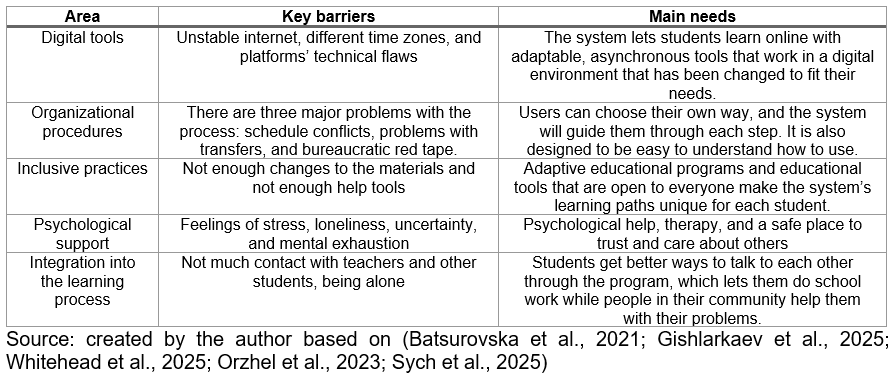
Students who study abroad during the war encounter interconnected digital, institutional, and psychosocial obstacles that allowed increasing the level of educational disruption and uncertainty. There is evidence to indicate that quality education is sustaining via flexible online delivery, inclusive practices, counseling, and coordinated strategies of integrating. In the circumstances of forced mobility, the Ukrainian higher education institutions need a methodological model based on a combination of empirically justified methods, adaptive assessment, and systematic diagnostics of the needs of the students to combat digital and psychological challenges (Batsurovska et al., 2021; Ihnatenko & Shorena, 2024). The expanding transnational enrollment requires institutional change grounded on receptiveness, virtual adaptability, and inclusiveness in order to provide continuity and individualization of learning in martial law (Bozorgmehr et al., 2024). The suggested model incorporates related steps of information analysis, evaluation standards, needs analysis, and adaption indicators that imply a logical framework of evidence-based decision-making in favor of displaced students (Ellis et al., 2024; Gishlarkaev et al., 2025).
The suggested model of the methodology is well grounded and makes it possible to implement purposeful system all-around changing in curricula of higher education establishments of Ukraine counting on increase number of moving students. It includes quantitative and qualitative measures, lets you see students’ needs in a variety of ways and builds out a set of standard metrics that help determine if programmatic changes are working well. more flexible education actions could be applied by model. It makes education more accessible, enhances inclusion and enables colleges to make sure educational trajectories can continue even when war breaks out.
Institutions adopted pro-flexible policies which were very essential for the survival of good quality education and also the higher education system during the war. Some science sources stress that universities were forced to strengthen the digital infrastructure, amend academic programs and introduce new student support, this allowed filling in part of learning loss and increased flexibility of educational process (Zayachuk, 2024). The latter adaptation has been discussed as a mechanism for sustaining access, reducing early disengagement, and broadening participation in emergency education contexts (Shah et al., 2024). At the same time, international reviews provide an overview of the distressing psychosocial circumstances as well as accounting for why adaptations have or have not been successful such as around young people’s access to digital technology; health problems and general vulnerabilities in a population that has experienced stress and forced movement through war (UNDP, 2024b). And in the process we can use statistical indicators to paint a fuller picture of how adaptive solutions affect to what extent kids learn in times of war. In advance of showing integrated results, the Table 2 presents summary of primary quantitative tendencies at Ukrainian HEIs after measures for adaptation concerning all educational process’s participants had been done.
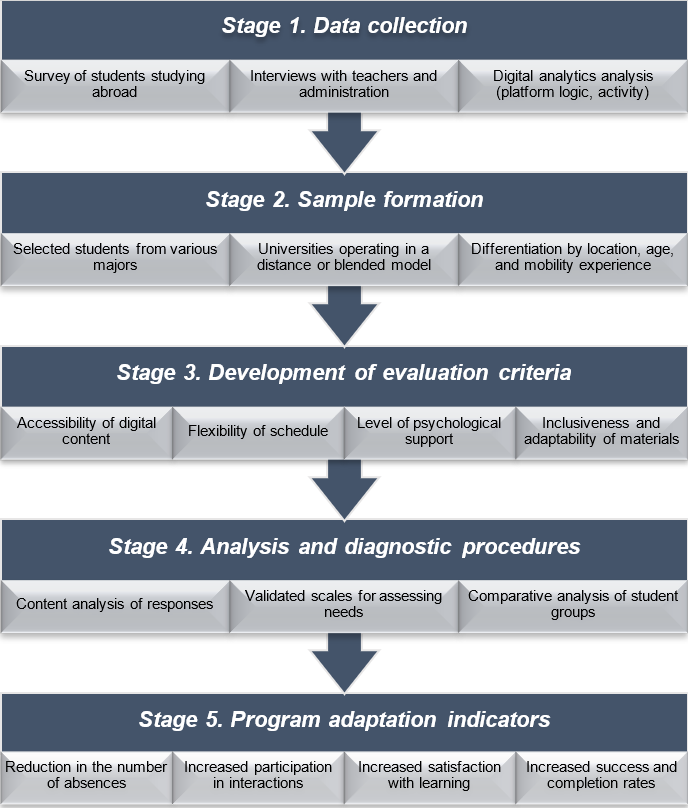
Figure 1. Methodological model for adapting educational programs to conditions of high student mobility.
Source: created by the author based on (Batsurovska et al., 2021; Ellis et al., 2024; Gishlarkaev et al., 2025; Ihnatenko & Shorena, 2024; Bozorgmehr et al., 2024)