
Original Article
Eduweb, 2026, enero-marzo, v.20, n.1. ISSN: 1856-7576
Doi: https://doi.org/10.46502/issn.1856-7576/2026.20.01.11
Preparación docente para la educación inclusiva en la educación superior
Oleksandr Alieksieiev
Doctor of Pedagogic Sciences, Professor, Associate Professor of the Department of Sport and Sport Games, Kamianets-Podіlskyi Ivan Ohiienko National University, Ukraine.
https://orcid.org/0000-0002-6950-4413
Viсtoria Kyslychenko
PhD., Associate Professor, Department of Special and Inclusive Education, V. O. Sukhomlynsky Educational and Scientific Pedagogical Institute, Admiral Makarov National University of Shipbuilding, Ukraine.
https://orcid.org/0000-0002-0186-5511
victoria.kislichenko@gmail.com
Nataliia Savchenko
Doctor of Pedagogical Sciences, Professor, Professor of the Department of Educational Sciences, Volodymyr Vynnychenko Central Ukrainian State University, Ukraine.
https://orcid.org/0000-0003-0420-3289
Mykola Dubinka
Doctor of Pedagogical Sciences, Аssociate Рrofessor, Associate Professor of the Department of Educational Sciences, Volodymyr Vynnychenko Central Ukrainian State University, Ukraine.
https://orcid.org/0000-0001-7129-3750
Iryna Makarenko
Candidate of Pedagogical Sciences, Associate Professor, Associate Professor of the Department of Pedagogy, Kryvyi Rih State Pedagogical University, Ukraine.
https://orcid.org/0000-0002-9190-2549
Cómo citar:
Alieksieiev, O., Kyslychenko, V., Savchenko, N., Dubinka, M., & Makarenko, I. (2026). Teacher preparation for inclusive education in higher education. Revista Eduweb, 20(1), 178-199. https://doi.org/10.46502/issn.1856-7576/2026.20.01.11
Recibido: 10/12/25 Aceptado: 19/02/26
Abstract
The study aims to evaluate the effectiveness of structured pedagogical conditions for preparing future teachers for innovative professional activity in inclusive educational environments within higher education institutions. The relevance of the research is determined by the discrepancy between the formally declared principles of inclusive education and the insufficient level of readiness of pre-service teachers for inclusive practice. A mixed-methods quasi-experimental design was implemented involved experimental and control groups of future teachers. Readiness for innovative activity in inclusive education was conceptualized as an integrated construct comprising motivational-value, operational-activity, and reflective-evaluative components. The results of the ascertaining stage revealed predominantly low and medium levels of readiness in both groups. Following the implementation of targeted pedagogical conditions in the experimental group – including motivational support, methodological guidance, immersion in inclusive practice, application of innovative and digital technologies, and structured reflection – a statistically significant increase was observed across all readiness components (p < .05). The findings confirm that the systematic integration of motivational, methodological, and reflective elements within teacher education programs significantly enhances readiness for innovative activity in inclusive education. The study contributes empirical evidence to inclusive pedagogy research and provides a validated framework for modernizing teacher preparation in the context of educational inclusion and digital transformation.
Keywords: innovative activity, inclusive education, higher education institutions, teacher self-development and professional self-efficacy, technologies.
Resumen
El estudio busca evaluar la efectividad de las condiciones pedagógicas estructuradas para preparar a futuros docentes para la actividad profesional innovadora en entornos educativos inclusivos dentro de instituciones de educación superior. La relevancia de la investigación está determinada por la discrepancia entre los principios formalmente declarados de la educación inclusiva y el nivel insuficiente de preparación de los futuros docentes para la práctica inclusiva. Se implementó un diseño cuasiexperimental de métodos mixtos que involucró a grupos experimentales y de control de futuros docentes. La preparación para la actividad innovadora en educación inclusiva se conceptualizó como un constructo integrado que comprende componentes de valor motivacional, actividad operativa y evaluación-reflexiva. Los resultados de la etapa de verificación revelaron niveles predominantemente bajos y medios de preparación en ambos grupos. Tras la implementación de las condiciones pedagógicas específicas en el grupo experimental – incluyendo apoyo motivacional, orientación metodológica, inmersión en la práctica inclusiva, aplicación de tecnologías innovadoras y digitales, y reflexión estructurada – se observó un aumento estadísticamente significativo en todos los componentes de preparación (p < .05). Los hallazgos confirman que la integración sistemática de elementos motivacionales, metodológicos y reflexivos dentro de los programas de formación docente mejora significativamente la preparación para la actividad innovadora en educación inclusiva. El estudio aporta evidencia empírica a la investigación en pedagogía inclusiva y proporciona un marco validado para modernizar la preparación docente en el contexto de la inclusión educativa y la transformación digital.
Palabras clave: actividad innovadora, educación inclusiva, instituciones de educación superior, autodesarrollo docente y autoeficacia profesional, tecnologías.
Introduction
In the context of ongoing educational reform in Ukraine, inclusive education has become a strategic priority aligned with national legislation and international commitments. While regulatory frameworks and institutional policies increasingly support inclusive practices, the professional preparation of future teachers for work in inclusive classrooms remains insufficiently systematic and practice-oriented.
An analysis of teacher education curricula and preliminary diagnostic data (student surveys, self-assessment instruments, and expert evaluations) revealed a significant discrepancy between the professional demands placed on teachers in inclusive settings and the actual level of preparedness among pre-service teachers. The findings indicate that a considerable proportion of students demonstrate fragmented understanding of inclusive education principles, limited ability to apply differentiated instructional strategies, difficulties in adapting digital and methodological tools for learners with special educational needs, and low confidence in implementing individualized learning trajectories (Castillo-Acobo et al., 2022).
Therefore, the research problem lies in identifying and experimentally validating pedagogical conditions and innovative training approaches that can ensure comprehensive preparation of future teachers for professional activity in inclusive educational environments. The necessity of this study is justified by the existing gap between the formally declared principles of inclusion and the empirically observed level of competence formation among pre-service teachers. Addressing this gap requires evidence-based pedagogical solutions supported by diagnostic data and contextualized within real institutional conditions.
Literature Review
Researchers from various countries have studied the features of inclusive education and its implementation in contemporary educational settings. For our research, it is essential to consider scientists' ideas on innovative approaches to high-quality training in inclusive education for future teachers.
Núñez-Naranjo et al. (2025) examined the role of innovative digital resources in promoting digital inclusion within entrepreneurship education in Ecuador. Using a mixed-methods approach, the study analyzed the impact of these tools on secondary school students and teachers, finding that digital resources significantly enhanced technological skills and increased student engagement. The results underscore the importance of integrating digital technologies into education to foster inclusive and effective learning environments, and recommend extending such practices across other curricular areas.
Da Silva & Franco Brandão (2024) conducted a systematic literature review on computer-supported collaborative activities as strategies for digital inclusion in youth and adult education. The review highlights persistent global inequalities in adult education participation. It identifies collaboration as a central pedagogical approach, often supported by mobile devices, social networks, and virtual learning environments due to their accessibility. The authors note a limited number of studies specifically addressing adult education, particularly in developing countries, and point out that the integration of computational thinking and artificial intelligence for digital inclusion remains underdeveloped. Overall, the study emphasizes the importance of digitally inclusive, collaborative approaches to support lifelong learning and improve educational opportunities for marginalized populations.
Ávata Varas et al. (2022) analyzed the impact of innovative educational management on inclusive, quality, and creative teaching–learning processes in a primary school context. Using a qualitative, non-experimental, and cross-sectional design based on interviews with school leaders and teachers, the study found that innovative management practices positively influence inclusive education by reducing physical, social, and cognitive barriers to learning. However, the results also revealed shortcomings in classroom practices and a lack of resources to support students with learning difficulties, highlighting the need for a shift in teachers’ mindsets toward inclusive, high-quality education. Overall, the study emphasizes that innovative educational management fosters the appreciation of diversity and strengthens institutional capacity to support equitable learning opportunities.
Benoit (2020) defines innovation as encompassing all that can improve human development and quality of life. Therefore, the scientist developed activity management technologies and a unified methodological system to introduce innovations in a teacher's workplace. A targeted new training program for innovative activities of future speech therapists, based on the author's scientific and methodological system, is proposed.
Sormunen et al. (2020) propose the mandatory introduction of an information component into the structure of the innovative activity of a speech therapist or any teacher. Scientists substantiate the interconnected stages of teachers' information activity in inclusive education.
Ortega-Sánchez & Jiménez-Eguizábal (2019) implemented a set of measures to modernize the educational process within inclusive education, thereby disseminating innovative technologies for correctional and speech therapy to enable effective correction of speech disorders and to provide modern learning conditions for children with special educational needs.
Inclusive education has been widely recognized as a fundamental principle of modern educational systems, emphasizing equity, accessibility, and individualized learning support. Contemporary research highlights the importance of preparing teachers not only at the level of theoretical awareness but also in terms of practical, methodological, and digital readiness for inclusive classroom environments. However, the conceptualization and operationalization of teacher preparedness for inclusion remain heterogeneous across studies.
A significant body of research focuses on teachers’ attitudes toward inclusion and general perceptions of readiness. These studies primarily employ cross-sectional survey designs and self-reported measures to assess beliefs, confidence levels, and perceived competence. While such research provides valuable descriptive insights, it often lacks experimental validation of specific pedagogical interventions aimed at strengthening inclusive competence.
Another group of studies examines the integration of digital technologies in inclusive education, emphasizing assistive tools, adaptive platforms, and differentiated instruction strategies. However, these investigations frequently concentrate on technological affordances rather than on systematically structured pedagogical models embedded within teacher education curricula. As a result, digital innovation is often treated as an auxiliary support mechanism rather than as a core component of competence formation.
Comparative analysis of previous research reveals three major gaps.
First, there is a methodological gap: much of the existing literature relies on descriptive or correlational designs, with limited use of quasi-experimental or experimental approaches that allow causal inferences regarding the effectiveness of pedagogical interventions.
Second, there is a structural gap: inclusive competence is often examined in isolation (attitudes, knowledge, or digital skills separately), without integrating motivational, cognitive, and activity-based dimensions into a coherent competence model.
Third, there is a contextual gap: relatively few studies provide empirically grounded evidence from Eastern European higher education systems, particularly within the Ukrainian context, where inclusive education reforms are rapidly evolving but institutional readiness remains uneven.
These gaps indicate that, despite extensive discourse on inclusive education and innovation in teacher training, there is insufficient empirical evidence regarding how structured pedagogical conditions and innovation-oriented training strategies influence the comprehensive formation of inclusive competence in pre-service teachers.
In response to these limitations, the present study aims to evaluate the effectiveness of context-specific pedagogical conditions implemented within Ukrainian higher education institutions for preparing pre-service teachers for inclusive practice. Unlike predominantly descriptive studies, this research employs a quasi-experimental design and operationalizes inclusive competence as an integrated construct encompassing motivational, cognitive, and activity-based components.
Thus, the contribution of this study to the existing literature is threefold:
Through this integrative approach, the study bridges the gap between normative discourse on inclusion and empirically verified pedagogical practice, aligning the identified research problem with a clearly defined and contextually grounded research aim.
Purpose of the article. The aim of this study is to evaluate the effectiveness of innovative pedagogical conditions and structured training strategies for preparing pre-service teachers to work in inclusive educational settings within Ukrainian higher education institutions.
Methodology
Research Design
The study employed a mixed-methods quasi-experimental design combining qualitative and quantitative approaches to examine the effectiveness of pedagogical conditions in developing future teachers’ readiness for innovative activities in inclusive education. The research was conducted longitudinally during 2022–2025 and included three consecutive stages: ascertaining, formative, and control.
Participants
The participants were future teachers enrolled in higher education institutions in Ukraine. They were divided into an experimental group (EG) and a control group (CG). The groups were comparable with respect to age, field of study, and level of professional training. Participation was voluntary, and ethical standards of educational research were observed throughout the study.
Research Instruments
To assess future teachers’ readiness for innovative activity in inclusive education, a complex of validated research instruments was used:
Readiness for innovative activity was operationalized through three criteria:
Each criterion included specific indicators, and three readiness levels were distinguished: low, average, and high.
Procedure
At the ascertaining stage, a theoretical analysis of scientific sources was conducted, and the initial level of readiness for innovative activity in inclusive education was diagnosed in both groups. Based on the obtained results, pedagogical conditions and an experimental program were developed.
The formative stage involved the implementation of the proposed pedagogical conditions exclusively in the experimental group. These conditions included:
formation of positive motivation for innovative professional activity;
scientific and methodological support of inclusive teacher training;
application of innovative methods, technologies, and forms of interaction in inclusive education.
The control group continued traditional training without targeted intervention.
At the control stage, a final assessment of readiness levels was conducted using the same diagnostic tools as at the ascertaining stage to ensure comparability of results.
Data Analysis
Quantitative data were processed using methods of mathematical statistics. The Mann–Whitney U test and the Kruskal–Wallis H test were applied to identify statistically significant differences between the experimental and control groups. The following hypotheses were tested:
H₀: There are no statistically significant differences between the EG and CG in readiness for innovative activity in inclusive education.
H₁: There are statistically significant differences between the EG and CG.
Qualitative data were analyzed through content and comparative analyses, thereby enabling triangulation of findings and enhancing the reliability of the results.
Ethical Considerations
The study complied with ethical standards for educational research. Participants were informed about the purpose of the study, anonymity was ensured, and data were used exclusively for scientific purposes.
Institutional Context
The study was conducted in three Ukrainian higher education institutions implementing bachelor-level teacher education programs (specialties: Primary Education, Special Education, and Social Pedagogy) during the national reform of inclusive education aligned with the Law of Ukraine “On Education” and the Concept of the New Ukrainian School. All participating institutions had formally introduced inclusive education policies; however, the level of methodological support, digital infrastructure, and practical training in inclusive settings varied.
The teacher preparation programs included mandatory pedagogical practice, psychological-pedagogical disciplines, and limited coursework specifically devoted to inclusive education (1–2 modules within general pedagogy courses). Prior to the intervention, no structured, competence-based model integrating motivational, operational, and reflective components of inclusive readiness had been systematically implemented.
Thus, the experimental intervention was embedded within the regular curriculum but functioned as a structured pedagogical enhancement integrated into the professional training cycle during the 3rd and 4th years of study.
Validity and Reliability
The validity and reliability of the research instruments were ensured through several complementary procedures.
Content validity was established via expert evaluation involving seven specialists in inclusive pedagogy and educational psychology. The Content Validity Index (CVI = 0.87) confirmed strong agreement regarding the relevance and clarity of the items and their alignment with the three-component model of readiness (motivational-value, operational-activity, evaluation-reflective).
Construct validity was examined using exploratory factor analysis. The Kaiser–Meyer–Olkin index (KMO = 0.81) and Bartlett’s test of sphericity (p < .001) confirmed data suitability. The results supported a three-factor structure consistent with the theoretical model, with factor loadings ranging from 0.62 to 0.84.
Criterion-related validity was verified through correlation with expert assessments during pedagogical practice (r = 0.69, p < .01).
Internal consistency was satisfactory (Cronbach’s α = 0.79–0.88). Inter-rater reliability (Cohen’s κ = 0.76) and test–retest reliability (r = 0.82) confirmed the stability and consistency of the measurements.
Description of the Pedagogical Intervention
The pedagogical intervention was implemented during the formative stage of the quasi-experimental study and lasted two academic semesters (32 weeks; 180 academic hours). It was integrated into the regular teacher education curriculum (3rd–4th year) and delivered exclusively to the experimental group (EG), while the control group (CG) continued traditional training.
The intervention was structured according to a three-component model of readiness for innovative activity in inclusive education: motivational–value, operational–methodological, and reflective–evaluative.
Motivational–Value Component (6 weeks)
This stage aimed to develop professional values, inclusive attitudes, and motivation for innovative practice. Activities included seminars on inclusive education principles, analysis of authentic classroom cases, structured discussions of ethical dilemmas, and workshops focused on professional self-efficacy. Reflective journals were used to monitor changes in students’ attitudes and professional orientation.
Operational–Methodological Component (14 weeks)
This stage focused on developing practical skills for inclusive teaching. The content included differentiated instruction strategies, adaptation of learning materials for students with special educational needs, use of assistive and digital technologies, and implementation of art-based inclusive methods (e.g., music, visual art, sand techniques).
Instructional formats included:
Students designed inclusive lesson plans integrating innovative and digital tools and presented them for expert evaluation.
Reflective–Evaluative Component (12 weeks)
This stage consolidated professional self-efficacy and reflective competence. It included supervised pedagogical practice in inclusive classrooms, structured observation protocols, group supervision sessions, and guided self-analysis of teaching performance.
Each participant completed an inclusive practice portfolio containing lesson plans, reflective reports, expert feedback, and self-evaluation materials.
Implementation Control
To ensure fidelity of implementation, instructors completed preparatory methodological training and used standardized guidelines. Observation checklists and coordination meetings were employed to monitor adherence to the intervention design.
Unlike traditional training, which emphasized theoretical knowledge, the intervention systematically integrated motivational, practical, and reflective dimensions and provided structured immersion into authentic inclusive contexts. This ensured a comprehensive and competence-oriented preparation of future teachers for innovative activity in inclusive education.
Results and Discussion
Content of the concepts of the study: Effective methods and techniques, forms, and principles of cooperation in preparing for innovative activity of future teachers in an inclusive educational environment.
The teacher's readiness for inclusive activities and the development of inclusive competence are becoming the primary tasks today in creating an innovative system for training future teachers to work in inclusive classes.
Inclusive competence of future teachers in their innovative activities is defined as an integral characteristic of a teacher, which in the context of an inclusive approach affects the ability to solve professional tasks of educational activities, as an appropriate modern level of skills and knowledge in the context of inclusive education, which is necessary for the performance of professional functions; which are embodied in the ability to perform and integrate professional functions into the environment, taking into account the special needs of young people with health problems, creating conditions for self-development, self-efficacy and development.
For self-development and professional self-efficacy of the future teacher, we draw attention to cooperation with inclusive educational institutions, modeling for higher school students during laboratory and practical knowledge situations of quasi-professional activity, implementation of group, individual, and creative projects, and involvement of students for self-development and professional self-efficacy to participate in social design at the level of educational institutions.
Practical methods and techniques for preparing future teachers for innovative activities in an inclusive educational environment include:
Familiarization with inclusive educational practices directly in educational institutions helps future teachers to exchange practical experience with specialists and fellow students, to comprehend the experience of interacting with children with special needs, and to immerse themselves in the content of inclusive activities at the rehabilitation and correctional stages.
Forms of cooperation with institutions serving children with special educational needs, including inclusive educational institutions, include master classes by specialists; participation in laboratory observations of children with special needs; and excursions that can be conducted via online videoconferences under conditions of live, direct interaction.
In higher education, when preparing future specialists to implement inclusive educational practices, it is advisable to teach algorithms that, at different stages of observation, involve constructing a teacher's action plan: observation of a special child's creative activity, play, and educational activities. Let us name the stages of such observation.
The observation stage includes visiting inclusive resource centers, correctional and rehabilitation institutions, and inclusive educational institutions to gain experience interacting with children with disabilities.
The stage of external observation, in the context of distance learning via video recordings of specialists working with a child with a disability, provides students with an opportunity to observe teachers' practical activities in inclusive educational institutions.
The stage of reflection involves understanding new experiences in professional practice, forming an image of the teacher's future professional trajectory, developing an attitude toward self-development and professional self-efficacy, and engaging in self-improvement for work in an inclusive educational environment.
All proposed methods of practical training and methods of cooperation in preparing future teachers for innovative activities in an inclusive educational environment are based on the principles of an interdisciplinary approach, the connection of theory with practice, activity, and awareness in the educational process of students, and personal and professional self-development (Ramírez-Montoya et al., 2024).
Innovative strategies for psycho-educational support of students in inclusive education. Basic requirements for teachers. The importance of teachers' readiness to organize inclusive education. Key conditions for organizing an inclusive environment. Professional self-efficacy of a teacher.
In his professional practice, a teacher experiences difficulties in pedagogical interactions and clearly recognizes the challenges faced by children with special educational needs; therefore, he develops strategies for psycho-educational support for students. To assess the quality of the general education process, new, modern requirements are being proposed for teachers.
Among the basic requirements for the pedagogical activity of specialists, one can single out:
One of the key conditions for organizing an inclusive environment is teachers' readiness to engage in innovative activities within such an educational environment, which requires developing personal qualities and a sufficient level of professional development that, in the context of inclusive education, make their activities effective.
An important condition for innovative training of future teachers is also the development of a complex of personal qualities, specialized skills, and knowledge that encompasses anatomical and physiological aspects, psychological and pedagogical characteristics of the child, strategies, stereotypes, professional attitudes, and tactics of individual behavior. This enables teachers to effectively implement innovative, modern educational methods for children with special educational needs across various categories. Modern graduates of higher education recognize the full significance of professional activity and understand that their professional activity will take place within the ongoing development of the educational digital system, which is continually undergoing innovations that cover almost all aspects of the educational process. One such innovative change is the introduction of inclusive education in groups in which children with special educational needs study. Future teachers must be able to implement innovative methods, work in an integrated educational space, serve as moderators of students' educational trajectories, and possess the fundamentals of coaching, individualization, and the principles of comprehensive pedagogy. Therefore, the training of future teachers should include disciplines that provide practical, appropriate training in inclusive education.
Significant changes have occurred in pedagogical and social approaches, as well as in legislation governing the education of children with special educational needs. Further improvement of the professional training of relevant specialists and the educational and methodological base requires the introduction of inclusive education across all educational institutions to effectively develop inclusive education and ensure high-quality preparation of children for life. Therefore, teacher training should focus on the practical, theoretical, and psychological aspects of their professional activities.
An important aspect of the training of future teachers, one of the key conditions for organizing an inclusive environment in inclusive education, is their professional self-efficacy, the formation of subjective confidence of the future specialist, and not just the transfer of knowledge about nosologies.
For a teacher, professional self-efficacy is an integrative socio-psychological construct characterized by self-awareness and readiness to engage in competent, skillful educational activity. At the same time, the levels of its formation are determined so that the teacher can begin performing production functions. Therefore, professional self-efficacy is not only a systematic self-assessment of one's own ability to ensure the quality and effectiveness of subject-subject interaction in the process of learning with children at the normative level (Garcia, 2025).
Readiness in an inclusive space for innovative activity is determined by the extent to which the teacher, regardless of an individual's starting capabilities, believes it is possible to ensure the qualitative progress of each child.
Inclusive education presents unique challenges: the use of assistive technologies, the need to individualize educational trajectories, and the need to ensure psychological comfort for all participants in the educational process. In contemporary working conditions, teachers face uncertainty regarding their own competencies and high levels of stress. That is why the foundation is the development of professional self-efficacy, on which the teacher's readiness for innovation is built. A teacher's self-efficacy is his conviction in his ability to perform actions clearly and to fully and innovatively organize the educational process. These teacher positions are necessary to achieve specific goals in working with children with special educational needs (Reyes-Parra et al., 2020).
Teachers with high professional self-efficacy are more likely to experiment with assistive devices and digital technologies. They are professionals in their field and adapt educational content more quickly (e.g., by using multisensory approaches and creating alternative formats for educational activities). Moreover, vice versa – low professional self-efficacy of the teacher leads to "methodological conservatism", that is, it leads to fear of departing from the template, and this, in inclusive education, is unacceptable. Therefore, it is precisely the teacher's high level of professional self-efficacy, in conditions of inclusion where standard methods often do not work, that enables the teacher not to perceive difficulties as a defeat but to see them as a task that requires an innovative approach.
In parallel with the mastery of new digital technologies, the future teacher's professional self-efficacy develops. The ability to use technical tools for inclusion or specialized software automatically enhances the assessment of his professional capabilities. Thus, a teacher's professional self-efficacy is an internal driver of their innovative development, because even the use of the most modern technologies in inclusive education will remain formal without confidence in the success of one's own actions (Carmona et al., 2023).
Key aspects of professional training of future teachers for work in inclusive education – ways to modernize higher pedagogical education in the context of the specified problem.
In the gradual introduction of a comprehensive education system in higher education, an important factor is the professional training of teachers, which is aimed at supporting the development of children with SEN and their education within an inclusive environment. The system of professional teacher training provides for the use of systematically substantiated and specifically developed software that will contribute to students' preparation for life and support them in the educational environment. The preparation of teachers for inclusive activities encompasses their moral and psychological readiness to work with children with special needs and to provide them with a modern material base and new methodological materials.
Let us highlight the key aspects that are important in the professional preparation of future teachers for their work in inclusion conditions:
Higher education institutions, in the context of the development of education and its humanistic and innovative paradigm at the contemporary social stage, face the challenge of preparing future teachers to work in inclusive educational environments alongside children with special educational needs.
In the context of the above problem, we will outline the ways of modernization of higher pedagogical education:
The application of innovative approaches and technologies to children with special educational needs is integral to a teacher's inclusive competence.
The function of removing mental barriers to learning and enhancing the child's development is achieved through innovations in art therapy, a component of therapeutic and suggestive technology.
Let us reveal the content of the main types of art technologies that teachers most often use to work with children who need exceptional support in education:
This "world-building technique" helps children express their emotions without words and share their experiences and feelings. Sand art technology is a correctional and developmental method, a psychological and pedagogical method aimed at solving the problems of a child with intellectual developmental disorders and speech problems, because it is working with sand that helps the child to level out his emotional background, establish contact between the teacher and the child, increase the child's motivation for his activities, increase the child's interest in his activities, form self-regulation processes in each individual, increase the child's interest in activities, influence the growth of cognitive activity, the development of the child's cognitive processes, etc.
Thus, as a result of the use of the art technology method by teachers in their professional activities:
Creative work guarantees recognition of the child's environment, increases his motivation, and forms self-education and self-esteem. The child becomes confident in himself when he succeeds in creative work.
Organization, stages, and methodology of experimental research
Taking into account the analyzed scientific and pedagogical sources, taking into account the existing preparation for innovative activity of future teachers in inclusive education, the structure of innovative activity, we will reveal the content of the components of readiness of future teachers for innovative activity in inclusive education identified by us in the conducted study:
A system of criteria and indicators has been developed to assess the readiness levels (low, average, high) of future teachers in inclusive education for innovative activities.
The motivational and value criterion has indicators:
The following indicators correspond to the activity criterion:
The evaluation criterion contains, in its essence, the following indicators:
The ascertaining stage of the experiment.
During 2022-2025, an experimental study was conducted, comprising three interrelated stages: the ascertaining stage, the forming stage, and the generalizing stage.
A theoretical analysis of the outlined problem and the state of the problem under study was carried out at the ascertaining stage of the study; the directions of scientific research were determined; the pedagogical conditions for preparing future teachers for innovative activity in inclusive education were theoretically substantiated; a program of experimental work was developed; the components of readiness, criteria, indicators, and levels of readiness of future teachers in relation to the specified research topic were substantiated; a ascertaining stage of the experiment was conducted, which was the final stage of this experiment, and the initial levels of readiness of future teachers for professional activity were investigated.
According to the results, the following results of the ascertaining stage were obtained regarding the initial levels of readiness of future teachers (Fig. 1):
Motivational and value criterion
Activity criterion
Evaluation criterion
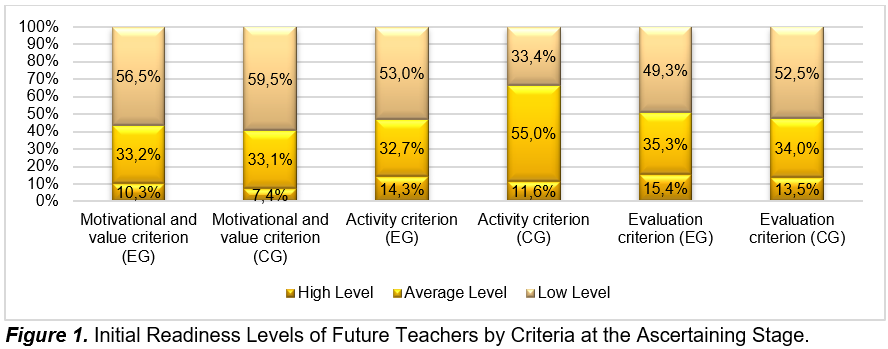
Having analyzed the diagnostic results on the readiness levels of future teachers at the ascertaining stage of the experiment, we conclude that future teachers exhibit low readiness for innovative activities in inclusive education.
The results of the ascertaining experiment showed the need for a formative stage.
Organization of a formative experiment to assess the readiness of future teachers for innovative activity in conditions of inclusion.
To verify the pedagogical conditions for preparing future teachers for innovative activities in inclusive education, we conducted experiments during the formative and control stages.
The research and experimental work of the formative stage was conducted in accordance with the main requirements of the pedagogical experiment, which provided for a long-term impact of the experimental means through the longitudinal method.
During the formative stage of the study, the pedagogical conditions were implemented in accordance with the experimental work program. Only students in the experimental group were administered formative measures (the traditional teaching of students in the control groups remained)
In our study, the developed pedagogical conditions were significant in successfully fostering future teachers' readiness for innovative activity within inclusive settings.
The following pedagogical conditions were effective:
All developed pedagogical conditions constitute a single complex, interconnected, and mutually conditioning set of prerequisites.
The final assessment of future teachers' readiness to work in an inclusive educational environment was conducted at the control stage of the experiment.
Using the same tools as at the ascertaining stage, an assessment of teachers' readiness for professional activity in inclusive settings was conducted.
At the control stage, qualitative and quantitative results were obtained (Fig. 2).
Motivational and value criterion
Activity criterion
Evaluation criterion
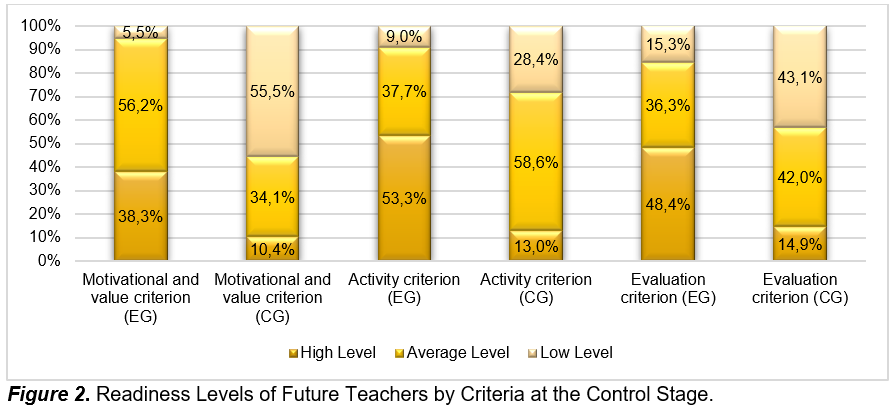
The results of the control section indicate that the work carried out in the EG was practical.
Motivational and value criterion – students’ motivation to introduce innovations into their future professional activities has significantly increased; positive, value-based attitude towards the chosen profession; orientation towards openness in the process of interaction with children and cooperation with subjects of inclusive education.
Activity criterion – the ability to creatively implement various methods of pedagogical interaction between all subjects of inclusive education has increased; knowledge of correctional work, the specifics of working with children with developmental disorders has increased; teachers’ willingness to change their own professional activities has increased.
The evaluation criterion increased teachers' readiness to apply innovations in future professional activities; the need for teachers' professional and personal self-development increased; and the level of adequate analysis of professional activities and of the results of building an inclusive educational environment increased.
In general, the dynamics of changes in the EG at the control stage are significantly more pronounced than in the CG.
Using the Mann-Whitney and Kruskal-Wallis statistical methods, the obtained data were verified. Using the Kruskal-Wallis statistical method, we formulate hypotheses as follows in order to verify the data:
𝐻0: There are no differences between the groups (EG, CG) at the control stage of the experiment, according to the results of the formation of the corresponding component (all components) of readiness.
𝐻1: There are significant differences between the groups (EG, CG) at the control stage of the experiment, according to the results of the formation of the corresponding component (all components) of readiness.
Therefore, we must reject the null hypothesis based on the results of the calculations and accept the alternative one. We argue that the dynamics of change in the EG and CG differ significantly across components of readiness and, consequently, across readiness as a whole.
We also used the Mann-Whitney test in the study to test the hypotheses, which confirmed significant differences at the control and ascertaining stages of the experiment.
Compared with the critical value, the empirical values indicate non-random differences across all components of readiness in the CG and EG.
This confirms the effectiveness of the pedagogical conditions proposed by us, as significantly better results in the formation of future teachers' readiness to address the outlined inclusion problem were obtained in the EG than in the CG, where the pedagogical conditions were introduced.
The results of the study provide empirically grounded evidence that the systematic implementation of structured pedagogical conditions significantly enhances the readiness of future teachers for innovative activity in inclusive education. The positive dynamics observed in the experimental group across motivational-value, operational-activity, and reflective-evaluative components confirm the effectiveness of the proposed competence-based model.
Theoretical Interpretation of the Results
From a theoretical perspective, the findings substantiate the integrative understanding of inclusive competence as a multidimensional construct. Unlike studies that examine attitudes, digital skills, or methodological preparedness separately (Reyes-Parra et al., 2020; Da Silva & Franco Brandão, 2024), the present research confirms that inclusive readiness develops most effectively when motivational, operational, and reflective dimensions are systematically interconnected.
The significant improvement in the motivational-value criterion supports the assumption that professional self-efficacy functions as an internal driver of innovative activity (Garcia, 2025; Carmona et al., 2023). The results demonstrate that motivation for inclusive practice is not formed through theoretical instruction alone but through structured immersion in authentic professional contexts and reflective engagement.
The growth observed in the operational-activity component confirms the position of Sormunen et al. (2020) and Ortega-Sánchez & Jiménez-Eguizábal (2019) regarding the effectiveness of project-based, case-based, and technology-enhanced pedagogies in inclusive teacher training. However, unlike predominantly descriptive studies, the present research provides quasi-experimental evidence of causal impact.
Pedagogical Significance
Pedagogically, the study demonstrates that inclusive readiness cannot be ensured through isolated coursework or declarative knowledge. Instead, it requires:
The experimental model shows that teacher preparation programs must transition from predominantly theoretical delivery toward competence-oriented, experience-based training. The inclusion of art-based technologies, project-based collaboration, immersion practices, and supervised reflection contributed to the measurable increase in readiness levels.
Thus, the study confirms that innovative pedagogical conditions operate as an interconnected system rather than as isolated methodological interventions.
Academic Contribution
The academic contribution of the research is threefold:
Practical Implications for the Education System
The results have direct implications for:
The study demonstrates that reforms in inclusive education require not only legislative support but also evidence-based restructuring of teacher preparation programs. The effectiveness confirmed in the experimental group indicates that the proposed pedagogical conditions may be recommended for broader institutional implementation.
Final Statement
In conclusion, the study bridges the gap between normative declarations of inclusive education and empirically validated pedagogical practice. The statistically significant differences between the experimental and control groups confirm that structured, innovation-oriented pedagogical conditions substantially enhance future teachers’ readiness for professional activity in inclusive environments.
While the research does not exhaust all aspects of the problem, it provides a validated theoretical and methodological foundation for further studies focused on digital transformation, interdisciplinary integration, and long-term tracking of inclusive competence development in teacher education systems.
Conclusions
The content of the research concepts is revealed. Practical methods, techniques, forms, and principles of cooperation for preparing future teachers for innovative activities in an inclusive educational environment are outlined. Innovative strategies for psycho-educational support of students in inclusive education are revealed. The main requirements for teachers are grouped. The importance of teachers' readiness for organizing inclusive learning is shown. The key conditions for organizing an inclusive environment are substantiated. The importance of a teacher's professional self-efficacy is described. Key aspects of professional training of future teachers for work in inclusive education are presented. Ways of modernization of pedagogical education in the context of the specified problem are shown. The advantages of applying innovative approaches and technologies for children with special educational needs, an integral component of a teacher's inclusive competence, are demonstrated.
During 2022-2025, an experimental study was conducted, comprising three interrelated stages: the ascertaining stage, the formative stage, and the generalizing stage.
Having analyzed the diagnostic results on the readiness levels of future teachers at the ascertaining stage of the experiment, we conclude that future teachers exhibit low readiness for innovative activities in inclusive education.
The results of the ascertaining experiment indicated the need to conduct a formative stage to assess the readiness of future teachers for innovative activity in inclusive education.
During the formative stage of the study, the developed pedagogical conditions were introduced to the students of the experimental group in accordance with the proposed experimental work program.
The results obtained in the control section indicate practical work performed in the EG.
In general, the dynamics of changes in the EG at the control stage are much more pronounced than in the CG.
Using the Mann-Whitney and Kruskal-Wallis statistical methods, the obtained data were verified. Using the Kruskal-Wallis statistical method, we formulate the hypotheses as follows in order to verify the data:
𝐻0: There are no differences between the groups (EG, CG) at the control stage of the experiment, according to the results of the formation of the corresponding component (all components) of readiness.
𝐻1: There are significant differences between the groups (EG, CG) at the control stage of the experiment, according to the results of the formation of the corresponding component (all components) of readiness.
Therefore, we must reject the null hypothesis based on the results of the calculations and accept the alternative one. We argue that the dynamics of change in the EG and CG differ significantly across components of readiness and, consequently, across readiness as a whole.
We also used the Mann-Whitney criterion in the study to test hypotheses, which confirmed the presence of significant differences at the control and ascertainment stages of the experiment.
Compared with the critical value, the empirical values indicate non-random differences across all components of readiness in the CG and EG.
This confirms the effectiveness of the pedagogical conditions proposed by us, as significantly better results in the formation of future teachers' readiness to the outlined problem under inclusion conditions were obtained in the EG than in the CG, where the pedagogical conditions were introduced.
The study we conducted does not address all aspects of the problem we outlined. However, the study can serve as a basis for further research on the described problem. A promising direction for research is the development of recommendations for innovative professional activities for specialists, taking into account inclusive experience in the new conditions of society's digitalization.
Bibliographic references
Ávata Varas, M. E., Ponce Tomalá, F. C., Cordero Orellana, F. M., & Palacios Marín, F. M. (2022). An innovative educational management allows the construction of inclusive, quality and creative teaching processes. Sapienza: International Journal of Interdisciplinary Studies, 3(2), 310–333. https://doi.org/10.51798/sijis.v3i2.335
Benoit, H. (2020). Inclusive education in the face of educational systems: Institutional and conceptual resistances. Journal of Studies in Language, Culture and Society, 3(2), 3–13. https://asjp.cerist.dz/en/downArticle/681/3/2/125374
Carmona, E., Gutierrez, M., Pósito, R. M., Buteler, L., Videla, A., Mercado, P., & Guzman, S. (2023). Articulations of innovative teaching proposals between the area of distance education on education network, subjectivities and technology, and postgraduate articulations of the National University of San Juan. Salud, Ciencia y Tecnología – Serie de Conferencias, 2, 583. https://doi.org/10.56294/sctconf2023583
Castillo-Acobo, R. Y., Ramírez, A. A. V., Teves, R. M. V., Orellana, L. M. G., Quiñones-Negrete, M., Sernaqué, M. A. C., Valdivieso, J. V. P., Chávez, C. M. R., Gonzáles, J. L. A., Carranza, C. P. M., Aponte, M. B. H., & Cáceres-Chávez, M. del R. (2022). Mediating role of inclusive leadership in innovative teaching behavior. Eurasian Journal of Educational Research, 2022(100), 18–34. Retrieved from https://ejer.com.tr/manuscript/index.php/journal/article/download/939/162/1852
Da Silva, F. L., & Franco Brandão, A. A. (2024). Innovative approaches in education: A systematic literature review on computer-supported collaborative activities and digital inclusion for youth and adult education. In 2024 IEEE Frontiers in Education Conference (FIE) (pp. 1–9). IEEE. https://doi.org/10.1109/FIE61694.2024.10893287
Fernández Muñoz, A., & Durán Rojas, D. (2020). Actuar-enseñar entre la diversidad: Construyendo educación inclusiva en Atacama. Revista Internacional de Educación Para La Justicia Social, 9(2), 71–88. https://doi.org/10.15366/riejs2020.9.2.004
Garcia, R. M. C. (2025). Inclusive education as a political consensus in disputes in the field of special education. Cadernos CEDES, 45, e292781. https://doi.org/10.1590/cc292781
George-Reyes, C. E., Tapia-Bastidas, T., Sandoval-Benitez, L. F., Caicedo-Quiroz, R., & Pinto-Santos, A. R. (2025). Rethinking maker education: Makerspaces, gender, and STEM skills in the era of inclusive educational intelligence. Frontiers in Education, 10. https://doi.org/10.3389/feduc.2025.1729067
Núñez-Naranjo, A. F., Morales-Molina, T., Silva-Ordoñez, C., & Chaviano-Quesada, A. (2025). Digital inclusion in Ecuadorian education through innovative resources for teaching entrepreneurship. In A. J. Tallon-Ballesteros (Ed.), Frontiers in Artificial Intelligence and Applications (Vol. 403, pp. 440–448). IOS Press. https://doi.org/10.3233/FAIA250049
Ortega-Sánchez, D., & Jiménez-Eguizábal, A. (2019). Project-based learning through information and communications technology and the curricular inclusion of social problems relevant to the initial training of infant school teachers. Sustainability, 11(22), 6370. https://doi.org/10.3390/su11226370
Ramírez-Montoya, M. S., Álvarez-Icaza, I., Weber, J., & Casillas-Muñoz, F. A. G. (2024). Open and inclusive technologies in the complexity of the future of education: Designing a research-based model. Pixel-Bit. Revista de Medios y Educación, 71, 123–139. https://doi.org/10.12795/pixelbit.103582
Reyes-Parra, P. A., Moreno Castiblanco, A. N., Amaya Ruiz, A., & Avendaño Angarita, M. Y. (2020). Educación inclusiva: Una revisión sistemática de investigaciones en estudiantes, docentes, familias e instituciones, y sus implicaciones para la orientación educativa. REOP – Revista Española de Orientación y Psicopedagogía, 31(3), 86–108. https://doi.org/10.5944/reop.vol.31.num.3.2020.29263
Reynaga-Peña, C. G., Sandoval-Ríos, M., Torres-Frías, J., López-Suero, C., Lozano Garza, A., Dessens Félix, M., González Maitland, M., & Ibanez, J. G. (2018). Creating a dialogic environment for transformative science teaching practices: Towards an inclusive education for science. Journal of Education for Teaching, 44(1), 44–57. https://doi.org/10.1080/02607476.2018.1422620
Sormunen, K., Juuti, K., & Lavonen, J. (2020). Maker-centered project-based learning in inclusive classes: Supporting students’ active participation with teacher-directed reflective discussions. International Journal of Science and Mathematics Education, 18, 691–712. https://doi.org/10.1007/s10763-019-09998-9

Este artículo no presenta ningún conflicto de intereses. Este artículo está bajo la licencia Creative Commons Atribución 4.0 Internacional (CC BY 4.0). Se permite la reproducción, distribución y comunicación pública de la obra, así como la creación de obras derivadas, siempre que se cite la fuente original.