
Original Article
Eduweb, 2026, enero-marzo, v.20, n.1. ISSN: 1856-7576
Doi: https://doi.org/10.46502/issn.1856-7576/2026.20.01.8
Desarrollo de la competencia digital de los especialistas en interacción social en la educación superior
Liudmyla Yasnohurska
PhD in Philology, Assistant Professor of the Department of Foreign Languages, Rivne State University of the Humanities, Ukraine.
https://orcid.org/0000-0003-3039-447X
Oleh Plakhotnik
Candidate of Sciences (Law), PhD., Associate professor of the Department of Justice of the Educational and Scientific Institute of Law, Taras Shevchenko National University of Kyiv, Ukraine.
https://orcid.org/0000-0002-2787-6956
Kyrylo Tulin
PhD in Education (Pedagogy), Assistant at the Department of Pedagogy, Faculty of Psychology, Taras Shevchenko National University of Kyiv, Ukraine.
https://orcid.org/0000-0002-4895-7296
Alla Kondratiuk
Candidate of Pedagogical Sciences, Associate Professor of the Foreign Languages Department, National Pirogov Memorial Medical University, Ukraine.
https://orcid.org/0000-0001-7104-0171
Andrii Lytvynov
Candidate of Pedagogical Science, Associated Professor, Department of Primary Education Theory and Methods, Oleksandr Dovzhenko Hlukhiv National Pedagogical University, Ukraine.
https://orcid.org/0000-0002-7914-9857
Cómo citar:
Yasnohurska, L., Plakhotnik, O., Tulin, K., Kondratiuk, A., & Lytvynov, A. (2026). Digital competence development of social-interaction specialists within higher education. Revista Eduweb, 20(1), 122-143. https://doi.org/10.46502/issn.1856-7576/2026.20.01.8
Recibido: 12/12/25 Aceptado: 10/02/26
Abstract
This study evaluates the impact of a digitally enriched educational environment on the development of digital competence among students in social-interaction specialties in higher education. A quasi-experimental design was implemented with control and experimental groups, integrating structured digital learning activities aimed at strengthening technological, cognitive, and motivational components of digital competence. Data were collected through validated diagnostic tools and analyzed using statistical procedures to determine the effectiveness of the intervention. The results indicate significant improvements in the digital competence levels of students exposed to the digitally enriched learning environment compared with those in the control group. These findings highlight the pedagogical value of systematically integrating digital environments into higher education curricula and support their role in enhancing students’ readiness to operate in digitally mediated professional contexts.
Keywords: digital competence, specialists in social-interaction specialties, higher education institutions, digital platforms, artificial intelligence.
Resumen
Este estudio evalúa el impacto de un entorno educativo digital enriquecida en el desarrollo de la competencia digital en estudiantes de especialidades de interacción social en educación superior. Se implementó un diseño cuasi experimental con grupos control y experimental, incorporando actividades formativas estructuradas orientadas al fortalecimiento de componentes tecnológicos, cognitivos y motivacionales de la competencia digital. Los datos se recopilaron mediante instrumentos diagnósticos validados y se analizaron a través de procedimientos estadísticos para determinar la efectividad de la intervención. Los resultados evidencian mejoras significativas en los niveles de competencia digital de los estudiantes que participaron en el entorno educativo digital, en comparación con el grupo control. Estos hallazgos resaltan el valor pedagógico de integrar sistemáticamente entornos digitales en la educación superior y respaldan su potencial para fortalecer la preparación de los estudiantes frente a contextos profesionales mediados por tecnologías digitales.
Palabras clave: сompetencia digital, especialistas en especialidades de interacción social, instituciones de educación superior, plataformas digitales, inteligencia artificial.
Introduction
The digital transformation of higher education in Ukraine has accelerated significantly in recent years, dbyriven to large-scale educational reforms, the expansion of distance and blended learning, and the increasing reliance on digital platforms for teaching, learning, and academic communication. In Ukrainian higher education institutions, learning management systems (e.g., Moodle, Google Workspace, Microsoft Teams) and cloud-based services have become integral components of the educational process. However, the rapid introduction of digital infrastructure has not been accompanied by a proportional and systematic development of students’ digital competence, particularly in professionally oriented programs.
The present study was conducted at a higher education institution in Ukraine that provides professional training for students in social-interaction specialties. These specialties include fields in which professional activity is based on communication, interaction, educational support, and social engagement. Within this institutional context, digital technologies are formally integrated into the educational environment; however, institutional monitoring and preliminary diagnostic assessments revealed persistent difficulties in students’ effective use of digital tools for professional and educational purposes (Guillén-Gámez et al., 2023).
Empirical diagnostic data collected at the ascertaining stage of the study provide evidence of a substantial deficit in students’ digital competence. Specifically, among 124 undergraduate and graduate students, the majority demonstrated low and medium levels of digital competence across motivational, cognitive, and activity-based components. Students showed limited ability to independently use learning management systems, cloud services, specialized software, and digital communication tools in ways aligned with professional tasks. These results indicate a discrepancy between the availability of digital educational technologies and students’ readiness to apply them in their professional practice.
This deficit is particularly critical in the Ukrainian higher education context, where digital technologies have become essential for ensuring continuity of education, access to learning resources, and participation in academic and professional communication. For students in social-interaction specialties, insufficient digital competence directly affects their ability to engage in collaborative work, digital documentation, online communication, and the use of digital tools for professional support and decision-making. Consequently, the identified gap represents not only a technical issue but also a pedagogical and professional training problem.
The diagnosed insufficiency of digital competence provided a direct empirical justification for the design and implementation of a pedagogical experiment. The experiment was developed as a targeted educational intervention aimed at addressing the specific needs identified in the institutional context. It included the introduction of defined pedagogical conditions, a specialized course focused on digital competence development, and a structured methodology for integrating digital technologies into professional training. The use of experimental and control groups enabled a controlled evaluation of the effectiveness of this intervention.
The scientific contribution of this study lies in its context-sensitive and experimentally validated approach to digital competence development in Ukrainian higher education. By grounding the intervention in empirical diagnostic data and institutional conditions, the study moves beyond general discussions of digitalization and provides evidence-based insights into how structured pedagogical interventions can enhance motivational, cognitive, and activity-based components of digital competence among students in social-interaction specialties. The findings contribute to the development of scalable models for digital competence formation that are relevant for higher education systems undergoing rapid digital transformation.
Literature Review
Recent research consistently emphasizes digital competence as a core component of professional readiness in higher education, particularly in contexts characterized by rapid digital transformation (Vuorikari et al., 2016; Cabero-Almenara et al., 2023). However, a closer examination of the literature reveals substantial heterogeneity in how digital competence is conceptualized, operationalized, and empirically assessed. While frameworks such as DigComp and TPACK provide comprehensive theoretical structures, empirical studies frequently adopt partial or fragmented interpretations of these models, focusing on selected dimensions rather than integrated competence development.
Several studies adopt a descriptive and cross-sectional approach, relying primarily on self-reported measures to assess students’ or teachers’ perceived digital competence (Vázquez-Cano et al., 2017; Sánchez Olavarría & Carrasco Lozano, 2021). Although these studies offer valuable insights into general trends and demographic differences, their methodological design limits their capacity to explain causal mechanisms or to evaluate the effectiveness of specific pedagogical interventions. As a result, the literature provides extensive descriptive evidence of digital competence levels but comparatively limited experimental evidence on how these competencies can be systematically developed through targeted educational strategies.
Intervention-based studies represent a smaller but methodologically more robust body of research. For example, Holguin-Alvarez et al. (2021) and Velásquez-Castro et al. (2023) demonstrate that structured digital learning activities and context-sensitive training programs can positively influence digital competence development. However, these studies often focus on specific populations (e.g., teacher education, vulnerable groups, or emergency remote teaching contexts) and are frequently embedded in short-term or crisis-driven educational settings. Consequently, their findings may not be directly generalizable to stable institutional contexts or to professionally oriented programs in social-interaction specialties.
Furthermore, comparative analysis indicates that many existing studies emphasize technological access and tool usage rather than the integration of motivational, cognitive, and activity-based components of digital competence as a unified construct (Saltos-Rivas et al., 2020; Gutiérrez-Santiuste et al., 2023). This fragmentation limits theoretical coherence and weakens the alignment between digital competence frameworks and pedagogical practice. In addition, while several authors highlight the importance of institutional and organizational factors, relatively few studies empirically examine how institutional contexts and diagnosed educational needs shape the design and effectiveness of pedagogical interventions.
A critical gap in the literature concerns the lack of contextually grounded experimental studies that link diagnostic evidence of digital competence deficits with systematically designed and evaluated pedagogical interventions. Most studies either (a) document competence levels without proposing or testing structured solutions, or (b) describe innovative practices without embedding them in controlled experimental designs that allow for robust causal inference. This gap is particularly evident in studies conducted in Eastern European and post-Soviet higher education contexts, where large-scale digitalization processes coexist with limited empirical evidence on intervention effectiveness.
In addition, existing research tends to focus predominantly on teachers' digital competence, whereas comparatively few studies address students in social-interaction specialties, whose professional activities rely heavily on communication, collaboration, and digitally mediated interaction. This population presents specific pedagogical and professional requirements that are insufficiently addressed in the current literature.
In response to these gaps, the present study adopts an experimentally grounded, context-sensitive approach to the development of digital competence. By integrating diagnostic data, institutional conditions, and a structured pedagogical intervention, the study extends prior research in three key ways. First, it moves beyond descriptive assessments by experimentally testing the effectiveness of defined pedagogical conditions and a specialized course. Second, it operationalizes digital competence as an integrated construct encompassing motivational, cognitive, and activity-based components. Third, it contributes empirical evidence from the Ukrainian higher education context, thereby addressing a geographical and institutional gap in the existing literature.
Through this critical integration, the study positions itself not merely as an additional descriptive contribution but as an intervention-oriented investigation that advances both theoretical coherence and empirical rigor in research on digital competence development in higher education.
Research objective. To evaluate the impact of a digitally enriched educational environment on the development of digital competence among students in social-interaction specialties in higher education.
Methodology
Research Design
This study employed a quasi-experimental mixed-methods design to examine the effectiveness of digitally mediated instructional interventions in forming digital competence of specialists in social-interaction specialties in higher education institutions. The research design included pre-test and post-test measurements with experimental and control groups to ensure comparative analysis and to strengthen internal validity.
Research Context and Participants
The pedagogical experiment was conducted at a higher education institution in Ukraine within undergraduate programs in social-interaction specialties (e.g., education, social work, psychology, and management in education). The study involved undergraduate students enrolled in professionally oriented foreign-language and digital-literacy courses.
Participants were assigned to an experimental group (EG) and a control group (CG). The experimental group received instruction enriched with systematically integrated digital educational resources, while the control group followed the traditional instructional model. The groups were comparable with respect to age, year of study, and baseline digital competence levels, as confirmed by pre-test results.
Intervention Procedure
The pedagogical intervention consisted of the systematic integration of digital educational resources into the instructional process. These resources included learning management systems, interactive online platforms, multimedia content, collaborative digital tools, and cloud-based applications.
The intervention was implemented over one academic semester. Instructional activities in the experimental group were designed according to pedagogical principles of learner-centeredness, interactivity, autonomy support, and professional relevance. The control group received instruction based on conventional teaching methods without targeted integration of digital educational resources.
Instruments and Measures
Digital competence was assessed using a structured diagnostic framework that included cognitive, operational, communicative, and reflective components. Data collection instruments comprised:
The reliability of the instruments was verified using internal consistency measures, and content validity was ensured through expert review by specialists in digital pedagogy and higher education methodology.
Data Collection and Analysis
Pre-test and post-test data were collected from both groups. Quantitative data were analyzed using descriptive statistics and inferential statistics to assess the significance of differences between the experimental and control groups. The level of statistical significance was set at p < 0.05.
Qualitative data obtained from reflective student feedback and instructor observations were analyzed thematically to complement the quantitative findings and to provide deeper insight into the pedagogical impact of the intervention.
Ethical Considerations
Participation in the study was voluntary. Informed consent was obtained from all participants. The study adhered to institutional ethical standards for educational research, and participant anonymity and data confidentiality were ensured throughout the research process.
Results and Discussion
In modern conditions, digital competence is a key component of professional activity and a priority for higher education institutions, as it ensures graduates’ competitiveness in the labor market. The ongoing digitalization of social and professional life expands the traditional understanding of digital competence into a broader, multidimensional concept (Bressan et al., 2025).
In scientific literature, digital competence is often associated with related concepts such as digital literacy or information and communication competence. According to the DigComp framework, digital competence includes five main components: information literacy, communication and collaboration, digital content creation, security, and problem solving. Thus, digital competence involves the ability to critically evaluate information, effectively use digital technologies, create digital content, follow legal and ethical norms, and ensure cybersecurity (Vuorikari et al., 2016).
The development of digital competence requires an information-rich digital educational environment that integrates cloud technologies, digital platforms, learning management systems, and collaborative multimedia tools. The use of digital tools is most effective when integrated into professional disciplines, allowing students to apply knowledge in practice while supporting their educational and professional development.
At the institutional level, this process requires appropriate organizational and pedagogical conditions, including modern digital infrastructure, flexible learning formats (blended, mobile, and distance learning), and the implementation of digital platforms and LMS such as Google Classroom, Moodle, and OpenEdX, which support adaptability, personalization, and flexible access to educational resources.
Stages in the development of digital competence among future specialists.
Use of adaptive learning in professional and educational activities based on artificial intelligence.
Let us highlight the main stages of the formation of digital competence in future specialists in a distance format.
At the first orientation stage, education seekers are initially familiarized with the features of the digital educational environment, including its services, elements, and tools. Here, it is advisable to conduct webinars, consultations, and adaptation trainings aimed at forming motivation, overcoming digital anxiety, and fostering a positive attitude towards learning in the digital environment.
The second, basic, stage involves the formation of basic digital skills necessary for the effective functioning of the educational process: creating electronic documents, participating in video conferences, registering on educational platforms, adhering to ethical norms, searching and storing information, etc.
The third, integration, stage aims to develop the ability to apply digital technologies, foster digital creativity to solve professional tasks, participate in interdisciplinary projects, create one's own digital content, and work in a team.
The fourth, reflective and analytical, stage is associated with assessing the level of development of digital competence, with critical reflection on one's own digital experience, and identifying needs for further professional development (Cañete Estigarribia et al., 2022).
The use of adaptive learning based on artificial intelligence is one of the promising areas for developing digital competence, personalized trajectories, and educational data analytics. Especially effective in the distance format are platforms that provide individual recommendations to students, identify weaknesses in the training of specialists, and adapt the material to the applicant's level of knowledge. The use of such tools fosters self-assessment and reflection skills, thereby increasing the effectiveness of self-study and deeper assimilation of the material. The introduction of innovative digital technologies also requires compliance with ethical norms, protection of personal data, and the resolution of issues of digital equality. Digital inclusion is of particular importance in this context – ensuring equal access to digital resources for higher education applicants, particularly residents of rural areas, the poor, and people with health conditions (Piontkewicz et al., 2023).
Digital content creation in the educational process includes the use of applications, programs, and services for creating presentations by students (Canva, Google, PowerPoint, VideoScribe), infographics, images (Infogr.am, Canva, Venngag, Easel.ly), videos (Windows Movie Maker, OpenShot, Pinnacle Studio, Canva, Movavi), mind maps (MindMeister, Coogle, Draw.io, Bubbl.us), and audio (Audacity, etc.). Also, higher education students have the opportunity to learn to use elements of artificial intelligence in professional and educational activities:
Expanding the degree of involvement of applicants in the educational process of higher education, we supplement the use of services with opportunities for collaboration (IDroo, Padlet, Jamboard), artificial intelligence tools, gamification (Wordwall, Kahoot, Learning Apps), simulators (Atom 3D, Simpop, Google 3D, PheT, etc.), smartphone sensors (using the Physics Suite, Phyphox, Arduino Science Journal platforms), augmented reality technologies, etc. During practical and lecture classes, we offer Instructions for working with them to applicants for higher education (López Simó et al., 2020).
Digital competence is designed to develop students' professional skills in designing educational activities, using the DigComp 2.2 framework, which is widely accepted across the European Union. The following need to be developed:
It should be noted that the fundamental difference between digital competence and information and communication competence lies in the motivation for integrating responsibility, namely, the need to develop the subject of critical thinking. (Santos et al., 2021a).
Key directions of digitalization of the educational process of higher education.
Main directions in the formation of digital competence among specialists in social-interaction specialties.
To support students’ personal development and digital competence formation, it is necessary to design educational content considering professional interests and interdisciplinary links, use modern digital technologies and technical tools, develop adapted methodological materials, account for individual student characteristics, effectively organize independent work, and enhance learning motivation.
A key direction of higher education digitalization is the integration of cloud technologies, virtual and augmented reality, mobile and Internet technologies, massive open online courses, gamification, distance learning, and digital libraries.
The use of open educational resources (edX, Coursera, MIT OpenCourseWare, Prometheus, FutureLearn, etc.) enables students to acquire knowledge and skills through interactive tasks and assessment (Glasserman-Morales et al., 2024). Digital learning environments, virtual classrooms, and communication platforms (Zoom, Google Meet, Webex, Blackboard, etc.) support the transition to flexible learning formats. Social networks can also be used for collaborative learning, surveys, and communication (Glasserman-Morales et al., 2024).
Digital competence development can be enhanced through digital games, mobile learning applications, and interactive platforms (Cabero-Almenara et al., 2023).
The main directions for forming digital competence of social-interaction specialists include the development of digital educational materials, digital management of academic data, information processing and storage, digital communication organization, use of digital educational resources and media tools, implementation of digital assessment methods, and organization of collaboration using digital visualization tools, shared documents, and project management systems (Gutiérrez-Santiuste et al., 2023).
The system of principles and methodological requirements will form the basis for the outlined process of developing specialists' digital competence.
The integration of digital technologies increases the effectiveness of professional activity of specialists in social-interaction fields by enabling the use of innovative teaching methods and strengthening information support in modern educational environments.
The development of digital competence requires a scientifically grounded training structure based on key methodological principles.
The principle of integrativity ensures a holistic educational system that combines theoretical and practical training through digital simulations, interactive tasks, educational materials, and assessment tools.
The principle of systematicity involves the use of integrated digital platforms to support adaptation, interdisciplinary learning, and interaction of all components of professional competence.
The principle of interactivity focuses on active student engagement through group projects, discussions, and gamified learning, fostering creativity and critical thinking.
The principle of professional orientation ensures alignment with labor market needs through the use of simulations, virtual reality, case studies, and practice-oriented digital tasks.
The principle of social responsibility emphasizes equal access to digital resources, ethical use of technologies, data protection, and promotion of inclusion and diversity (Santos et al., 2021b).
The principle of individualization supports personalized learning through adaptive digital platforms, digital progress monitoring, and customized educational trajectories.
The principle of reflection promotes continuous self-assessment through e-portfolios, automated assessment tools, and participation in digital academic communication, supporting lifelong professional development (dos Santos et al., 2023).
Organization, stages, and methodology of experimental research
The experimental research was conducted within the educational process of a higher school under natural conditions.
In total, 124 people were involved in the experiment as part of scientific knowledge at its various stages (63 respondents in the control group and 61 in the experimental group). In the control group, the development of digital competence occurred traditionally among future specialists in social-interaction specialties; no additional conditions were created.
In the experimental group, pedagogical conditions and a methodology for the formation of digital competence in future specialists in social-interaction specialties were developed and implemented.
The pedagogical experiment consists of the following stages: ascertaining, formative, and final.
The purpose of the ascertaining stage of the experiment is to substantiate the scientific apparatus of the research; scientifically prove the relevance of the specified problem and substantiate the importance of digital competence for the present; define the key concepts of the study; clarifying the real state of the problem of forming digital competence in future specialists of social-interaction specialties; studying the state of formation of digital competence in future specialists; The state of the problem of developing digital competence among higher education applicants was analyzed based on a theoretical review of sources and experience in higher education. Surveys and questionnaires were conducted in higher education institutions to examine the development of digital competence among students.
Based on the results of the ascertaining experiment, we substantiated the assumption of the feasibility of implementing the special course we developed, "Formation of digital competence of specialists in higher education institutions"; the division of applicants into control and experimental groups for participation in the experiment was justified.
At the ascertaining stage, we obtained convincing results during the data synthesis that for the productive formation of digital competence in future specialists by means of digital technologies, it is advisable to implement the developed special course aimed at the formation of students' digital competence in higher education institutions, and for the quality of its implementation to develop a methodology for using digital learning technologies.
The purpose of the formative stage of the experiment is to establish pedagogical conditions, implement the developed special course aimed at the formation of students' digital competence, and assess the quality of its implementation by applying the developed methodology for using digital technologies and determining effectiveness in practice.
The verification of the development of digital competence in future specialists was carried out using methods of the ascertaining experiment, both at the beginning and at the end. It takes into account the specific features of the formation of digital competence in higher education students, which we identified during the study:
To ensure the maximum validity of the experiment's results, it was important for us to determine the content of the developed special course “Formation of digital competence of specialists in higher education institutions” during the experimental work, which serves as a leading factor in the process of forming digital competence of specialists.
We have developed and implemented the following pedagogical conditions:
The priority methods that were actively used by students in the process of forming digital competence were: familiarization with online literature in the digital and information and communication field, working on the Internet with websites, using educational digital environments, formulating tasks for the implementation of students' digital competence, a step-by-step method of using modern digital infrastructure, including the use of specialized software, cloud services, using educational digital environments, using platforms such as Google Workspace, Moodle, Microsoft Teams, using team projects to form the communication and technological component of students' digital competence, etc. We took into account that digital technologies encourage students to discover their own identity independently; are today the most sought-after applicants for higher education; contribute to the self-realization and personal self-determination of each person; are productive in higher education; and allow them to master skills, abilities, and knowledge.
The final stage of the experiment aimed to summarize the study's results, formulate conclusions, predict innovative ways to organize the process of developing students' digital competence, and identify the causes of potential relapses in the implementation of scientific research. In this regard, the pedagogical conditions we developed, which are innovative, played an important role.
Substantiation of criteria, levels, and indicators of the formation of students' digital competence.
To identify the current state of students' digital competence, we have developed, analyzed, and substantiated criteria (motivational, cognitive, and activity-based) and indicators, as well as levels of formation (high, sufficient, medium, low).
Having summarized the leading criteria and identified indicators for each criterion based on a comprehensive analysis of special, scientific, and methodological sources, which, in our opinion, are necessary for the formation of students' digital competence and their high-quality professional training, we saw at the final stage of the study a significant increase in the level of students' digital competence. Let us describe the criteria and indicators for productivity.
The motivational criterion includes the following indicators:
The cognitive criterion includes the following indicators:
The activity criterion includes the following indicators:
These criteria and indicators allow us, in their totality, to distinguish the levels of digital competence development for specialists in social-interaction specialties.
We have identified four levels of digital competence formation for future specialists: high, sufficient, medium, and low.
Results of diagnostics and analysis of the current state of digital competence of future specialists in social-interaction specialties.
The survey conducted with higher education applicants at the ascertaining stage of the experimental study indicates that future specialists in social-interaction specialties are familiar with the essential meanings of the basic concepts of the problem under study. However, the assessmentdiagnostic diagnostics indicate that students have developed average to low levels of skill in using digital educational environments, including specialized software for cloud services. The analysis suggests that average and low levels of digital competence among future specialists are evident.
Let us present the resulting analysis of the summarized data for respondents of the EG and CG of the components outlined by us at the ascertaining stage of the experiment (Fig. 1):
Motivational component (ascertaining stage)
CG:
Low level – 24.2% of respondents.
Average level – 29.6% of respondents.
Sufficient level – 24.3% of respondents.
High level – 21.9% of respondents.
EG:
Low level – 25.9% of respondents.
Average level – 25.6% of respondents.
Sufficient level – 28.8% of respondents.
High level – 19.7% of respondents.
During the ascertaining experiment, studying the formation of the cognitive component of digital competence among future specialists, we established that indicators of low and average levels of formation of digital competence prevail among the respondents in CG and EG. A high level of observer competence was revealed among a small number of participants in the experiment.
Cognitive component (ascertaining stage)
CG:
Low level – 30.6% of respondents.
Average level – 27.2% of respondents.
Sufficient level – 21.9% of respondents.
High level – 20.3% of respondents.
EG:
Low level – 30.6% of respondents.
Average level – 27.8% of respondents.
Sufficient level – 19.7% of respondents.
High level – 21.9% of respondents.
Let us analyze the activity component data we obtained based on the results of the experiment's ascertainment section. In the CG and EG, respondents with an average or low level of competence formation prevail. A sufficient level and a high level were found in a small number of participants in the experimental study. Let us present these results.
Activity component (ascertaining stage)
CG:
Low level – 30.8% of respondents.
Average level – 34.7% of respondents.
Sufficient level – 20.8% of respondents.
High level – 13.7% of respondents.
EG:
Low level – 30.4% of respondents.
Average level – 35.1% of respondents.
Sufficient level – 20.7% of respondents.
High level – 13.8% of respondents.
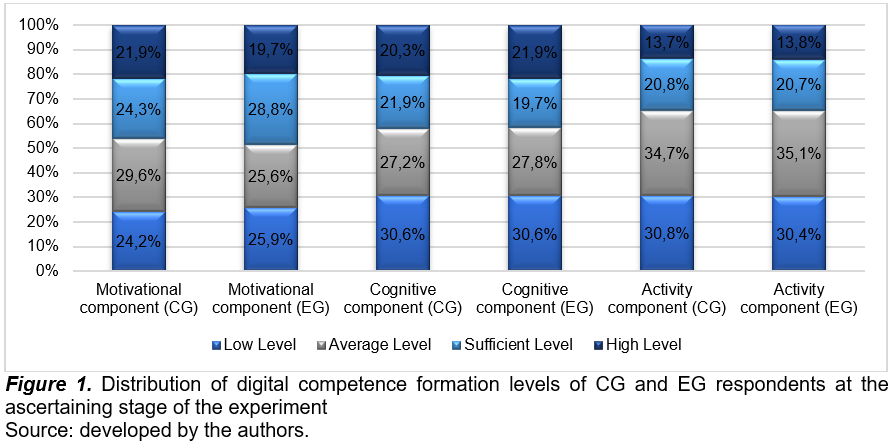
Analysis of the data presented (both in the CG and in the EG) shows that according to all indicators of all components at the ascertaining stage of the study, the majority of respondents are students with low and medium levels of digital competence, they cannot use educational digital environments at the proper level; use cloud services, specialized software, modeling and visualization systems of technical processes; formation of the technological and communication component of students' digital competence.
The results of the process of ascertaining the section of the experiment confirm that the level of development of digital competence among future specialists is insufficient for successful professional activity. Therefore, we see the need to implement pedagogical conditions, a specialized course aimed at the development of students' digital competence, and a methodology for the use of digital technologies.
The key to purity and an important condition of the experiment is strict compliance with the requirements for forming the experimental and control groups, ensuring their similarity and maximum identity in terms of the main characteristics. After all, it is incorrect to conduct a study involving respondents from the outlined groups if there are significant differences among them with respect to the studied characteristic.
Therefore, we performed a statistical assessment of the reliability of differences across all components and indicators of digital competence in the distributions of future specialists according to their levels of competence development.
We used the Kolmogorov-Smirnov λ-criterion to assess this. Based on the distributions of respondents in the CG and EG, empirical values for the criterion are calculated based on the levels of development of components and indicators of digital competence.



It is proven that there are no statistically significant differences between the respondents in the CG and EG groups in terms of the levels of formation of indicators and components of digital competence; that is, the groups (EG and CG) are similar to each other in this studied feature.
Verification of the effectiveness of the formation of digital competence in future specialists at the formative stage.
To verify the effectiveness of introducing a professional training process for future specialists in social-interaction specialties, including the implementation of pedagogical conditions, the developed special course, and the methodology for using digital technologies, we conducted the formative stage of the experiment.
Analysis of the study results showed the dynamics. It demonstrated the statistical reliability of changes in the distributions of respondents of the CG and EG regarding the levels of formation of components and indicators of digital competence in general. Let us prove this in a digital context (Fig. 2).
Motivational component (formative stage)
CG:
Low level – 23.3% of respondents.
Average level – 25.3% of respondents.
Sufficient level – 28.6% of respondents.
High level – 22.8% of respondents.
EG:
Low level – 5.1% of respondents.
Average level – 16.4% of respondents.
Sufficient level – 41.1% of respondents.
High level – 37.4% of respondents.
Analysis of data on the motivational component shows that after the formative experiment in the EG, there was a significant increase in the high and sufficient levels of digital competence. In contrast, in the CG, there was no significant increase. The number of applicants with low and average levels decreased, but in the EG, the difference compared to the ascertaining cut is more pronounced.
Cognitive component (formative stage)
CG:
Low level – 25.5% of respondents.
Average level – 20.3% of respondents.
Sufficient level – 28.8% of respondents.
High level – 25.4% of respondents.
EG:
Low level – 6.5% of respondents.
Average level – 20.0% of respondents.
Sufficient level – 40.7% of respondents.
High level – 32.8% of respondents.
Generalizing the data obtained according to the indicators of the cognitive component enabled the identification of the outcomes of the development of digital competence in future specialists. The distribution of applicants in the CG and EG by the levels of formation of this component suggests that in the CG, there were minor changes in the levels of formation of the cognitive component of digital competence. In contrast, in the EG, significant changes occurred.
Activity component (formative stage)
CG:
Low level – 28.3% of respondents.
Average level – 29.2% of respondents.
Sufficient level – 26.5% of respondents.
High level – 16.0% of respondents.
EG:
Low level – 10.1% of respondents.
Average level – 20.0% of respondents.
Sufficient level – 40.7% of respondents.
High level – 29.2% of respondents.
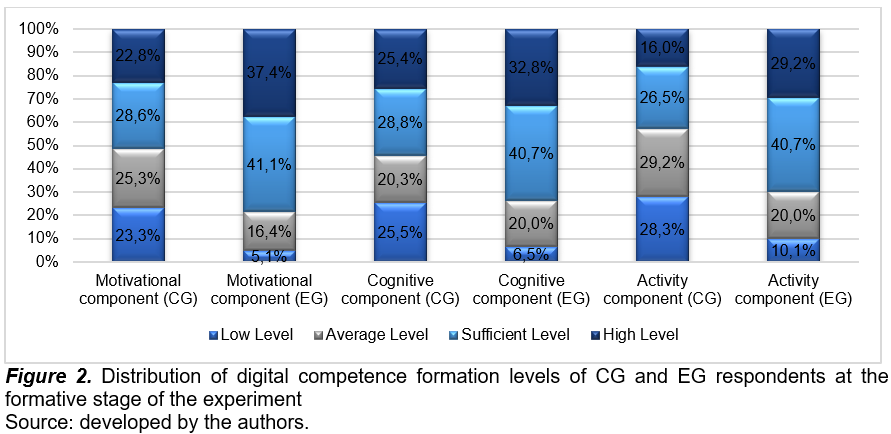
Thus, according to the results of the formative experiment, the activity component showed a decrease in the number of applicants at low and medium levels, and an increase in the number of applicants at high and sufficient levels of digital competence development. However, the indicators in EG are significantly higher at a high and sufficient level than in CG.
Therefore, the research and experimental work carried out during the formative experiment led to changes in the levels of digital competence development among higher education applicants. However, in EG, they are significantly higher than in CG.
The statistical reliability of changes in the levels of component formation and indicators of digital competence formation in the distributions of CG and EG applicants was assessed using the 
Allows us to draw the following conclusions regarding the identified changes and their statistical reliability.
At the final stage of the pedagogical experiment, as a result of implementing the developed toolkit, a clear, positive dynamics of increasing the level of digital competence formation, according to the identified components, was recorded in EG applicants, whereas in CG these changes were significantly lower. The results of the experiment demonstrate the effectiveness of implementing pedagogical conditions, the developed special course aimed at the formation of students' digital competence, and the developed methodology for using digital technologies.
Pedagogical Explanation of the Observed Improvements
The statistically significant improvement in digital competence observed in the experimental group can be explained through several pedagogical mechanisms embedded in the intervention design.
First, the systematic integration of digital tools into professionally oriented learning tasks created conditions for situated learning, where students applied digital technologies directly within professional problem-solving contexts. This aligns with competence-based education principles, according to which competencies develop most effectively when knowledge is applied in authentic professional situations.
Second, the introduction of learner-centered digital environments increased students’ intrinsic motivation and reduced digital anxiety. At the initial stage, diagnostic data indicated that most students demonstrated low or average levels of digital competence and had difficulty using digital tools independently.
The structured exposure to digital platforms, collaborative tools, and cloud environments gradually increased students’ confidence and autonomy.
Third, project-based digital collaboration contributed to the development of activity-based competence components. Participation in team digital projects strengthened communication skills, digital responsibility, and problem-solving abilities, which are essential for social-interaction specialists.
Fourth, the reflective component of the intervention (self-assessment tools, digital portfolios, feedback mechanisms) enhanced metacognitive awareness, which is considered a key factor in sustainable competence development.
Thus, the observed improvements can be interpreted not only as a technological effect but as a result of pedagogically structured digital immersion.
Systematic Comparison with Previous Studies on Digital Competence in Higher Education
The obtained results are consistent with previous research demonstrating the effectiveness of structured digital learning interventions. However, several distinctive features warrant highlighting.
Unlike descriptive cross-sectional studies that rely primarily on self-reported competence levels, the present study employed a quasi-experimental design with pre- and post-test measurements and a control-group comparison. Previous studies often documented competence levels without testing the effectiveness of interventions, whereas this study provides experimental evidence of competence growth.
Compared with intervention studies focused on teacher education or emergency remote learning contexts, the present study contributes evidence from stable institutional higher education environments and from social-interaction specialties, which are underrepresented in digital competence research.
In contrast to studies that focus primarily on technological access or tool use, the current study operationalized digital competence as an integrated construct comprising motivational, cognitive, and activity components. This integrated approach corresponds to the DigComp framework but extends it through experimental validation in institutional practice.
Additionally, this research contributes geographically contextualized evidence from Ukrainian higher education, where rapid digitalization has not always been accompanied by systematic competence development.
Contextual Factors Influencing the Effectiveness of the Intervention
The effectiveness of the pedagogical intervention was influenced by several contextual variables.
Technological Infrastructure
The availability of learning management systems (Moodle, Google Workspace, Microsoft Teams), cloud services, and specialized software created favorable conditions for continuous digital engagement. The presence of institutional digital ecosystems allowed students to practice digital skills in real learning scenarios.
Previous Digital Experience
Baseline diagnostics revealed heterogeneous digital readiness among students. The intervention was particularly effective for students with initially low competence levels, demonstrating the compensatory potential of structured digital pedagogy.
Disciplinary Profile
Students in social-interaction specialties require strong digital communication, collaboration, and content creation skills. Therefore, digital competence development was directly aligned with professional identity formation, which increased learning relevance and engagement.
Institutional Digitalization Level
The integration of digital platforms into institutional teaching practice supported continuity between intervention activities and general educational processes.
Sample Size, Institutional Coverage, and Intervention Duration
The study involved 124 students, including 61 in the experimental group and 63 in the control group, ensuring sufficient statistical power for between-group comparisons.
The experiment was conducted within the natural educational process of a higher education institution in Ukraine, ensuring ecological validity of the results.
The intervention lasted one academic semester, which is longer than many short-term digital training interventions described in previous studies, increasing the reliability of observed competence changes.
Full Statistical Results and Significance Levels

Normality Testing
Kolmogorov–Smirnov test confirmed normal distribution of scores:
This allowed the use of parametric statistical methods.
Within-Group Differences (Paired t-test)
Experimental Group:
Control Group:
Between-Group Differences (Independent t-test)
Post-test comparison:
ANCOVA (Controlling Pre-test Scores)
Interpretation of Statistical Findings
The statistical results demonstrate that the intervention had a strong and practically significant impact on digital competence development. The large effect sizes indicate that the pedagogical intervention was not only statistically significant but also educationally meaningful.
The moderate improvement in the control group can be explained by general exposure to digital technologies within the educational environment, but the significantly greater gains in the experimental group confirm the effectiveness of structured pedagogical digital integration.
Conclusions
The study confirms that the systematic integration of pedagogical conditions, a specialized digital competence course, and structured use of digital technologies contributes to statistically significant improvement in digital competence among students in social-interaction specialties. The results demonstrate that competence development is most effective when digital technologies are embedded into professionally oriented learning activities rather than used as isolated technical tools.
At the same time, the findings require critical interpretation. The observed positive dynamics may be influenced not only by the intervention itself but also by broader processes of institutional digitalization and increased student exposure to digital environments in higher education. Therefore, the intervention should be considered as a strengthening factor within a complex educational ecosystem rather than as a single causal determinant of competence growth.
The results also highlight that digital competence development is multidimensional. The most pronounced improvements were observed in motivational and activity-based components, while cognitive growth, although statistically significant, demonstrated more moderate dynamics. This suggests that practice-oriented and collaborative digital activities may have a stronger short-term pedagogical effect than purely knowledge-based digital training.
Scientific Contribution
The scientific contribution of the study is threefold. First, the study provides experimentally validated evidence of the effectiveness of context-sensitive pedagogical interventions for digital competence development in higher education, extending predominantly descriptive research in this field. Second, the research operationalizes digital competence as an integrated construct combining motivational, cognitive, and activity-based components and demonstrates the effectiveness of this integrated model in real institutional conditions. Third, the study contributes empirical evidence from the Ukrainian higher education context, which remains underrepresented in international digital competence research, particularly regarding experimentally validated pedagogical models.
Limitations of the Study
Several limitations should be acknowledged.
The study was conducted within a single higher education institution, which may limit the generalizability of the findings across different institutional, cultural, and technological contexts.
The intervention duration was limited to one academic semester, which allows evaluation of short-term competence development but does not fully capture long-term sustainability of competence growth.
The sample size, although sufficient for statistical analysis, does not allow deep subgroup analysis (e.g., by specialty, prior digital experience, or socio-economic background).
In addition, the study focused primarily on student digital competence and did not systematically evaluate the influence of teachers’ digital competence or institutional digital maturity as mediating variables.
Directions for Future Research
Future research should focus on longitudinal studies examining long-term stability of digital competence development, multi-institutional comparative studies, and analysis of the interaction between student competence, teacher digital competence, and institutional digital ecosystems.
Further research is also needed to investigate adaptive and AI-supported digital learning environments as tools for personalized competence development.
Discursive Precision and Theoretical Implications
The results support the position that digital competence should be interpreted not as a static set of technical skills but as a dynamic professional meta-competence integrating technological, cognitive, motivational, and socio-communicative dimensions.
Thus, the study contributes to the transition from technology-centered models of digitalization toward pedagogically grounded models of digital competence formation in higher education.
Bibliographic references
Bressan, D., Santos, C., & Kfouri da Silva, S. F. (2025). Competência digital docente no ensino superior em frameworks: Scoping review. Sisyphus Journal of Education, 13(2). https://doi.org/10.25749/sis.41209
Cabero-Almenara, J., Gutiérrez-Castillo, J. J., Guillén-Gámez, F. D., & Gaete-Bravo, A. F. (2023). Digital competence of higher education students as a predictor of academic success. Technology, Knowledge and Learning, 28, 683–702. https://doi.org/10.1007/s10758-022-09624-8
Cañete Estigarribia, D. L., Torres Gastelú, C. A., Lagunes Domínguez, A., & Gómez García, M. G. (2022). Competencia digital de futuros docentes en una institución de educación superior en Paraguay. Pixel-Bit. Revista de Medios y Educación, (63), 159–195. https://doi.org/10.12795/pixelbit.91049
dos Santos, A. I., Chinkes, E., Carvalho, M. A. G., Solórzano, C. M. V., & Marroni, L. S. (2023). The digital competence of academics in higher education: Is the glass half empty or half full? International Journal of Educational Technology in Higher Education, 20(1), 9. https://doi.org/10.1186/s41239-022-00376-0
Glasserman-Morales, L. D., Alcantar-Nieblas, C., & Sisto, M. I. (2024). Demographic and school factors associated with digital competences in higher education students. Contemporary Educational Technology, 16(2), ep498. https://doi.org/10.30935/cedtech/14288
Guillén-Gámez, F. D., Ruiz-Palmero, J., & García, M. G. (2023). Digital competence of teachers in the use of ICT for research work: Development of an instrument from a PLS-SEM approach. Education and Information Technologies, 28, 16509–16529. https://doi.org/10.1007/s10639-023-11895-2
Gutiérrez-Santiuste, E., García-Lira, K., & Montes, R. (2023). Design and validation of a questionnaire to assess digital communicative competence in higher education. International Journal of Instruction, 16(1), 241–260. https://doi.org/10.29333/IJI.2023.16114A
Holguin-Alvarez, J., Garay-Rodríguez, P., Amasifuén-Sánchez, V., Huaita Acha, D. M., Luza Castillo, F. F., Cruz-Montero, J., & Ledesma-Pérez, F. (2021). Digital competences in the elderly and university students: didactic interaction from the use of social networks. International Journal of Emerging Technologies in Learning (iJET), 16(04), 188–200. https://doi.org/10.3991/ijet.v16i04.18519
López Simó, V., Couso Lagarón, D., & Simarro Rodríguez, C. (2020). Educación STEM en y para el mundo digital. Revista de Educación a Distancia (RED), 20(62), 07. https://doi.org/10.6018/red.410011
Piontkewicz, R., Freitas, M. do C. D., & Mendes Junior, R. (2023). Digital competence of higher education professors in the adequation of remote teaching. Revista Digital de Investigación en Docencia Universitaria, 18(1), e1589. https://doi.org/10.19083/ridu.2024.1589
Saltos-Rivas, R., Novoa-Hernández, P., & Serrano Rodríguez, R. (2020). On the reliability and validity of digital competence evaluation in higher education. In Proceedings of the 39th International Conference of the Chilean Computer Science Society (SCCC). IEEE. https://doi.org/10.1109/SCCC51225.2020.9281279
Sánchez Olavarría, C., & Carrasco Lozano, M. E. E. (2021). Competencias digitales en educación superior. Etic@net, 21(1), 28–50. https://doi.org/10.30827/eticanet.v21i1.16944
Santos, C., Pedro, N., & Mattar, J. (2021a). Competencia digital de profesores de educación superior: análisis de factores académicos e institucionales. Obra Digital, (21), 69–92. https://doi.org/10.25029/od.2021.311.21
Santos, C. C., Pedro, N. S. G., & Mattar, J. (2021b). Avaliação do nível da proficiência nas competências digitais dos docentes do ensino superior em Portugal. Educação, 46(1), 1–37. https://doi.org/10.5902/1984644461414
Vázquez-Cano, E., Marín Díaz, V., Maldonado Berea, G. A., & García-Garzón, E. (2017). La competencia digital del alumnado universitario de Ciencias Sociales desde una perspectiva de género. Revista Prisma Social, (19), 347–367. Recuperado de https://revistaprismasocial.es/article/view/1680
Velásquez-Castro, L. A., Martín-Domínguez, J., & Ramírez-Orellana, E. (2023). Competencia digital docente para la inclusión y la cohesión social en los procesos de enseñanza: Experiencia chilena durante el COVID-19. Revista Latinoamericana de Tecnología Educativa (RELATEC), 22(2), 59–82. https://doi.org/10.17398/1695-288X.22.2.59
Vuorikari, R., Punie, Y., Carretero, S., & Van den Brande, L. (2016). DigComp 2.0: The digital competence framework for citizens. Update phase 1: The conceptual reference model. Publications Office of the European Union. https://doi.org/10.2791/11517

Este artículo no presenta ningún conflicto de intereses. Este artículo está bajo la licencia Creative Commons Atribución 4.0 Internacional (CC BY 4.0). Se permite la reproducción, distribución y comunicación pública de la obra, así como la creación de obras derivadas, siempre que se cite la fuente original.