
Original Article
Eduweb, 2026, enero-marzo, v.20, n.1. ISSN: 1856-7576
Doi: https://doi.org/10.46502/issn.1856-7576/2026.20.01.2
Del Clicktivismo a la acción real: El compromiso civico juvenil en la era digital
Volodymyr Anushkevych
Candidate of Psychological Sciences, Assistant Chair of Psychology, Poltava V. G. Korolenko National Pedagogical University, Ukraine.
https://orcid.org/0009-0004-3535-2062
Nazar Salata
Doctor of Philosophy, Lecturer at the Department of Vocational Education and Technology, Pavlo Tychyna Uman State Pedagogical University, Ukraine.
https://orcid.org/0000-0002-0194-8480
Andrii Diachenko
PhD Student, Volodymyr Vynnychenko Central Ukrainian State Pedagogical University, Ukraine.
https://orcid.org/0009-0002-4418-107X
Vsevolod Broiakovskyi
PhD Student, Volodymyr Vynnychenko Central Ukrainian State Pedagogical University, Ukraine.
https://orcid.org/0009-0007-6638-3568
vsevolodbroiakovskyi@gmail.com
Dmytro Nefodov
Doctor of Historical Sciences, Associate Professor at the Department of History, Admiral Makarov National University of Shipbuilding, Ukraine.
https://orcid.org/0000-0003-1992-7271
Cómo citar:
Anushkevych, V., Salata, N., Diachenko, A., Broiakovskyi, V., & Nefodov, D. (2026). From clicktivism to real action: Youth civic engagement in the digital age. Revista Eduweb, 20(1), 30-45. https://doi.org/10.46502/issn.1856-7576/2026.20.01.2
Recibido: 01/12/25 Aceptado: 26/01/26
Abstract
This study analyzes the transformation of youth civic engagement in the context of digitalization, specifically among Ukrainian university students. The objective is to identify the forms of digital participation and the barriers hindering active citizenship. The research employed a quantitative methodology based on a survey of 486 students from pedagogical universities. Results indicate a high level of digital connectivity, with 92% of respondents using social media for news consumption. However, a significant gap exists between passive consumption and active engagement; only 38% participate in online debates and 45% sign petitions. The study identifies "clicktivism" as the dominant form of participation. Key barriers include low media literacy, distrust in political institutions, and susceptibility to information manipulation. The authors conclude that while digitalization provides tools for mobilization, it does not automatically translate into effective civic action without targeted educational interventions. Recommendations include integrating media literacy into university curricula to foster critical thinking and responsible digital citizenship.
Keywords: Civil society, youth activism, digital tools, media literacy, clicktivism.
Resumen
Este estudio analiza la transformación de la participación cívica juvenil en el contexto de la digitalización, específicamente entre estudiantes universitarios ucranianos. El objetivo es identificar las formas de participación digital y las barreras que dificultan la ciudadanía activa. La investigación empleó una metodología cuantitativa basada en una encuesta a 486 estudiantes de universidades pedagógicas. Los resultados indican un alto nivel de conectividad digital, con un 92% de los encuestados utilizando las redes sociales para el consumo de noticias. Sin embargo, existe una brecha significativa entre el consumo pasivo y la participación activa; solo el 38% participa en debates en línea y el 45% firma peticiones. El estudio identifica el "activismo mediático" como la forma dominante de participación. Las principales barreras incluyen la baja alfabetización mediática, la desconfianza en las instituciones políticas y la susceptibilidad a la manipulación de la información. Los autores concluyen que, si bien la digitalización proporciona herramientas para la movilización, no se traduce automáticamente en una acción cívica efectiva sin intervenciones educativas específicas. Las recomendaciones incluyen la integración de la alfabetización mediática en los planes de estudio universitarios para fomentar el pensamiento crítico y una ciudadanía digital responsable.
Palabras clave: sociedad civil, activismo juvenil, herramientas digitales, alfabetización mediática, activismo mediático.
Introduction
Youth civic activity ensures young people's participation in public organizations and initiatives that improve society's quality of life. Civic activity can be informal and formal, covering actions aimed at implementing social changes in society – participation in youth initiatives and movements, starting with volunteering. Youth activity is a component of civil society, which plays a key role in supporting democratic values and fostering social interaction.
In the modern context of Ukraine, digitalization acquires not only a technological but also a distinct social dimension. In the context of military challenges, internal and external migration, transformation of social ties, and the growing need for mutual support, digital technologies act as an important tool for strengthening social cohesion. They ensure continuity of communication, access to education, social and cultural resources, and contribute to the formation of common values, civic identity, and solidarity. Thus, digitalization in Ukraine appears as a factor not only in modernizing social processes but also in consolidating society, which is critically important for its stability and further development.
Today, modern education is undergoing significant changes, aligned with the requirements of the information society, which are associated with defining new goals and modernizing legal, managerial, economic, and organizational frameworks. The role of civic education is strengthened in ensuring the educational potential of the educational process, the development of democratic principles within the educational process of an educational institution, and the organization of youth social practice in the information society. The implementation of the training of a competitive, active personality, competent in solving professional problems, life problems, a personality responsible for the development of their country and their own well-being, ready to fulfill civic duties, requires a social order from the education system. Therefore, fostering youth civic engagement through the digitalization of educational spaces in training and professional activities is important.
The digitalization of youth civic activity fosters consciousness and responsibility in public, political, and social life. This process is of decisive importance for the development of an active civic stance among youth, enabling them to promote societal well-being, defend common values, and participate in democratic processes worldwide. Through participation in community life, education, and professional activities, young people gain knowledge, the skills to collaborate with peers, an attitude toward solving social problems, and the ability to shape a personal future within a broader social context.
One of the key foundations for the formation of national solidarity is the civic activity of a young person, because without the active participation of young people in the life of the country, their deep concern for the future of the Motherland and full involvement in society are impossible; therefore, the topic chosen for the study is relevant and timely.
Literature Review
The problem of fostering youth civic activity through digitalization is consistently addressed in the work of scientists from various countries who have studied contemporary aspects of civic education. Scientific research, building on the pedagogical, political, theoretical, and psychological achievements of their predecessors, has created a methodologically sound field for studying how to foster youth civic activity through digitalization.
Perry-Hazan & Nir (2016), when forming youth civic engagement, describes five categories of participation: sharing responsibility and power in the decision-making process with the individual, listening to the individual, taking into account and accepting the individual's voice, supporting the individual in their desire to express their views, and involving youth in the decision-making process.
The issues of socio-pedagogical support for youth and the formation of youth civic activity are the subject of the work of scientists such as Fejes et al. (2024). Scientists have proven the significant and effective participation of youth in the future, in the management of educational institutions and projects, with the help of which young people become active citizens of the state, are more willing to get involved in public organizations, participate in voting, are interested in the life of the educational institution, and are active members of the educational community.
The integration of the researchers' scientific views indicates that civic education is the primary means of developing youth civic activity. Damiani et al. (2024) focus on actions aimed at solving economic and social problems, demonstrating the use of social media to disseminate information to mobilize youth, which, through the organization of mass actions, should become an engine of change in society, since young people actively use their platforms to support humanitarian initiatives and express solidarity with those affected by the conflict. Civic activity among youth, in this case, becomes a key element in the protection of human rights during crises and in the pursuit of justice.
The study by Uribe (2017) is significant because it shows the concern about civic education in Mexico, as in other Latin American countries, related to the democratic and social crisis that Mexico has experienced, and suggests ways to solve this problem that are necessary after a long-standing desire for democracy and democratic governments, war, social conflicts around the world, because civic education as peace education is constantly evolving.
Naanous & Broom (2017) have developed a dynamic model of youth behavior and attitudes toward civic life. A theory of youth attitudes and actions is proposed, grounded in the interaction of external and internal factors that shape a particular civic mentality among young people. Internal factors are elements that reflect attitudes, personality traits, knowledge, and sense of efficacy. School, family, and culture are external elements.
Kanacri et al. (2021) have identified and described a framework for supporting a cohesive and democratic society, as the quality of social interaction between groups and individuals is increasingly recognized. The study focuses on incorporating empirical local data and systematizing knowledge on the predictors of civic engagement that ensure social cohesion in Latin America, using Chile as an example. The Naccians propose three empirical studies developed in the Chilean context. The first is an investigation into the interaction among school factors, the civic participation of Chilean adolescents, and civic self-efficacy. The second is an investigation of the trajectory of cohesive classes in a heterogeneous and multicultural environment. The third is a study aimed at civic engagement among young Chileans and the promotion of prosocial behavior among individuals of different socioeconomic statuses.
Civic engagement is a multidimensional concept, and low levels of participation in mainstream politics among young people are often interpreted as an indicator of lower civic engagement. The study by Varela Candia et al. (2015) questions the central role of participation as a key indicator of civic engagement in mainstream political activity and assesses the extent to which young people pay attention to mainstream politics as an indicator of civic engagement. The results of a logistic regression analysis of a sample of Chilean youth classified as political or apolitical indicate that membership in a political group predicts participation in mainstream political activity. In contrast, membership in an apolitical group predicts local-level participation. The individual's level of civic competence, tolerance, and non-traditional political participation was not a predictor of membership in any of the groups. The results prove that participation in mainstream political activity is not the leading indicator of civic engagement, and also emphasize the need and importance of developing models of civic engagement Schulz et al. (2024) emphasize the importance of trust between young people, the need for social ties for active participation in social processes, and argue that community activity through digitalization increases the level of civic responsibility. In contrast, a decline in social activity weakens democracy.
An analytical review of scientific works on the problem addressed in the selected study indicates that the development of youth civic activity through digitalization remains an important task in modern education.
Purpose of the article. Formation of civic activity of youth by means of digitalization.
Methodology
Research Design
This study employed a quantitative quasi-experimental research design to examine the effectiveness of pedagogical conditions aimed at fostering youth civic engagement through digitalization. The research was conducted during the 2024–2025 academic year and consisted of three stages: ascertaining, formative, and control.
Participants and Sampling
The study involved 217 university students enrolled in pedagogical higher education institutions in Ukraine. Participants were divided into an experimental group (EG, n = 113) and a control group (CG, n = 104).
A stratified random sampling technique was used to ensure the sample's representativeness. The general population was divided into homogeneous strata by institutional affiliation, and respondents were randomly selected from each stratum. The equivalence of the experimental and control groups was verified using the Wilcoxon–Mann–Whitney U test, which showed no statistically significant differences between groups at the initial stage (p > 0.05).
Instruments and Measures
Data collection was carried out using a set of standardized and author-designed diagnostic tools, including:
Youth civic engagement was operationalized through three criteria:
Based on these criteria, three levels of civic engagement were identified: high, medium, and low.
Experimental Procedure
The formative intervention in the experimental group was based on the implementation of pedagogical conditions integrating digital tools, including:
The control group followed the standard educational curriculum without targeted digital civic engagement interventions.
Data Analysis
Quantitative data were analyzed using descriptive and inferential statistical methods.
The following statistical procedures were applied:
Statistical analyses were performed using Microsoft Excel (XI2TEST function) and online statistical calculators.
Ethical Considerations
Participation in the study was voluntary and anonymous. All respondents were informed about the purpose of the research and provided informed consent. The study complied with ethical standards for educational and social research.
Results and Discussion
The role of youth civic activity through digitalization and participation in state-building. Basic principles and types of youth civic engagement. Rules governing the use of ICT and materials for youth civic engagement are available online.
Youth civic engagement through digitalization is essential for preparing young people to actively participate in democratic processes. In countries like the USA and Canada, students are involved in analyzing socio-political issues, understanding democratic values, and engaging with civil society through digital tools. In Europe, civic education emphasizes developing youth civic competencies via digitalization, as reflected in the Council of Europe’s Competence Framework and the European Charter, which stress active participation in public life beyond elections.
Youth participation fosters social cohesion, strengthens civic values, and allows young people to influence state and global decisions, becoming active agents rather than passive observers of society (Middaugh et al., 2025). Civic activity through digitalization encourages involvement in decision-making, responsibility, and initiative. Key types include:
Developing civic readiness requires an educational environment aligned with personal values, opportunities to respond to digital challenges, and active roles in society. Core principles include subject-subject interaction, activity, independence, and self-directed meaningful participation (Norabuena-Figueroa et al., 2025).
ICT is essential for organizing civic activity. Basic rules for using digital tools include:
Key programs for the formation of youth civic activity through digitalization.
Approaches to fostering youth civic engagement through digitalization vary across countries and educational systems but share a common goal: educating responsible and active citizens capable of participating in democratic processes and addressing social challenges. In the United States, civic education is systematically integrated into curricula through digital tools, focusing on constitutional principles, democratic values, and citizens’ rights and responsibilities (Yang & Ogawa, 2022).
Among the most influential initiatives is We the People, which promotes civic knowledge and engagement through competitions, project-based learning, and curriculum modules that encourage youth to apply democratic principles in practice (DiGiacomo, 2021). Closely related is Project Citizen, where students address real community issues by developing policy proposals, engaging with local authorities, and creating digital portfolios, thereby strengthening civic responsibility and participatory skills (Reis & Dayrell, 2020; Zukerfeld et al., 2024).
Digital civic education is further supported by iCivics, a nonprofit platform offering interactive resources and educational games that enhance understanding of government, democracy, and human rights through game-based learning (De Coninck et al., 2025). At the advanced level, Civic Action Projects (CAP) foster leadership, public–private collaboration, and innovative policymaking by engaging youth in solving complex societal problems (Sádaba, 2022; Souza De Oliveira & Sommer, 2017).
In addition, national and international volunteer programs such as AmeriCorps and the Peace Corps provide digitally supported pathways for youth participation in social, educational, environmental, and humanitarian initiatives, contributing to the development of civic responsibility and global solidarity (del Moral Pérez et al., 2021).
Overall, these programs demonstrate that digitalization significantly enhances youth civic engagement by combining civic education, project-based learning, and volunteering, thereby fostering active citizenship and democratic participation in contemporary societies (Caldeiro-Pedreira et al., 2021).
Interpretation Through Theories of Political Disaffection
Political disaffection describes a persistent negative attitude toward the political system and actors, including low trust, disengagement, and skepticism about democratic processes. Key theoretical perspectives (e.g., from Nie et al., Dalton, and Klingemann) identify three core dimensions of political disaffection: (1) distrust in political institutions, (2) perceived ineffectiveness of political actors, and (3) low motivation for political participation. These dimensions often emerge where citizens feel alienated from formal political processes and believe that their participation yields minimal influence on outcomes.
Our study’s findings align with these theoretical constructs: high levels of disaffection among youth (e.g., elevated mistrust or reduced civic engagement scores) reflect alienation and skepticism consistent with classical political disaffection frameworks. Such attitudes are typically associated with institutional distrust and perceptions of democratic underperformance, reinforcing the notion that citizens may adopt a detached or passive stance toward political participation when they perceive systemic inadequacies or elite unresponsiveness.
Comparison With EU Averages and Trends
When comparing our results with broader European data, some relevant patterns emerge:
Comparison to Our Results:
Overall, our results mirror broader EU trends of skepticism toward democratic institutions and processes, reinforcing arguments that political disaffection is not isolated but part of a wider European phenomenon, particularly among younger generations. However, while support for the EU itself has risen in some polls (e.g., 74 % see EU membership as beneficial), this does not fully translate into trust in political systems or active civic engagement, suggesting that political disaffection manifests differentially across institutional levels (EU vs. national politics).
Implications for Theory and Policy
The alignment between our findings and EU trends underscores the salience of political disaffection as a structural issue affecting civic engagement, particularly among youth. It suggests that democratic resilience may require both institutional reforms and targeted civic education strategies that address not only procedural participation (e.g., voting) but also perceptions of political efficacy and trust.
Organization and course of the experimental study
The formation of youth civic activity by means of digitalization involves a set of stages of predicted, planned work from the set goal to the result, namely:
To foster youth civic activity through digitalization, criteria, indicators, and levels of its formation have been established.
Indicators of the motivational criterion − content of civic activity are: knowledge of the essence of civic relations, civic youth; knowledge of the nature of such civic qualities as civic responsibility, solidarity, social responsibility, tolerance, youth civic activity, and civic activity.
Indicators of the performance criterion – the manifestation of civic activity are: participation, based on universal human values, in civic activity; awareness of oneself as a citizen of one's country, the presence of civic feelings; the desire to acquire solidarity, social responsibility, tolerance, civic activity of youth, and civic activity.
Indicators of the evaluation criterion – the manifestation of civic activity in youth are: the manifestation of a civic active position of youth towards current social problems; the presence of communication skills when interacting with other individuals, civic activity, the manifestation of solidarity, social responsibility, tolerance, civic activity of youth, and civic activity.
The levels of youth civic activity are determined as high, average, and low.
The ascertaining stage of the experiment proved, based on the results of the study, that a significant majority of youth who participated in the experiment showed low and medium levels of formation of civic activity of youth:
EG:
The results of the study at the ascertaining stage indicate that the general level of youth civic activity formation does not meet social requirements and requires systematic efforts to improve it.
Therefore, based on the results of diagnosing the levels of formation of youth civic activity and based on the analysis of scientific sources, to ensure the effectiveness of the process of forming personal qualities and youth civic activity, we developed pedagogical conditions that were implemented in the educational process of EG respondents:
Respondents of the CG continued their studies according to the usual program.
To form civic activity of young people, based on the results of the analysis of the innovative activity of respondents, we offered a special course developed for the respondents of the experimental group "Innovations in the education of responsible, active citizens who will be ready to build society and participate in democratic processes", the purpose of which was to familiarize young people with the strategy of forming civic activity in the educational process and throughout life, improve the professional skills of young people, motivate them for professional development, develop individuality, create the ability of young people to make changes in their own lives and stimulate social activity.
Individual approaches to fostering civic activity in the educational process in the EG included the use of Internet resources, consultations, self-education, and participation in webinars and programs for personal development. Group-based forms of civic activity included master classes, creative group work, methodological support programs, seminars, conferences, training sessions, business games, etc.
The EG paid attention to the formation of youth civic activity, the real participation of citizens in the exercise of state power, in education, the harmonious combination of the interests of the state and the citizen, equality regardless of nationality, race, gender of citizens, active participation of youth in various types of socially oriented, collective, individual activities, orientation on the active life position of the individual.
An effective means of forming youth civic activity was project activity, which provided applicants for educational space with the opportunity to correlate and integrate their personal perspectives obtained in the process of learning with the real world in which they exist, as well as with socio-political events and public life taking place within the educational institution or local community. During the project activities, young people drew on existing knowledge, collaborated and communicated with one another, and demonstrated their active civic stance.
During the implementation of the developed system for the formation of youth civic activity, we focused on popularizing the activities of youth centers, conducting an information campaign on the innovative activities of public organizations, involving youth in volunteer activities, disseminating knowledge about the political and social system in society, creating a website, and pages on social networks Instagram and Facebook.
A practical step during the information stage of implementing the system for the formation of youth civic activity by means of digitalization in the framework of the special course "Innovations in the education of responsible, active citizens who will be ready to build society and participate in democratic processes" was the involvement of young people in the project "Formation of youth civic activity by means of digitalization" and master classes.
Analysis of the results of experimental work
The control experiment was conducted at the final stage of the study to compare the levels of civic activity formation among youth through digitalization in the control and experimental groups, after the formative stage of the experiment had been completed. According to the criteria, indicators, and levels of the formation of youth civic activity through digitalization established at the beginning of the study, a control section was conducted, and the methods used at the ascertaining stage of the experiment were also employed.
At the final stage of the experimental work, at the end of the 2024-2025 academic year, a control section was carried out.
Two hundred seventeen respondents (113 – EG; 104 – CG) participated in the experimental verification of the effectiveness of substantiated pedagogical conditions for the development of youth civic activity through digitalization.
The qualitative composition of the sample was established through a stratified sampling method, which involved dividing the general population into strata and then randomly selecting respondents from each stratum. Using the empirical Wilcoxon-Mann-Whitney test, the qualitative composition of participants in the experimental and control groups was tested using a software tool. The critical value is 1.96, so the critical value for this test is 0.3731. The qualitative and quantitative composition of reviewers in the control and experimental groups is approximately the same, as the significance level of 0.05 indicates that the characteristics of the samples being compared are comparable.
We characterized the sample through representativeness. The level of foster youth civic activity through digitalization corresponds to the level of civic activity among all respondents who participated in the study.
The development of youth civic activity through digitalization in the EG occurred in three stages: the preparatory stage, the main stage, and the generalizing stage.
Using the Pearson test, the distribution of respondents across levels of civic activity formation was compared. The Excel XI2TEST function was used for calculations.
Using an online calculator, the p-level was calculated using the Fisher test.
H0: The proportion of reviewers in the experimental group with a high level of civic activity does not differ from the proportion of reviewers in the control group.
H1: The activity of respondents (proportion) in the experimental group with a high level of civic activity is significantly different from that of the control group.
The distribution of respondents in the experimental and control groups by level of civic activity formation at the ascertaining stage does not differ (p = 0.0001). In contrast, at the formative stage of the experiment, it does differ (p=0.9843).
Therefore, the data obtained confirmed the distribution of respondents into the control and experimental groups, which is objective for the formative experiment.
According to the results of the ascertaining stage of the experiment, the following results were obtained (Fig. 1):
EG:
CG:
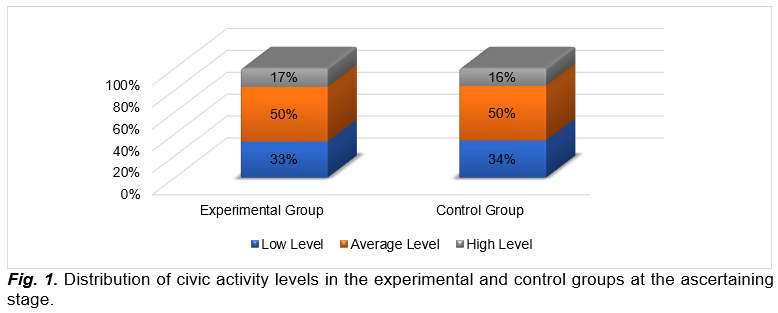
That is, the majority of respondents showed average and low levels of civic activity.
Conducting the main stage of the experiment on the formation of youth civic activity through digitalization involved focusing EG respondents' attention on the implementation of clearly defined and justified pedagogical conditions necessary for this process.
We present the overall averaged results from the control section of the experiment, which was conducted to assess the effectiveness of the experimental results.
In the experimental group, our results showed a significant increase in civic activity among youth through digitalization compared with the control group (Table 1, Fig. 2).
Table 1.
Dynamics of the levels of formation of civic activity of youth (results of the ascertaining and formative stages of the experiment)

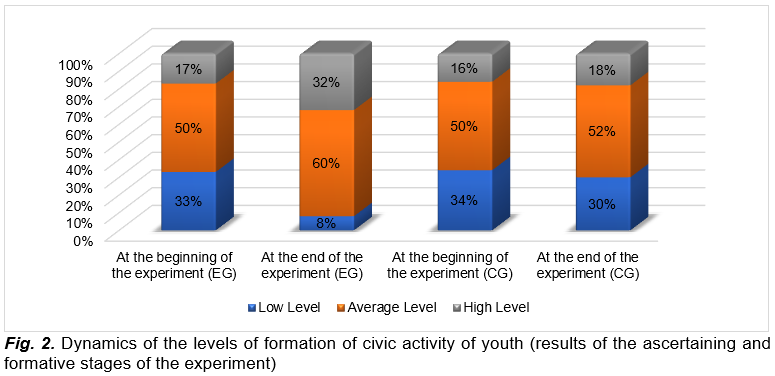
Thus: the shift in the share of high levels of civic activity formation according to Fisher's test, in the reviewers of the experimental group was p-level 0.0183 and 16.2 − by xi-square; the shift in the share of average levels of civic activity formation according to Fisher's test, in the reviewers of the experimental group was p-level – 0.0145, and by xi-square 6.197; the shift in the share of low levels of civic activity formation according to Fisher's test, in the reviewers of the experimental group was p-level – 0.0001, by xi-square – 45.87.
The number of high school students in the experimental group who demonstrate conscious knowledge of moral and legal norms, civic relations, civic activity, rules of behavior, give a meaningful characteristic of civic concepts, can establish connections between them has increased; demonstrate deep knowledge of the essence of such civic qualities as: solidarity, tolerance, civic responsibility, initiative; demonstrate civic feelings, respect for civic values, moral and legal norms; demonstrate a value-based attitude, strive to participate in civic activity, realize themselves as citizens of an innovative society; demonstrate an active civic position towards current social problems; possess communication skills.
The results showed a significant increase in the proportion of respondents with an average or high level of civic activity in the experimental group compared with the control group. These statistical indicators in the EG significantly exceed the results obtained in the CG. Analysis of the control group's comparative results shows no significant positive changes in young people's civic activity attributable to digitalization.
Therefore, the results of the research and experimental work demonstrated the effectiveness of the developed and substantiated pedagogical conditions for the development of youth civic activity through digitalization methods, implemented in the EG.
Conclusions
The role of youth civic activity in digitalization and state-building is demonstrated; the basic principles and types of youth civic activity formation are highlighted; and guidelines for the use of ICT and online materials for the formation of youth civic activity are proposed.
Key programs for fostering youth civic activity through digitalization are described.
The ascertaining stage of the experiment, based on the study's results, indicated that a substantial majority of the youth who participated exhibited low to moderate levels of civic activity.
The results of the study at the ascertaining stage indicate that the general level of youth civic activity formation does not meet social requirements and requires systematic efforts to improve it.
Therefore, based on the results of diagnosing the levels of youth civic activity formation and an analysis of scientific sources, to ensure the effectiveness of the process of developing personal qualities and youth civic activity, we created pedagogical conditions that were implemented in the educational process for EG respondents. The CG respondents continued their studies according to the usual program.
To form the civic activity of youth based on the results of the analysis of the innovative activity of the respondents, we offered a special course developed for the respondents of the experimental group "Innovations in the education of responsible, active citizens who will be ready to build society and participate in democratic processes", the purpose of which was to familiarize young people with the strategy of forming civic activity in the educational process and throughout life, to increase the professional skills of young people, to motivate them for professional development, to develop their individuality, to form the ability of young people to make changes in their own lives and to stimulate social activity.
A practical step during the information stage of implementing the system of forming civic activity of youth by means of digitalization, in addition to the special course "Innovations in the education of responsible, active citizens who will be ready to build society and participate in democratic processes", was the involvement of young people in the project "Forming civic activity of youth by means of digitalization" and master classes.
The control experiment was conducted at the final stage of the study to compare the levels of civic activity among youth through digitalization in the control and experimental groups, after the formative stage of the experiment had been completed. According to the criteria, indicators, and levels of the formation of youth civic activity through digitalization defined at the beginning of the study, a control section was conducted, and the methods used at the ascertaining stage of the experiment were also employed.
In the experimental group, our results showed a significant increase in civic activity among youth through digitalization compared with the control group.
The results showed a significant increase in the number of respondents with an average or high level of civic activity formation in the experimental group compared with the control group. These statistical indicators in the EG significantly exceed the results obtained in the CG. Analysis of the control group's comparative results shows no significant positive changes in the formation of youth civic activity through digitalization.
Therefore, the results of the research and experimental work have demonstrated the effectiveness of the developed, substantiated, and implemented EG pedagogical conditions for the formation of youth civic activity through digitalization.
To strengthen youth civic engagement through digitalization, universities should adopt targeted and evidence-based strategies.
First, civic and digital citizenship education should be systematically integrated into university curricula through mandatory modules focusing on digital rights, democratic participation, and ethical online behavior. Particular attention should be paid to developing critical thinking and media literacy.
Second, universities should implement practical media literacy interventions, such as workshops on fake news verification, fact-checking techniques, and critical analysis of social media content, to reduce passive “clicktivism” and vulnerability to information manipulation.
Third, student participation in digital civic projects should be expanded. Universities are encouraged to support project-based learning linked to real community problems, where students design and implement online civic initiatives, with such activities recognized within the credit system.
Fourth, digital tools should be used to enhance student self-governance, including online platforms for consultations, discussions, and voting, thereby increasing students’ sense of political efficacy and trust in institutional decision-making.
Finally, universities should invest in faculty training on digital civic education and regularly monitor students’ civic engagement levels to ensure continuous improvement of educational practices.
Bibliographic references
Caldeiro-Pedreira, M. C., Renés-Arellano, P., Alvites-Huamaní, C. G., & González-Larrea, B. (2021). Digital youth and their acquisition of values when using the Internet. Sustainability, 13(21), 11963. https://doi.org/10.3390/su132111963
Damiani, V., Caponera, E., Losito, B., Palmerio, L., & Agrusti, G. (2024). Young people’s civic engagement in Italy: Evidence on grade 8 students from the International Civic and Citizenship Education Study (ICCS) 2016. Large-scale Assessments in Education, 12, 29. https://doi.org/10.1186/s40536-024-00229-4
De Coninck, D., Waechter, N., & d’Haenens, L. (2025). Unraveling the engagement paradox: High civic engagement among vulnerable European youth in the digital age. Journal of Youth and Adolescence, 8, 249–267. https://doi.org/10.1007/s43151-024-00129-y
del Moral Pérez, M. E., Guzmán Duque, A. P., & Bellver Moreno, M. C. (2021). Consumption and leisure of Generation Z in the digital sphere. Prisma Social, 34, 88–105. https://revistaprismasocial.es/article/view/4320
DiGiacomo, D. K. (2021). Digital civic learning in schools: Youth perspectives and experiences. Information and Learning Sciences, 122(11–12), 709–725. https://doi.org/10.1108/ILS-01-2020-0013
Fejes, Z. L., Radu, B., Angi, D., Lese, M., Bartok, S., & Bădescu, G. (2024). Civic engagement landscape: Romania 2024. Research Center for Civil Society. Retrieved from https://acortar.link/Zsblcr
Kanacri, B. P. L., Jiménez-Moya, G., & González, R. (2021). Youth civic engagement: Challenges for social cohesion in Latin America. In C. Zúñiga & W. López-López (Eds.), Political psychology in Latin America (pp. 79–104). American Psychological Association. https://doi.org/10.1037/0000230-005
Middaugh, E., Kornbluh, M., Lee, A., Kligler-Vilenchik, N., Ramasubramanian, S., Schofield Clark, L., & Vea, T. (2025). Youth participatory politics: Understanding and supporting civic engagement in the social media era. In D. A. Christakis & L. Hale (Eds.), Handbook of Children and Screens (pp. 253-259). Cham, Switzerland: Springer. https://doi.org/10.1007/978-3-031-69362-5_35
Naanous, T., & Broom, C. (2017). Youth engagement or disengagement, civic mindsets, and democracy. In C. Broom (Ed.), Youth civic engagement in a globalized world (pp. 161–178). Palgrave Studies in Global Citizenship Education and Democracy. New York, NY, USA: Palgrave Macmillan. https://doi.org/10.1057/978-1-137-56533-4_9
Norabuena-Figueroa, R. P., Deroncele-Acosta, A., Rodríguez-Orellana, H. M., Norabuena-Figueroa, E. D., Flores-Chinte, M. C., Huamán-Romero, L. L., Tarazona-Miranda, V. H., & Mollo-Flores, M. E. (2025). Digital teaching practices and student academic stress in the era of digitalization in higher education. Applied Sciences, 15(3), 1487. https://doi.org/10.3390/app15031487
Perry-Hazan, L., & Nir, T. (2016). The framed right to participate in municipal youth councils and its educational impact. Children and Youth Services Review, 69, 174–183. https://doi.org/10.1016/j.childyouth.2016.07.012
Reis, J. B. dos, & Dayrell, J. (2020). Experiências juvenis contemporâneas: reflexões teóricas e metodológicas sobre socialização e individualização. Educação, 45(1), e71/ 1–23. https://doi.org/10.5902/1984644439944
Sádaba, C. (2022). Juventud, digitalización y activismo. Algunas reflexiones. Revista ICONO 14. Revista científica De Comunicación Y Tecnologías Emergentes, 20(2). https://doi.org/10.7195/ri14.v20i2.1902
Schulz, W., Ainley, J., Fraillon, J., Losito, B., Agrusti, G., Damiani, V., & Friedman, T. (2024). National contexts for civic and citizenship education. In International civic and citizenship education study 2022 (Chap. 2). Cham, Switzerland: Springer. https://doi.org/10.1007/978-3-031-65603-3_2
Souza De Oliveira, P., & Sommer, L. (2017). Globalization and digitalization as challenges for a professional career in manufacturing industries – differences in awareness and knowledge of students from Brazil and Germany. Education Sciences, 7(2), 55. https://doi.org/10.3390/educsci7020055
Uribe, M. T. (2017). Exploring youth civic engagement and disengagement in Mexico. In C. Broom (Ed.), Youth civic engagement in a globalized world: Citizenship education in comparative perspective (pp. 145–159). New York, NY, USA: Palgrave Macmillan. https://doi.org/10.1057/978-1-137-56533-4_8
Varela Candia, E., Martínez Guzmán, M. L., & Cumsille Eltit, P. (2015). ¿Es la participación política convencional un indicador del compromiso cívico de los jóvenes? Universitas Psychologica, 14(2), 715-730. https://doi.org/10.11144/Javeriana.upsy14-2.eppc
Yang, P., & Ogawa, M. (2022). Becoming citizens in the age of online social networks: Youths’ civic engagement in China and Japan. In I. Management Association (Ed.), Research anthology on citizen engagement and activism for social change (pp. 735–752). IGI Global Scientific Publishing. https://doi.org/10.4018/978-1-6684-3706-3.ch039
Zukerfeld, M., Fressoli, M., Marco, C. D., & Xhardez, V. (2024). Towards the concept of digital grassroots youth innovation. Science, Technology and Society, 29(4), 632–650. https://doi.org/10.1177/09717218241281945

Este artículo no presenta ningún conflicto de intereses. Este artículo está bajo la licencia Creative Commons Atribución 4.0 Internacional (CC BY 4.0). Se permite la reproducción, distribución y comunicación pública de la obra, así como la creación de obras derivadas, siempre que se cite la fuente original.